
The global stadium lighting market is undergoing a significant transformation, driven by rapid technological advancements, sustainability mandates, and the evolving expectations of spectators and broadcasters. As sports venues increasingly double as entertainment hubs and multi-purpose arenas, lighting systems are no longer viewed as basic infrastructure. Instead, they are strategic investments that influence energy efficiency, visual performance, operational costs, and fan experience.
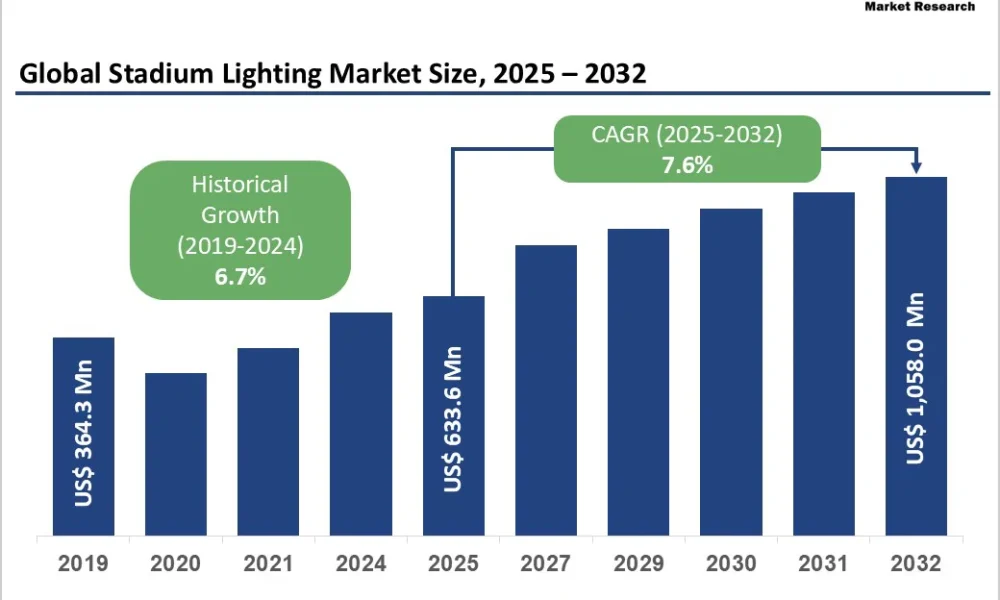
In 2025, the global stadium lighting market size is valued at US$633.6 million and is projected to reach US$1,058.0 million by 2032, expanding at a compound annual growth rate (CAGR) of 7.6% during the forecast period. This growth trajectory reflects the industry’s steady shift toward intelligent, energy-efficient LED systems and smart lighting controls across indoor and outdoor sports facilities worldwide.
Market Overview: A Shift Toward Efficiency and Performance
Stadium lighting plays a critical role in modern sports infrastructure. Beyond basic illumination, lighting systems must meet strict requirements for athlete visibility, spectator comfort, high-definition broadcasting, and regulatory compliance. Traditional lighting technologies such as metal halide and halogen lamps are rapidly being phased out due to their limited lifespan, high energy consumption, and maintenance-intensive nature.
LED-based stadium lighting systems are redefining industry standards. With lifespans of up to 100,000 hours, compared to approximately 6,000 hours for metal halide systems, LEDs significantly reduce long-term operational and replacement costs. Their ability to deliver uniform illumination, instant on/off functionality, and precise light control makes them ideal for both professional and community-level sports venues.
The increasing emphasis on sustainability and carbon footprint reduction further accelerates this transition, positioning stadium lighting as a key component of green building strategies.
Key Growth Drivers Shaping the Stadium Lighting Market
Rising Adoption of Energy-Efficient LED Technology
Energy efficiency remains the most powerful driver of market growth. Stadiums are among the most energy-intensive public facilities, particularly those hosting night-time events and high-definition broadcasts. LED lighting systems consume significantly less power while delivering superior brightness and color rendering.
As electricity costs continue to rise globally, stadium owners and municipalities are prioritizing LED retrofits to achieve long-term cost savings. These upgrades not only reduce energy bills but also lower cooling requirements and maintenance expenses, strengthening the business case for LED adoption.
Expansion of Sports Infrastructure in Emerging Economies
Emerging economies across Asia Pacific, Latin America, and the Middle East are investing heavily in sports infrastructure as part of broader urban development and tourism strategies. The construction of new stadiums, training centers, and multipurpose arenas creates sustained demand for advanced lighting systems.
International sporting events, including cricket leagues, football tournaments, and global competitions, are accelerating infrastructure development in countries such as India, China, and Japan. These projects increasingly incorporate smart lighting solutions from the design stage, ensuring compliance with international broadcasting and safety standards.
Regulatory Mandates and Broadcast Quality Standards
Regulatory bodies and sports federations impose strict lighting requirements to ensure athlete safety, audience comfort, and broadcast clarity. High-definition and ultra-high-definition broadcasting demand precise illumination levels, uniformity, and flicker-free performance.
LED stadium lighting systems meet these requirements more effectively than traditional technologies. As broadcasting standards continue to evolve, particularly for global sporting events, stadium operators are compelled to upgrade lighting infrastructure to remain competitive and compliant.
Elevate your business strategy with comprehensive market data. Request a sample report now: https://www.persistencemarketresearch.com/samples/24532
Regional Market Analysis: Established Leaders and High-Growth Markets
North America: The Leading Regional Market
North America dominates the global stadium lighting market, accounting for an estimated 30% market share in 2025. The region’s leadership is driven by the modernization of existing sports infrastructure, strong adoption of smart lighting control systems, and consistent investments in energy-efficient technologies.
Major professional leagues, including football, basketball, baseball, and hockey, operate stadiums that require advanced lighting solutions to meet broadcasting and fan engagement expectations. Additionally, renovation projects across older arenas continue to fuel demand for LED retrofits and intelligent control systems.
Asia Pacific: The Fastest-Growing Region
Asia Pacific represents the fastest-growing regional market for stadium lighting. Rapid urbanization, rising disposable incomes, and government-led infrastructure initiatives are driving the construction of new sports venues across the region.
Countries such as China, India, and Japan are witnessing increased hosting of international sporting events, which necessitates world-class lighting systems. The growing popularity of night-time matches and televised leagues further strengthens demand for high-performance stadium lighting solutions.
Europe and Other Regions
Europe remains a mature yet stable market, supported by stringent energy efficiency regulations and sustainability goals. Retrofitting older stadiums with LED lighting systems is a major growth avenue, particularly in Western Europe.
Meanwhile, regions such as the Middle East and Latin America are emerging as attractive markets due to investments in mega sporting events and tourism-driven infrastructure development.
Control Systems: Automation Takes the Lead
Automated lighting control systems dominate the stadium lighting market, accounting for approximately 65% of total installations. These systems offer centralized management, programmable lighting scenes, and real-time energy monitoring, enabling stadium operators to optimize performance while minimizing costs.
Automation allows seamless transitions between training sessions, live events, and maintenance modes. It also supports dynamic lighting effects that enhance fan engagement during pre-game and post-game activities.
Interestingly, the manual control segment is witnessing the fastest growth, particularly in smaller venues and cost-sensitive installations. Community stadiums and developing regions often opt for manual systems due to lower upfront costs, although long-term trends favor gradual migration toward automation.
Application Analysis: Indoor vs. Outdoor Stadium Lighting
Indoor Stadium Lighting Dominates the Market
Indoor stadium lighting accounts for approximately 80% of the global market share, driven by the need for consistent illumination quality and advanced control systems in enclosed environments. Indoor arenas host a wide range of sports, concerts, and entertainment events, requiring flexible and high-performance lighting solutions.
LED systems are particularly well-suited for indoor applications due to their precise beam control, minimal heat emission, and compatibility with sophisticated control platforms.
Outdoor Stadium Lighting Shows Strong Growth Potential
The outdoor stadium lighting segment is expected to record the highest growth rate during the forecast period. Expanding sports infrastructure, increasing night-time event scheduling, and the retrofitting of traditional floodlights with smart LED systems are key contributors to this trend.
Outdoor venues benefit significantly from LEDs’ durability, weather resistance, and reduced maintenance requirements, making them ideal for large-scale installations.
Technology Trends: LEDs Lead the Way
LED technology currently dominates the stadium lighting market, accounting for approximately 60% of total installations, with projections indicating this share will reach 65% by 2025. The advantages of LED systems extend beyond energy efficiency to include longer lifespans, lower maintenance needs, and superior lighting quality.
The ongoing shift from metal halide and halogen systems reflects a broader industry transition toward sustainability and performance optimization. Intelligent LED-based solutions are increasingly integrated with Internet of Things (IoT) platforms, enabling predictive maintenance, remote monitoring, and data-driven energy management.
Strategic Market Developments and Competitive Landscape
The stadium lighting market has witnessed several strategic developments between 2023 and 2025, highlighting the industry’s focus on innovation and consolidation.
- Acuity Brands strengthened its smart lighting capabilities through the acquisition of M3 Innovation, enhancing its portfolio of intelligent control solutions.
- Musco Lighting expanded its sports lighting offerings with the acquisition of Ephesus, reinforcing its presence in professional and collegiate sports venues.
- Signify launched advanced modular LED systems specifically designed for professional sports stadiums and large-scale events, emphasizing flexibility and scalability.
These developments underscore the competitive nature of the market, where technological differentiation and integrated solutions are key success factors.
Market Size, Growth Rates, and Historical Performance
In 2025, the stadium lighting market is valued at US$633.6 million, with projections reaching US$1,058.0 million by 2032. The forecasted 7.6% CAGR from 2025 to 2032 represents an acceleration compared to the historical growth rate of 6.7% recorded between 2019 and 2023.
This acceleration reflects increasing adoption of LED systems, growing infrastructure investments, and heightened awareness of energy efficiency benefits across both developed and developing regions.
Future Outlook: Innovation and Sustainability at the Core
The future of the stadium lighting market will be shaped by continued innovation in LED technology, smart controls, and integrated digital platforms. As stadiums evolve into connected, data-driven environments, lighting systems will play a central role in enhancing operational efficiency and fan experience.
Sustainability will remain a defining theme, with stadium operators prioritizing solutions that align with global environmental goals. Government incentives, regulatory mandates, and corporate sustainability commitments will further reinforce the adoption of energy-efficient lighting technologies.
In the long term, the convergence of lighting, data analytics, and immersive fan engagement technologies is expected to redefine how stadiums operate and interact with audiences, positioning advanced lighting systems as a cornerstone of modern sports infrastructure.
Related Reports:




