
The mining industry is undergoing one of its most significant transformations in decades, driven by the rapid integration of artificial intelligence (AI) technologies across exploration, extraction, processing, and logistics. Traditionally capital-intensive and operationally complex, mining is now leveraging AI to improve efficiency, reduce costs, enhance worker safety, and meet increasingly stringent environmental and regulatory requirements.
As commodity markets remain volatile and margins tighten, mining operators are turning to data-driven intelligence to stay competitive. AI solutions—ranging from predictive maintenance and real-time analytics to robotics and autonomous systems—are no longer experimental technologies. They are fast becoming core components of modern mining operations.
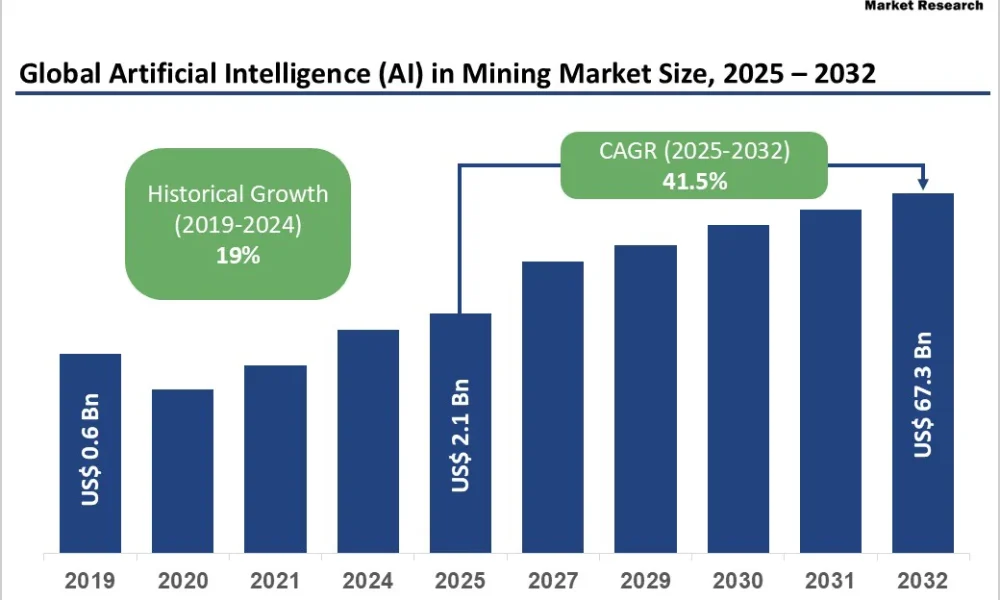
According to current estimates, the global AI in mining market is valued at US$2.1 billion in 2025 and is projected to reach US$67.3 billion by 2032, expanding at an impressive compound annual growth rate (CAGR) of 41.5% during the forecast period. This exponential growth reflects both the accelerating adoption of AI tools and the expanding scope of their application across the mining value chain.
Market Overview: From Automation to Intelligence-Driven Mining
The evolution of AI in mining has moved beyond basic automation toward intelligent, self-learning systems capable of analyzing vast volumes of operational data in real time. These systems enable mining companies to make faster, more accurate decisions while minimizing human intervention in hazardous environments.
Between 2019 and 2024, the AI in mining market grew at a CAGR of approximately 19%, laying the foundation for the rapid acceleration expected post-2025. The sharp increase in growth rate during the forecast period highlights how AI adoption is shifting from pilot projects to enterprise-wide deployments.
Key drivers fueling this growth include rising operational costs, aging mining infrastructure, workforce shortages, and heightened focus on sustainability. AI helps mining companies optimize energy usage, extend equipment life, reduce waste, and improve ore recovery rates—outcomes that directly impact profitability and environmental performance.
Cost Optimization and Productivity as Primary Growth Catalysts
One of the most compelling reasons for AI adoption in mining is its ability to significantly reduce operational costs. Equipment downtime, unplanned maintenance, and inefficient asset utilization have long been persistent challenges for the industry.
AI-powered analytics platforms continuously monitor equipment health, analyze sensor data, and detect early signs of failure. By identifying issues before breakdowns occur, mining operators can schedule maintenance proactively, reduce repair costs, and avoid costly production interruptions.
Beyond maintenance, AI also improves productivity through optimized mine planning, fleet management, and real-time process control. Machine learning algorithms can dynamically adjust operations based on geological conditions, equipment performance, and environmental variables, enabling mines to operate closer to peak efficiency.
Predictive Maintenance: The Dominant Application Segment
Among all AI applications in mining, predictive maintenance is expected to account for approximately 28.5% of total market revenue in 2025, making it the largest application segment.
Mining equipment such as haul trucks, crushers, drills, and conveyors operate under extreme conditions and are subject to high wear and tear. Unexpected failures can lead to significant production losses and safety risks. Predictive maintenance systems use AI models to analyze vibration patterns, temperature changes, pressure levels, and historical maintenance data to forecast failures with high accuracy.
This approach allows operators to shift from reactive or preventive maintenance strategies to condition-based maintenance. The result is improved asset availability, longer equipment lifespan, and reduced maintenance expenditure.
As mining companies continue to digitize their operations, predictive maintenance is expected to remain a cornerstone of AI adoption throughout the forecast period.
Cloud Deployment Driving Scalability and Real-Time Intelligence
From a deployment perspective, cloud-based AI solutions are projected to dominate the market, capturing around 51.7% share in 2025. Cloud deployment offers several advantages over on-premise systems, particularly for large, geographically dispersed mining operations.
Cloud platforms enable centralized data storage, real-time analytics, and seamless integration with Internet of Things (IoT) devices deployed across mine sites. They also support advanced AI workloads without requiring heavy upfront investments in IT infrastructure.
The scalability of cloud solutions allows mining companies to expand AI capabilities as operations grow or as new use cases emerge. Additionally, cloud-based systems facilitate collaboration between teams, remote monitoring, and faster deployment of software updates and AI models.
While data security and connectivity challenges remain, advancements in secure cloud architectures and edge-cloud hybrid models are addressing these concerns, further accelerating cloud adoption.
Robotics and Automation: The Fastest-Growing Technology Segment
Robotics and automation are expected to be the fastest-growing technology segment in the AI in mining market from 2025 to 2032. Autonomous haulage systems, robotic drilling rigs, and AI-controlled inspection drones are increasingly being deployed to enhance safety and efficiency.
AI-enabled robotics reduce human exposure to hazardous environments such as underground mines, high-temperature zones, and unstable geological areas. Autonomous vehicles can operate continuously with minimal downtime, improving productivity while lowering labor costs.
Advances in computer vision, sensor fusion, and reinforcement learning are making mining robots more adaptive and reliable. As technology maturity improves and capital costs decline, adoption of AI-driven robotics is expected to accelerate rapidly, particularly in large-scale open-pit and underground mining operations.
Elevate your business strategy with comprehensive market data. Request a sample report now: https://www.persistencemarketresearch.com/samples/35862
Regional Analysis: North America Leads, Asia Pacific Accelerates
North America: Market Leader in AI-Driven Mining
North America holds approximately 37% of the global AI in mining market share in 2025, making it the leading regional market. The region benefits from early technology adoption, strong digital infrastructure, and the presence of major mining companies and AI solution providers.
Mining operators in the U.S. and Canada are actively investing in AI to improve operational resilience, comply with regulatory requirements, and achieve sustainability goals. The region’s focus on innovation and automation positions it at the forefront of AI integration.
North America is expected to maintain its leadership position through 2032, with market value projected to reach US$154.14 billion, driven by continued investments in advanced AI platforms and autonomous mining technologies.
Asia Pacific: The Fastest-Growing Regional Market
In contrast, Asia Pacific is projected to be the fastest-growing regional market during the forecast period. Rapid industrialization, expanding mining activities, and supportive government initiatives are driving AI adoption across countries such as China, India, Australia, and Southeast Asian nations.
The region’s vast mineral resources and increasing demand for metals and energy materials are pushing mining companies to adopt AI solutions to scale operations efficiently. Government-led digitalization programs and investments in smart mining technologies further support market growth.
Competitive Landscape and Industry Developments
The AI in mining market is becoming increasingly competitive, with technology providers, mining equipment manufacturers, and mining majors all playing active roles in innovation and deployment.
Strategic acquisitions, partnerships, and product launches are shaping the competitive landscape. Mining companies are collaborating with AI startups and software vendors to develop customized solutions tailored to specific operational challenges.
A notable industry milestone occurred in October 2025, when Movus received the Mining Beacon Breakthrough Innovation Award at IMARC 2025. The recognition highlighted Movus’s pioneering work in prescriptive AI for mining operations, which goes beyond predictive maintenance by delivering actionable, real-time recommendations to optimize asset performance and operational decision-making.
Such advancements signal a shift toward more autonomous and intelligent mining systems capable of self-optimization.
Sustainability, Safety, and Regulatory Compliance
AI is also playing a critical role in helping mining companies meet sustainability and safety objectives. Advanced analytics enable more efficient resource utilization, reduced energy consumption, and lower emissions across mining operations.
AI-driven monitoring systems improve worker safety by detecting hazardous conditions, predicting equipment malfunctions, and enabling remote operation of machinery. These capabilities align with stricter regulatory frameworks emphasizing worker protection and environmental responsibility.
As environmental, social, and governance (ESG) considerations gain prominence, AI will increasingly be viewed as an essential tool for sustainable mining.
Future Outlook: Toward Intelligent and Autonomous Mines
Looking ahead, the AI in mining market is poised for transformational growth. As AI models become more sophisticated and integrated with digital twins, edge computing, and advanced robotics, mines will evolve into highly intelligent, semi-autonomous systems.
The transition from predictive to prescriptive and ultimately autonomous AI will redefine how mining operations are planned, executed, and optimized. Companies that invest early in AI capabilities are likely to gain significant competitive advantages in terms of cost efficiency, safety, and operational agility.
With a projected CAGR of 41.5% between 2025 and 2032, AI is set to become one of the most influential technologies shaping the future of the global mining industry.
Related Reports:




