
The radio frequency (RF) filter market has entered a decisive growth phase, fueled by the accelerating rollout of 5G networks, rapid IoT adoption, and rising demand for interference-free wireless communication. As modern connectivity ecosystems grow more complex, RF filters have become essential components in ensuring signal integrity, spectrum efficiency, and reliable data transmission across consumer electronics, telecom infrastructure, automotive systems, and aerospace applications.
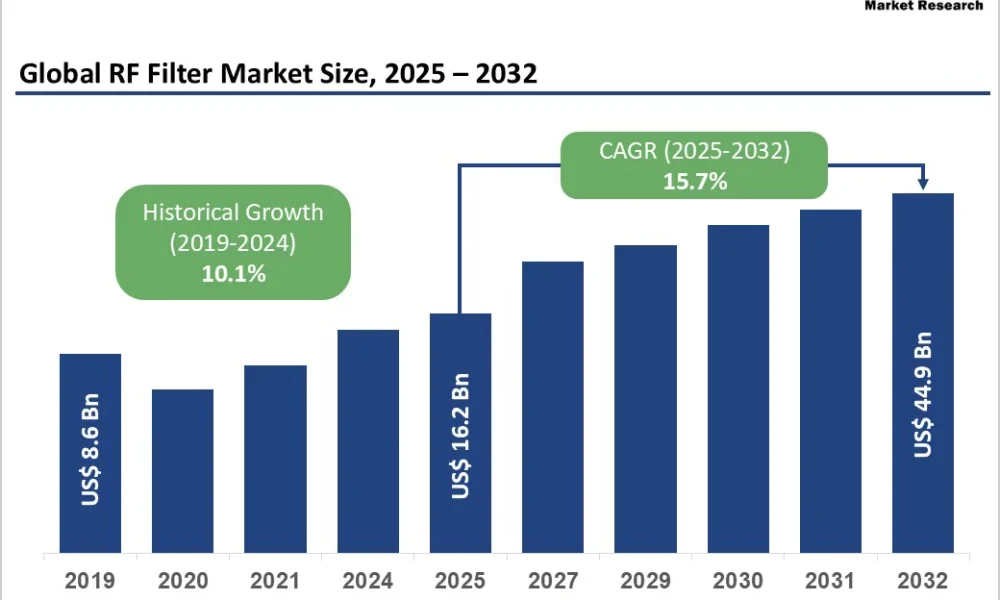
In 2025, the global RF filter market is expected to be valued at US$16.2 billion, with forecasts projecting expansion to US$44.9 billion by 2032. This translates into a strong compound annual growth rate (CAGR) of 15.7% between 2025 and 2032, significantly higher than the 10.1% CAGR recorded during 2019–2024. The shift reflects both technological evolution and a fundamental transformation in global wireless communication requirements.
Understanding RF Filters and Their Role in Modern Connectivity
RF filters are electronic components designed to allow certain frequency ranges to pass while attenuating unwanted signals. They play a critical role in wireless communication systems by minimizing interference, improving signal quality, and enabling coexistence among multiple frequency bands.
As wireless devices increasingly support multiple standards—such as 4G, 5G, Wi-Fi 6E, Bluetooth, GPS, and satellite links—the demand for advanced RF filtering solutions has surged. Without efficient filtering, signal overlap and electromagnetic interference can severely degrade performance, especially in dense urban and industrial environments.
The importance of RF filters has grown in parallel with the expansion of the 5G infrastructure market, which is projected to reach US$123 billion by 2032. High-frequency operation, massive MIMO systems, and ultra-low latency requirements all depend on high-performance RF filters to function reliably.
Market Size Outlook and Growth Trajectory
The RF filter market’s growth trajectory reflects the global transition toward data-intensive, high-frequency communication systems. In 2025, the market’s valuation of US$16.2 billion represents a sharp rise compared to historical levels, driven primarily by telecom investments and smartphone upgrades.
By 2032, the market is forecast to reach US$44.9 billion, adding nearly US$29 billion in new value within seven years. This rapid expansion is underpinned by:
- Global 5G network deployment and densification
- Rising adoption of IoT devices across industries
- Increased spectrum congestion requiring advanced filtering
- Expansion of connected vehicles and autonomous systems
- Growth in satellite and space-based communication networks
The accelerating CAGR of 15.7% indicates that RF filters are no longer passive components but strategic enablers of next-generation connectivity.
Key Industry Trends Shaping the RF Filter Market
Rising Frequency Bands and Spectrum Complexity
One of the most defining trends in the RF filter market is the move toward higher frequencies. While earlier wireless systems operated primarily below 2 GHz, modern applications increasingly utilize mid-band and high-band spectrum.
5G networks, in particular, rely on a mix of sub-6 GHz and millimeter-wave frequencies. This shift introduces new challenges related to signal loss, noise, and interference, all of which require more advanced RF filter designs. As spectrum becomes more crowded, filters must deliver sharper roll-off, wider bandwidth, and higher power handling capabilities.
Multi-Standard Integration in Devices
Modern consumer devices now integrate multiple wireless standards within a single compact form factor. Smartphones, wearables, and IoT devices must seamlessly switch between cellular, Wi-Fi, Bluetooth, and satellite signals.
This multi-standard integration is reshaping RF filter architecture. Instead of discrete components for each band, manufacturers are developing highly integrated RF front-end modules that combine multiple filters, switches, and amplifiers. This trend is driving innovation in materials, packaging, and semiconductor integration techniques.
Growth of Connected and Autonomous Vehicles
The automotive sector has emerged as a significant growth driver for the RF filter market. Connected vehicles rely on RF communication for navigation, vehicle-to-everything (V2X) communication, infotainment, and advanced driver-assistance systems.
As vehicles become increasingly autonomous, the need for reliable, low-latency, and interference-free communication intensifies. RF filters play a vital role in ensuring stable performance across cellular, radar, satellite, and short-range communication systems within vehicles.
Segment Analysis: Function, Technology, and Application
Band Pass Filters Lead by Function
By function, band pass filters dominate the RF filter market, accounting for more than 43% share in 2025. Their ability to allow a specific frequency range while rejecting unwanted signals makes them indispensable in wireless systems.
Band pass filters are widely used in smartphones, base stations, and IoT devices to ensure precise frequency selection and improved signal clarity. Their dominance reflects the growing need for efficient spectrum utilization in multi-band communication environments.
Meanwhile, band stop filters are emerging as the fastest-growing functional segment. Increasing spectrum congestion and the proliferation of wireless devices have heightened the demand for selective interference suppression, particularly in dense urban and industrial settings.
SAW Filters Dominate, BAW Filters Grow Fastest
By technology, surface acoustic wave (SAW) filters hold a commanding position, capturing over 56% market share in 2025. Their compact size, cost efficiency, and proven reliability make them ideal for lower-frequency applications up to 2.5 GHz.
SAW filters are extensively used in smartphones, tablets, and consumer electronics, where space constraints and cost considerations are critical.
In contrast, bulk acoustic wave (BAW) filters represent the fastest-growing technology segment. BAW filters support higher frequencies and wider bandwidths, making them well-suited for 5G, Wi-Fi coexistence, and advanced automotive communication systems. As demand for high-performance filtering increases, BAW technology is expected to gain substantial traction over the forecast period.
Mobile Communication Leads Application Demand
In terms of application, mobile phone communication remains the largest revenue contributor, accounting for over 34% market share in 2025. The surge in 5G-enabled smartphones, along with growing demand for multi-band connectivity, continues to drive RF filter adoption.
Each new smartphone generation integrates more RF filters than its predecessor, reflecting increased complexity in wireless standards and frequency bands.
At the same time, satellite communication is emerging as a high-growth application area. The expansion of low Earth orbit (LEO) satellite constellations and their integration into automotive, maritime, and aviation systems are creating new opportunities for RF filter manufacturers focused on high-reliability and high-frequency solutions.
Elevate your business strategy with comprehensive market data. Request a sample report now: https://www.persistencemarketresearch.com/samples/24187
Regional Analysis: North America Leads, Asia Pacific Accelerates
North America Maintains Market Leadership
North America is expected to account for over 36% of the global RF filter market in 2025, supported by robust 5G deployment, advanced telecom infrastructure, and defense modernization initiatives.
The region benefits from early adoption of next-generation wireless technologies and strong investments in aerospace, satellite communication, and military systems. These factors collectively sustain high demand for advanced RF filtering solutions.
Asia Pacific Emerges as the Fastest-Growing Region
The Asia Pacific region is projected to register the fastest growth rate over the forecast period. Rapid 5G expansion in China and India, combined with a strong smartphone manufacturing base and semiconductor leadership, is fueling regional demand.
Asia Pacific’s dominance in electronics manufacturing positions it as a critical hub for RF filter production and innovation. As regional governments invest in digital infrastructure and smart city initiatives, RF filter demand is expected to rise significantly.
Key Growth Drivers Accelerating Market Expansion
Miniaturization and Advanced Integration
One of the most influential drivers in the RF filter market is the ongoing miniaturization of electronic devices. Smartphones, wearables, and IoT devices demand smaller, lighter, and more power-efficient components without compromising performance.
Advanced semiconductor integration techniques—such as multi-layer organic (MLO) substrates and system-on-chip (SoC) integration—are enabling compact, high-performance RF front-end solutions. These innovations allow manufacturers to integrate multiple RF functions into smaller footprints, accelerating adoption across applications.
Proliferation of IoT and Smart Devices
The rapid growth of IoT ecosystems across healthcare, industrial automation, smart homes, and smart cities is significantly expanding the addressable market for RF filters. Each connected device requires reliable wireless communication, often operating in crowded frequency environments.
As IoT deployments scale, the need for efficient filtering to manage interference and ensure stable connectivity becomes increasingly critical, further boosting market demand.
Future Outlook and Strategic Implications
The RF filter market is poised for sustained, high-growth expansion through 2032. As wireless systems become more sophisticated, RF filters will continue to evolve from simple components into highly engineered solutions that define overall system performance.
Manufacturers that invest in high-frequency technologies, advanced materials, and integrated RF modules are likely to gain a competitive edge. At the same time, partnerships between semiconductor companies, telecom operators, and device manufacturers will play a key role in shaping future innovation.
With strong growth fundamentals, expanding application areas, and accelerating technological advancements, the RF filter market stands as a critical pillar of the global wireless communication ecosystem.
Related Reports:




