
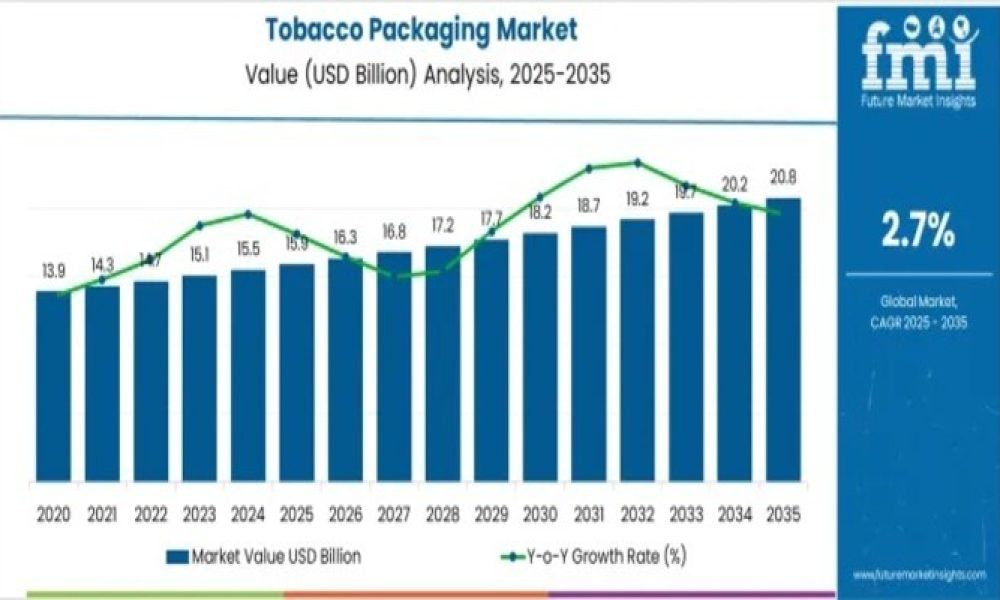
The global tobacco packaging market is projected to grow from USD 15.9 billion in 2025 to USD 20.8 billion by 2035, registering a compound annual growth rate (CAGR) of 2.7% over the forecast period. This steady expansion reflects the tobacco industry’s growing reliance on secure, compliant, and innovation-led packaging solutions amid tightening regulations, shifting consumer preferences, and heightened scrutiny around product safety and traceability.
While tobacco consumption patterns continue to evolve, packaging remains a strategic differentiator balancing regulatory mandates such as plain packaging and graphic health warnings with the need for operational efficiency, anti-counterfeiting measures, and retail-ready formats.
Quick Market Snapshot
- Market Value (2025): USD 15.9 billion
- Forecast Value (2035): USD 20.8 billion
- CAGR (2025–2035): 2.7%
- Leading Material Segment (2025): Paper (39.2% share)
- Dominant Distribution Channel: Offline retail (65.0% share)
- Top Packaging Format: Pouches and sachets (34.2% share)
- Key Growth Regions: North America, Asia-Pacific, Europe
Unlock Growth Potential and Explore Market Opportunities With Our Comprehensive Industry Overview. Request Your Sample Now
Packaging Innovation Gains Strategic Importance
The tobacco packaging market is increasingly shaped by regulatory pressure and sustainability imperatives. Governments across regions continue to enforce strict labeling norms, child-resistant packaging requirements, and anti-counterfeiting controls—pushing manufacturers to invest in advanced printing technologies, tamper-evident designs, and automated packaging lines.
At the same time, premiumization trends in cigars, smokeless tobacco, and specialty products are driving demand for customized, high-quality packaging that enhances shelf presence without violating advertising restrictions.
Paper Emerges as the Material of Choice
The paper material segment is expected to command 39.2% of market revenue in 2025, making it the dominant material category.
Key growth drivers for paper packaging include:
- High recyclability and alignment with sustainability goals
- Cost-effectiveness compared to plastic-heavy alternatives
- Excellent printability for regulatory text, warnings, and branding
- Advances in coatings and barrier technologies that enhance durability
Paper’s lightweight and versatile nature supports a wide range of formats—from cartons to sachets—reinforcing its leadership in both mass-market and premium tobacco applications.
Offline Distribution Channels Maintain Leadership
Despite the rise of e-commerce, offline distribution channels are projected to retain a 65.0% revenue share in 2025.
Factors sustaining offline dominance include:
- Strong presence of convenience stores and specialty tobacco retailers
- Efficient enforcement of age-verification and controlled sales
- Immediate product availability and visibility at the point of sale
- Strategic brand positioning through packaging formats suited for physical shelves
Traditional retail infrastructure continues to play a decisive role in packaging demand, particularly in regulated markets.
Pouches and Sachets Lead Packaging Formats
The pouches and sachets segment is anticipated to account for 34.2% of market revenue in 2025, driven by consumer demand for portability, convenience, and single-use formats.
Why pouches and sachets are gaining traction:
- Ease of handling, storage, and transportation
- Compatibility with premium and flavored tobacco products
- Lower material usage, improving cost efficiency
- Flexibility for innovative, tamper-evident designs
This format remains especially popular in smokeless tobacco and emerging markets.
Regional Growth Highlights
- North America continues to dominate, supported by established tobacco producers and advanced packaging technologies.
- Asia-Pacific is witnessing rapid growth, particularly in India and China, fueled by chewing tobacco consumption and compact packaging demand.
- Europe shows steady expansion, with countries like Spain focusing on premium, heritage-driven packaging aesthetics.
Country-Level CAGR Outlook (2025–2035):
- India: 5.5%
- China: 4.3%
- Spain: 2.5%
- France: 1.9%
- United States: 1.6%
Competitive Landscape and Industry Momentum
Leading packaging manufacturers are intensifying R&D investments, sustainability initiatives, and automation upgrades to stay competitive.
Notable industry developments include:
- WestRock Company expanding its consumer packaging footprint with new facilities in the United States
- British American Tobacco (BAT) introducing paper-based, renewable packaging solutions
- Philip Morris International (PMI) advancing packaging designed for heat-not-burn products
Key players shaping the market include Amcor, WestRock, Smurfit Kappa, Mondi Group, Stora Enso, ITC Limited, Innovia Films, and Taghleef Industries.
Outlook: Innovation Within Constraints
From 2025 to 2035, the tobacco packaging industry will operate within tight regulatory boundaries, but opportunities remain for companies that innovate responsibly. Sustainable materials, smart packaging features, and supply-chain-optimized formats will define the next phase of growth.
Why FMI: https://www.futuremarketinsights.com/why-fmi
About Future Market Insights (FMI)
Future Market Insights, Inc. (FMI) is an ESOMAR-certified, ISO 9001:2015 market research and consulting organization, trusted by Fortune 500 clients and global enterprises. With operations in the U.S., UK, India, and Dubai, FMI provides data-backed insights and strategic intelligence across 30+ industries and 1200 markets worldwide.



