
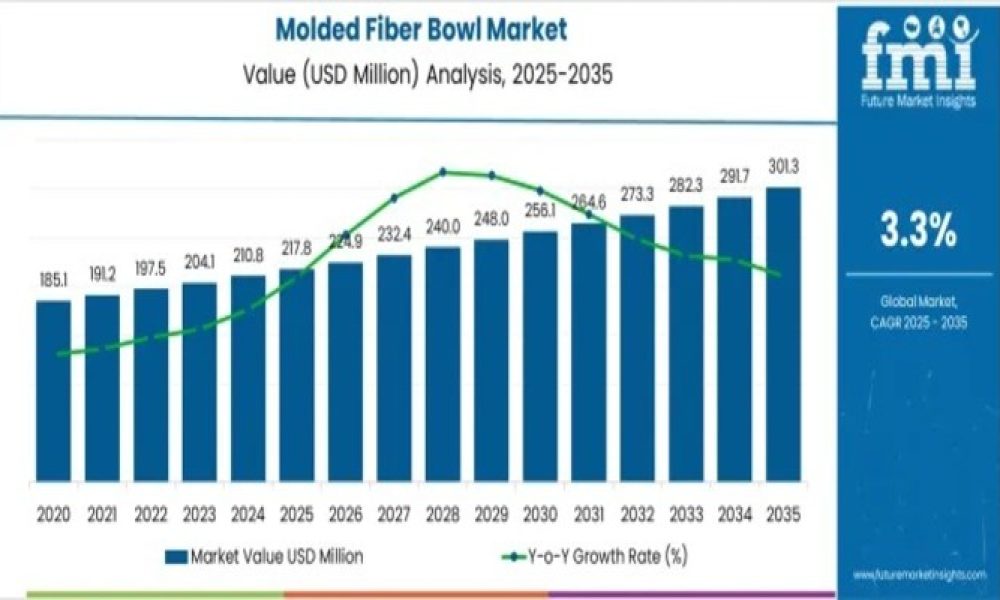
The global molded fiber bowl market is entering a decisive growth phase as sustainability moves from a branding advantage to a regulatory and commercial necessity. Valued at USD 217.8 million in 2025, the market is projected to reach USD 301.3 million by 2035, expanding at a compound annual growth rate (CAGR) of 3.3% over the forecast period.
This steady expansion reflects a broader structural shift in food packaging, driven by tightening restrictions on single-use plastics, rising environmental awareness among consumers, and rapid innovation in fiber molding technologies. Molded fiber bowls—made from renewable, compostable, and recyclable materials—are increasingly favored across foodservice, retail, and institutional dining channels.
Explore Opportunities – Get Your Sample of Our Industry Overview Now!
Sustainability and Regulation Reshape Food Packaging Choices
Global policy frameworks promoting circular economy models are accelerating the transition toward biodegradable packaging formats. Molded fiber bowls are emerging as a preferred alternative to plastic and Styrofoam, offering performance reliability while aligning with sustainability mandates.
Key drivers supporting adoption include:
- Rising demand for eco-friendly takeout and delivery packaging
- Regulatory pressure to eliminate plastic food containers
- Growing preference for compostable and recyclable materials
- FMCG and foodservice brands prioritizing sustainability credentials
The growing popularity of on-the-go meals and food delivery platforms has further amplified demand, particularly in urban markets where waste reduction initiatives are gaining momentum.
Quick Market Snapshot: Molded Fiber Bowl Industry
- Market Value (2025): USD 217.8 million
- Forecast Value (2035): USD 301.3 million
- Forecast CAGR (2025–2035): 3.3%
- Leading Molded Pulp Type (2025): Transfer Molded (36.4%)
- Dominant Distribution Channel: Offline (61.7%)
- Top End Use Segment: Food Service Outlets (42.5%)
- Key Growth Regions: North America, Asia-Pacific, Europe
Transfer Molded Technology Leads Product Innovation
Among molded pulp types, Transfer Molded fiber bowls are projected to account for 36.4% of market revenue in 2025, maintaining leadership due to superior surface finish, structural strength, and scalability.
Manufacturers increasingly favor transfer molding for its ability to deliver:
- Thin-wall, high-precision designs
- Faster drying cycles and improved energy efficiency
- Compatibility with automated production lines
- Custom branding, textures, and improved aesthetics
Established players such as Huhtamaki Oyj, Pactiv, and Sabert Corporation are enhancing process efficiency, while emerging technology providers and machinery specialists—including EAMC Pulp Molding Machine Manufacturer—are enabling capacity expansion for new entrants.
Offline Distribution Channels Remain the Backbone of Market Growth
The offline distribution segment is expected to generate 61.7% of total market revenue in 2025, underpinned by entrenched procurement systems across foodservice distributors, wholesalers, and institutional buyers.
Offline channels continue to dominate due to:
- Bulk purchasing requirements of restaurants and catering services
- Long-term supplier contracts and negotiated pricing
- Strong presence at packaging expos and trade fairs
- Reliable logistics in regions with limited digital infrastructure
As sustainability criteria become central to supplier selection, offline distributors are expanding portfolios of certified molded fiber products.
Food Service Outlets Drive Volume and Innovation
Food service outlets are projected to capture 42.5% of molded fiber bowl demand in 2025, making them the largest end-use segment. Quick-service restaurants, cafés, and delivery-first brands are increasingly adopting molded fiber bowls to meet regulatory compliance and consumer expectations.
Key advantages for foodservice operators include:
- Compatibility with hot and cold food applications
- Leak resistance and structural durability
- Stackability and convenience for takeaway formats
- Strong alignment with eco-labeling initiatives
As global delivery ecosystems expand, molded fiber bowls are becoming essential for maintaining food integrity while supporting sustainability goals.
Technology Advancements and Agro-Friendly Materials Gain Momentum
Manufacturers are investing heavily in next-generation fiber molding technologies, including impulse drying and dry molded fiber processes. These innovations improve production efficiency, reduce energy consumption, and allow greater design flexibility.
Notable trends shaping the industry include:
- Increased use of agro-based fibers such as bagasse, bamboo, and wheat straw
- Development of PFAS-free barrier coatings
- Enhanced moisture and oil resistance without compromising compostability
- Integration of 3D-printed molds for rapid prototyping
For instance, PulPac’s Dry Molded Fiber technology continues to influence industry standards, supporting scalable alternatives to plastic packaging.
Regional Growth Outlook Highlights Asia-Pacific Leadership
While North America and Europe remain mature markets, Asia-Pacific is emerging as the fastest-growing region, driven by foodservice expansion and rising environmental awareness.
Projected CAGR by Country (2025–2035):
- India: 6.6%
- China: 5.7%
- United Kingdom: 2.6%
- United States: 2.4%
- Germany: 2.1%
India and China, in particular, are witnessing rapid adoption due to booming quick-service restaurant sectors, premiumization trends, and government-led sustainability initiatives.
Competitive Landscape: Expansion, Partnerships, and New Technologies
The molded fiber bowl market is characterized by active innovation and strategic expansion. Leading manufacturers are collaborating with startups, investing in regional production hubs, and launching recycling programs to strengthen supply chains.
Prominent players shaping the competitive landscape include:
- Huhtamaki Oyj
- World Centric
- Pactiv
- Sabert Corporation
- Eco-Products
- Genpak
- Fabri-Kal
- Be Green Packaging
- Dinearth Eco Friendly Tableware
- Genera Inc.
Recent industry developments highlight the market’s innovation momentum, including PFAS-free product launches and new molded fiber manufacturing facilities aimed at replacing single-use plastics.
Outlook: Sustainable Packaging Moves from Option to Obligation
As environmental accountability becomes a core business requirement, molded fiber bowls are transitioning from niche alternatives to mainstream food packaging solutions. With steady demand growth, advancing technologies, and expanding participation from both global leaders and agile newcomers, the molded fiber bowl market is well positioned for long-term, sustainable expansion through 2035.
Why FMI: https://www.futuremarketinsights.com/why-fmi
About Future Market Insights (FMI)
Future Market Insights, Inc. (FMI) is an ESOMAR-certified, ISO 9001:2015 market research and consulting organization, trusted by Fortune 500 clients and global enterprises. With operations in the U.S., UK, India, and Dubai, FMI provides data-backed insights and strategic intelligence across 30+ industries and 1200 markets worldwide.



