
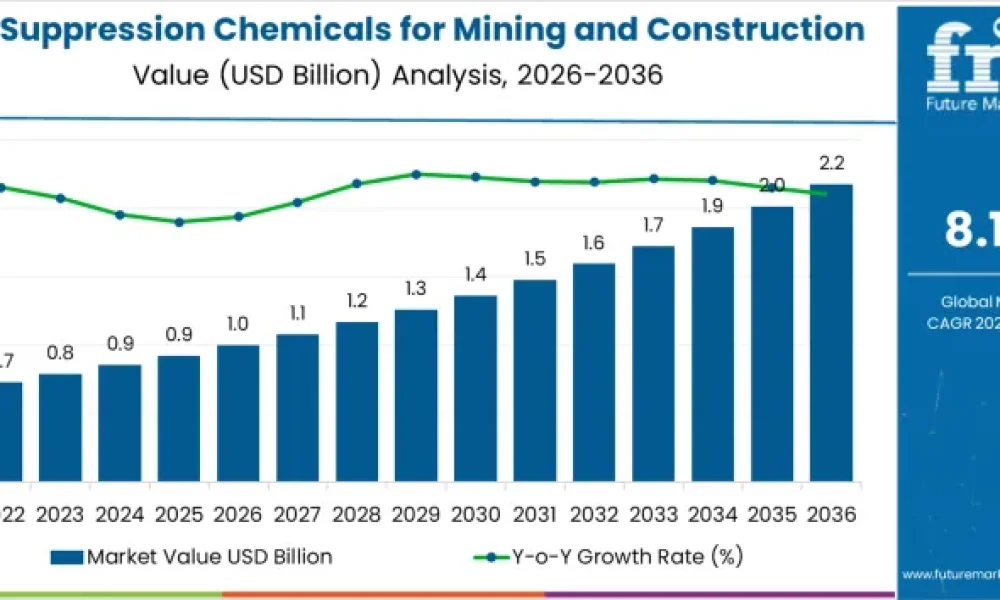
The global Dust Suppression Chemicals for Mining and Construction Market is projected to expand rapidly from an estimated USD 1 billion in 2026 to USD 2.2 billion by 2036, representing a compound annual growth rate (CAGR) of 8.1 % over the forecast period. This strong growth trajectory reflects intensifying demand for dust control solutions across heavy-duty industrial sectors—especially mining and infrastructure development—driven by stringent air quality regulations, rising urbanization, and expanding construction and mining activities worldwide.
Key market insights reveal that mining operations, characterized by high dust emissions from haul roads and pits, account for the largest end-user share at 36 %, with application areas such as mining haul roads also dominating the usage of dust suppression chemicals globally. Surfactant-based suppressants and polymer emulsions are among the most widely adopted chemical formulations due to their proven effectiveness in reducing airborne particulates under varied environmental conditions.
Key Market Insights at a Glance
In 2026, the market’s value is poised at approximately USD 1 billion, with anticipated growth to USD 2.2 billion by 2036. The 8.1 % CAGR indicates a resilient expansion as mining and construction industries intensify efforts to control particulate matter (PM) emissions. Regulatory drivers, including stricter ambient air quality standards and occupational health requirements, are shaping procurement of dust suppression solutions that not only improve visibility and safety but also help facilities meet compliance mandates while enhancing community relations.
Over the forecast period, market growth will be underpinned by several structural trends: the integration of dust suppression technologies with digital monitoring systems that facilitate targeted chemical application; development of eco-friendly and biodegradable products that minimize environmental impact; and growing investments in large-scale infrastructure across Asia Pacific, Latin America, and the Middle East.
To access the complete data tables and in-depth insights — Request Your Sample Report Now
Segment Overview
The market is segmented by chemical type, application area, end-user industry, and region. Among chemical types, surfactant-based suppressants, lignosulfonate bio-binders, polymer emulsions and acrylic copolymers, and salt-based agents such as magnesium chloride and calcium chloride are key categories. Mining haul roads and pits represent the largest application segment, responsible for roughly 34 % of total usage, reflecting the intense dust generation from heavy machinery and frequent material movement in mining operations. In terms of end-user industries, mining leads the demand, followed by construction and civil engineering, cement and aggregates, oil and gas, and public infrastructure sectors.
The prominence of surfactant-based products is attributed to their ability to improve moisture retention on problematic surfaces, effectively binding fine particulates and reducing resuspension during high winds or heavy traffic. Polymer emulsions and bio-binders are increasingly adopted for their longer-lasting performance and lower environmental footprints, especially in areas with strict ecological safeguards.
Regional Overview
Geographically, the Asia Pacific region emerges as the fastest-growing market, with countries such as India and China at the forefront due to rapid industrialization, infrastructure investment, and strict enforcement of dust emission standards. India, in particular, is expected to exhibit a high CAGR driven by expansive mining operations and large-scale construction projects in urban renewal and transportation sectors. North America and Europe also present stable growth opportunities as construction and mining companies adopt advanced dust management protocols to comply with occupational safety and environmental regulations.
This regional diversification underscores the global nature of dust control initiatives: while developed markets emphasize innovation and sustainability, emerging economies are scaling adoption through increased regulatory adherence and infrastructure development.
Competitive Landscape
The competitive landscape is marked by a mix of specialized chemical manufacturers and broader industrial solutions providers. Leading players in the dust suppression chemicals segment include Soilworks, Benetech Inc., Quaker Houghton, Ecolab, and BASF SE, each offering tailored products designed to balance performance, cost, and environmental considerations. Firms compete on formulation efficacy, delivery mechanisms, and integration of digital site management tools to optimize usage and reduce total cost of ownership.
These companies are increasingly collaborating with equipment OEMs and engineering firms to embed dust suppression strategies into broader site safety and sustainability frameworks, enhancing value propositions for clients in mining and construction.
Market Outlook: Powering the Next Decade
Looking ahead to 2036, the dust suppression chemicals market is positioned for sustained expansion as industrial sectors embrace proactive environmental stewardship. The increasing adoption of real-time particulate monitoring, coupled with advanced chemical formulations that reduce water use and environmental impact, will drive innovation and offer new growth avenues. With global infrastructure spending on the rise and regulatory pressure mounting, the demand for dust suppression solutions that improve air quality and protect worker health will continue to rise—reaffirming the market’s strategic importance in the next decade.
Key Players of Sustainable Label Industry
Market leaders are focusing on sustainable product development, emphasizing biodegradable and low-toxic formulations that align with environmental, social, and governance (ESG) criteria. This shift is not only driven by regulatory compliance but also by client preferences for solutions that reduce ecological footprints without compromising performance.
Recent Strategic Developments
Recent industry moves include strategic partnerships to enhance distribution networks, investment in R&D for next-generation suppressants, and expanded service offerings that combine chemical solutions with digital monitoring and advisory services. These initiatives reflect a broader trend of integrating dust control into comprehensive environmental risk management frameworks.
Have a specific Requirements and Need Assistant on Report Pricing or Limited Budget please contact us – [email protected]
About Future Market Insights (FMI)
Future Market Insights, Inc. (FMI) is an ESOMAR-certified, ISO 9001:2015 market research and consulting organization, trusted by Fortune 500 clients and global enterprises. With operations in the U.S., UK, India, and Dubai, FMI provides data-backed insights and strategic intelligence across 30+ industries and 1200 markets worldwide.
Why Choose FMI: https://www.futuremarketinsights.com/why-fmi



