
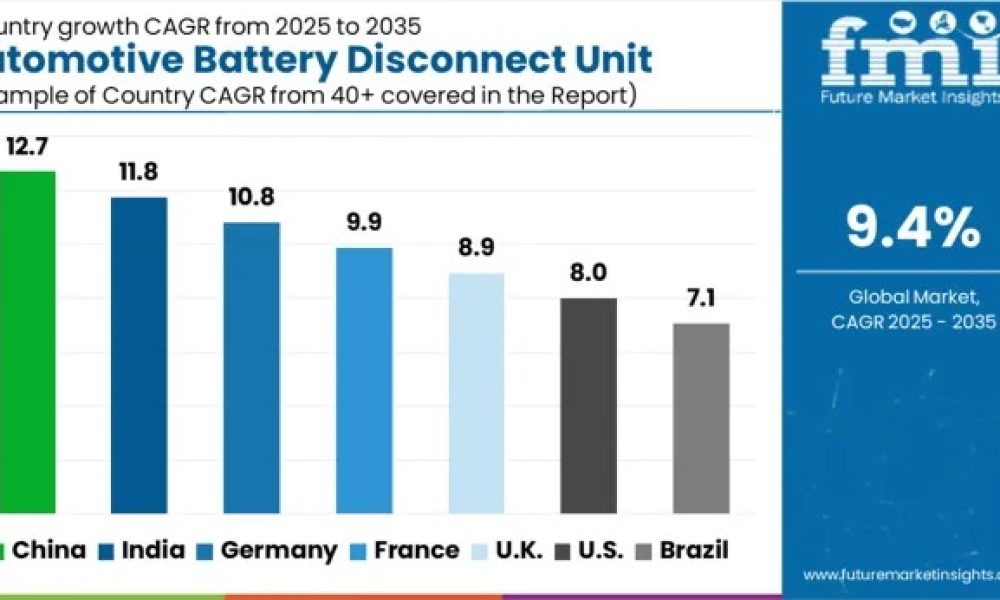
The global automotive battery disconnect unit (BDU) market is witnessing strong and sustained growth as electric vehicle (EV) adoption accelerates and vehicle safety requirements become increasingly stringent. Valued at USD 1.5 billion in 2025, the market is projected to reach USD 3.8 billion by 2035, expanding at a compound annual growth rate (CAGR) of 9.4% during the forecast period. This growth reflects the rising importance of BDUs as essential components within modern electric and hybrid vehicle architectures, rather than optional safety add-ons.
Battery disconnect units play a critical role in managing high-voltage power flow, isolating battery packs during faults or collisions, and protecting both vehicles and occupants from electrical hazards. As global automakers transition toward electrified platforms, BDUs are emerging as core enablers of reliability, compliance, and system efficiency across passenger and commercial vehicle segments.
Electrification Momentum Reshaping Market Trajectory
The year-on-year (YoY) trajectory of the automotive BDU market highlights a steady and accelerating adoption curve. From a market size of approximately USD 1.0 billion in the pre-2025 phase, revenues climbed toward USD 1.7 billion by 2027, driven by early-stage EV penetration and tightening safety regulations. Momentum is expected to intensify as high-voltage vehicle architectures become mainstream, pushing the market beyond USD 2.6 billion by 2030.
Get access to comprehensive data tables and detailed market insights — request your sample report today!
https://www.futuremarketinsights.com/reports/sample/rep-gb-24993
Between 2025 and 2030, YoY growth averaged 8–10%, supported by rising EV production volumes and growing consumer confidence in electric mobility. The period from 2031 to 2035 is forecast to see even stronger acceleration, with annual growth approaching 11%, allowing the industry to approach the USD 3.8 billion mark. This trajectory underscores a structural shift: BDUs are now viewed as indispensable components for advanced mobility, not niche safety devices.
Strong Influence from EV, Electronics, and Safety Ecosystems
The adoption and expansion of the automotive BDU market are shaped by several interconnected parent markets. The electric vehicle market accounts for nearly 35% of demand, reflecting the essential role of BDUs in managing power safety, current regulation, and thermal stability within high-voltage battery systems. The automotive electronics market contributes around 25%, as BDUs are increasingly integrated into intelligent power distribution and electronic control architectures.
Another 20% share is linked to the energy storage and battery management systems (BMS) market, where BDUs help prevent thermal runaway and ensure safe charging and discharging cycles. The automotive safety systems market, with about 12% share, is driven by regulatory mandates that require advanced isolation and protection mechanisms. The remaining 8% stems from the smart grid and charging infrastructure market, where BDUs support safe interfaces between vehicles and external power networks. Together, these influences highlight the strategic position of BDUs within the broader electrification ecosystem.
High-Voltage Systems and Passenger Vehicles Lead Adoption
By voltage type, high-voltage BDUs dominate the market, accounting for an estimated 61.4% of total revenue in 2025. This dominance is directly linked to the growing use of high-capacity battery packs in electric and hybrid vehicles, which require robust power isolation and current-handling capabilities. High-voltage systems enable faster charging, improved acceleration, and longer driving range, making them central to next-generation EV design. As battery capacities continue to rise, demand for advanced high-voltage BDUs with arc suppression, overcurrent protection, and thermal monitoring is expected to remain strong.
From a vehicle perspective, passenger vehicles represent the leading segment, contributing 54.8% of market revenue in 2025. Rapid electrification of sedans, hatchbacks, crossovers, and SUVs—supported by government incentives and expanding charging infrastructure—has fueled BDU demand in this category. Passenger EVs require compact, modular, and highly reliable BDUs that can integrate seamlessly into space-constrained architectures while meeting stringent safety standards.
OEM Channel Dominance Reinforces Integrated Design Trends
The OEM distribution channel is projected to hold approximately 69.2% of market revenue in 2025, reflecting the preference for factory-integrated BDU solutions. Direct integration during vehicle manufacturing ensures compatibility with electrical architectures and compliance with global safety standards. OEM partnerships with Tier-1 suppliers have accelerated innovation, enabling lighter, more compact, and thermally stable BDU designs.
The rise of platform-based EV manufacturing has further strengthened OEM dominance, as standardized BDU designs can be deployed across multiple vehicle models, reducing costs and complexity. As global EV production scales, OEM-led sourcing is expected to remain the primary route to market.
Regional Growth Anchored by Asia-Pacific and Europe
Regionally, the automotive BDU market shows strong growth across Asia-Pacific, Europe, and North America. China leads with a projected CAGR of 12.7%, driven by large-scale EV production, strong government incentives, and advanced battery manufacturing capabilities. India follows at 11.8% CAGR, supported by policy initiatives such as FAME II and rapid growth in electric two-wheelers and passenger cars.
In Europe, Germany (10.8%), France (9.9%), and the UK (8.9%) benefit from strict safety regulations, engineering excellence, and ambitious electrification targets. The United States, growing at 8.0% CAGR, emphasizes safety-driven EV integration, supplier partnerships, and innovation in high-voltage systems.
Drive Your Business Growth Strategy: Checkout the Report for Key Insights
https://www.futuremarketinsights.com/checkout/24993
Competitive Landscape Focused on Safety and Integration
Competition in the automotive BDU market is defined by safety certification, current-handling capability, thermal management, and deep integration with battery management systems. Leading players such as Aptiv, Bosch, Continental, Denso, Eaton, Johnson Controls, Lear, Mitsubishi Electric, Panasonic, and ZF Friedrichshafen are leveraging scale, established OEM relationships, and advanced engineering expertise to strengthen their market positions.
At the same time, emerging players focusing on miniaturization, material innovation, and cost optimization are gaining attention. Strategic collaborations across the EV value chain are becoming increasingly common, shaping long-term growth and technology roadmaps.
Outlook: BDUs Become Central to EV Reliability and Compliance
As electrification deepens and safety standards continue to evolve, automotive battery disconnect units are transitioning into mission-critical components of electric mobility. Their role in ensuring safe, efficient, and reliable high-voltage operation positions BDUs as foundational elements of next-generation vehicles. With strong regulatory support, rising EV adoption, and continuous innovation, the automotive BDU market is set to remain a high-growth segment through 2035, offering significant opportunities for technology leaders and supply chain partners worldwide.
Why Choose FMI: Empowering Decisions that Drive Real-World Outcomes: https://www.futuremarketinsights.com/why-fmi
About Future Market Insights (FMI)
Future Market Insights, Inc. (FMI) is an ESOMAR-certified, ISO 9001:2015 market research and consulting organization, trusted by Fortune 500 clients and global enterprises. With operations in the U.S., UK, India, and Dubai, FMI provides data-backed insights and strategic intelligence across 30+ industries and 1200 markets worldwide.



