
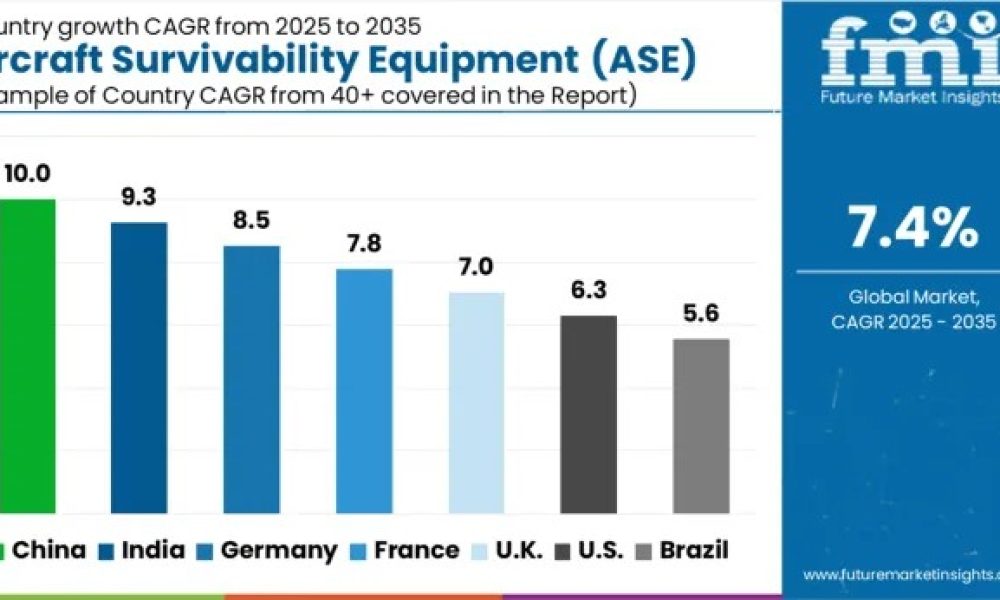
The global Aircraft Survivability Equipment (ASE) market is undergoing a decisive expansion, driven by intensified defense modernization programs, evolving threat environments, and rising investments in advanced aerial protection systems. The market is estimated to be valued at USD 5.0 billion in 2025 and is projected to reach USD 10.3 billion by 2035, registering a compound annual growth rate (CAGR) of 7.4% over the forecast period. This trajectory reflects an absolute dollar opportunity of USD 5.3 billion over the decade, underscoring the strategic importance of survivability technologies across military and aerospace platforms.
Aircraft survivability equipment plays a critical role in safeguarding aircrews, passengers, and mission assets against hostile threats, environmental hazards, and emergency scenarios. The market’s steady rise from USD 3.5 billion in the early years to USD 7.2 billion by 2030 highlights a predictable growth pattern, allowing stakeholders to align production capacity, supply chain strategies, and long-term procurement planning with confidence.
Predictable Growth Cycles Support Strategic Investment
A breakpoint analysis of the ASE market reveals two distinct phases of expansion. Between 2025 and 2028, the market grows from USD 5.0 billion to USD 5.8 billion, with annual increments of approximately USD 0.3 billion. This phase represents a stable environment for operational scaling, supplier onboarding, and system validation across defense fleets. Early engagement during this period enables organizations to establish competitive positioning ahead of the accelerated growth cycle.
Get access to comprehensive data tables and detailed market insights — request your sample report today!
https://www.futuremarketinsights.com/reports/sample/rep-gb-25082
The second breakpoint emerges between 2030 and 2035, when the market expands from USD 7.2 billion to USD 10.3 billion, reflecting higher annual increments averaging USD 0.7–0.9 billion. This phase marks intensified adoption of integrated survivability suites, electronic warfare systems, and advanced emergency equipment, creating significant opportunities for suppliers capable of delivering scalable, interoperable solutions.
Life Rafts and Fixed-Wing Platforms Anchor Demand
By equipment type, life rafts are projected to account for 31.4% of market revenue in 2025, reinforcing their indispensable role in post-incident survival across overwater, remote, and polar flight operations. Continuous innovation in lightweight materials, rapid inflation mechanisms, and integrated emergency provisions has enhanced deployment efficiency and survivability outcomes. Regulatory mandates and mission readiness requirements ensure sustained demand across both defense and commercial aviation.
From a fleet perspective, fixed-wing aircraft are expected to contribute 46.8% of ASE market revenue in 2025, reflecting their extensive deployment in transport, patrol, reconnaissance, and combat missions. Longer operational ranges and exposure to diverse threat environments necessitate comprehensive survivability solutions, driving higher procurement volumes for fixed-wing platforms.
Defense Applications Remain the Primary Growth Engine
By application, the defense segment is projected to hold 58.7% of market revenue in 2025, positioning it as the dominant driver of ASE demand. Military forces worldwide are prioritizing aircraft protection against infrared-guided missiles, radar-based threats, and electronic warfare systems. Investments in countermeasure dispensers, missile approach warning systems, radar warning receivers, and crew protection equipment are accelerating as defense budgets emphasize operational readiness and force protection.
In parallel, multinational defense collaborations and interoperability requirements are reinforcing standardized ASE integration across allied fleets, further strengthening long-term procurement pipelines.
Regional Dynamics Highlight Asia-Pacific Momentum
Geographically, North America, Asia-Pacific, and Europe remain the core growth regions. Asia-Pacific stands out with strong momentum, led by China (10.0% CAGR) and India (9.3% CAGR), supported by large-scale military modernization, fleet expansion, and increased domestic production of survivability systems. Europe maintains steady growth, with Germany projected at 8.5% CAGR, driven by NATO-aligned upgrades and advanced aerospace manufacturing capabilities.
The United States, while a mature market, continues to expand at 6.3% CAGR, supported by sustained fleet modernization programs, next-generation electronic warfare adoption, and leadership in aerospace technology development.
Technology Evolution and Supply Chain Strength Shape Competitiveness
Technological advancements in lightweight materials, modular system architectures, and integrated threat detection are reshaping the ASE landscape. Suppliers are increasingly focusing on multi-sensor integration, real-time threat response, and compatibility with diverse aircraft platforms, including unmanned aerial vehicles. At the same time, production infrastructure and supply chain resilience are emerging as critical differentiators, particularly in managing high-precision electronics and specialized materials.
Regulatory compliance and export control frameworks continue to influence market access and competitive dynamics, reinforcing the importance of certified, interoperable systems in securing long-term defense contracts.
Drive Your Business Growth Strategy: Checkout the Report for Key Insights
https://www.futuremarketinsights.com/checkout/25082
Competitive Landscape Defined by Integration and Reliability
The ASE market is characterized by the presence of established global defense and aerospace technology providers, including BAE Systems plc, Elbit Systems Ltd., Northrop Grumman Corporation, RTX Corporation, Safran, THALES, Saab AB, RUAG Ltd., Airborne Systems Ltd., Survitec Group Limited, and TULMAR Safety Systems. Competition is increasingly centered on system reliability, threat detection accuracy, modular integration, and lifecycle support.
Leading suppliers are investing in networked survivability suites, advanced electronic countermeasures, and enhanced emergency egress systems to address evolving operational requirements. Technical differentiation through verified performance metrics, interoperability, and low lifecycle maintenance remains central to procurement decisions.
Outlook
As geopolitical uncertainties persist and defense forces prioritize aerial protection, the aircraft survivability equipment market is positioned for sustained expansion through 2035. The convergence of modernization initiatives, technological innovation, and predictable growth cycles underscores the strategic relevance of ASE solutions within the broader aerospace and defense ecosystem. Stakeholders equipped with detailed market intelligence will be best positioned to capitalize on the significant value creation opportunities unfolding across this critical market segment.
Why Choose FMI: Empowering Decisions that Drive Real-World Outcomes: https://www.futuremarketinsights.com/why-fmi
About Future Market Insights (FMI)
Future Market Insights, Inc. (FMI) is an ESOMAR-certified, ISO 9001:2015 market research and consulting organization, trusted by Fortune 500 clients and global enterprises. With operations in the U.S., UK, India, and Dubai, FMI provides data-backed insights and strategic intelligence across 30+ industries and 1200 markets worldwide.



