
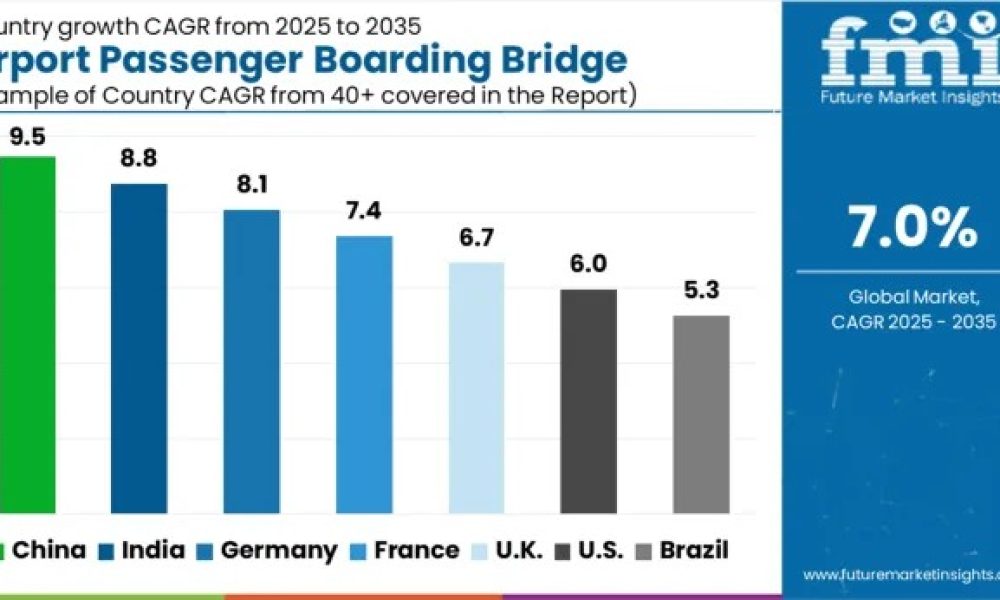
The global airport passenger boarding bridge (PBB) market is entering a phase of sustained and structurally supported growth, underpinned by large-scale airport infrastructure investments, rising air passenger volumes, and the modernization of terminal operations worldwide. Valued at USD 2.3 billion in 2025, the market is projected to reach USD 4.5 billion by 2035, registering a robust compound annual growth rate (CAGR) of 7.0% over the forecast period. This expansion reflects the growing strategic importance of passenger boarding bridges as core assets in enhancing operational efficiency, safety, and passenger experience across global airports.
The market’s early growth phase between 2025 and 2030 captures nearly one-third of the total decade-long opportunity, driven primarily by airport expansion programs and fleet upgrades that directly translate into increased procurement of boarding bridges. During this phase, rising investments in new terminals, additional gates, and upgraded ground handling infrastructure create consistent demand for both new installations and technologically enhanced systems. As airports scale capacity to accommodate higher traffic volumes, passenger boarding bridges increasingly move from optional infrastructure to essential terminal equipment.
Get access to comprehensive data tables and detailed market insights — request your sample report today!
https://www.futuremarketinsights.com/reports/sample/rep-gb-25086
From 2030 to 2035, the market enters a consolidation and acceleration phase, expanding from USD 3.0 billion to USD 4.5 billion and unlocking an incremental USD 1.5 billion in absolute opportunity within just five years. This period alone contributes more than two-thirds of the total incremental market value generated across the decade, highlighting a sharp rise in adoption intensity. Growth in this phase is fueled by replacement of aging infrastructure, expansion of mid-sized airports, and broader implementation of advanced, automated, and climate-controlled boarding bridge systems. Overall, the total absolute opportunity of USD 2.2 billion from 2025 to 2035 underscores the scale of revenue potential available across product upgrades, service contracts, retrofits, and global deployments.
A breakpoint analysis reveals two critical inflection points shaping market momentum. The first occurs around 2028–2029, when the market surpasses USD 2.7 billion, marking the transition from early expansion to accelerated adoption. At this stage, annual additions average USD 0.2 billion, supported by airport capacity expansion projects and infrastructure modernization. Procurement volumes become large enough to generate economies of scale, enabling more competitive pricing structures and bundled service offerings. The second breakpoint emerges after 2031, when the market crosses USD 3.4 billion and accelerates sharply toward its 2035 forecast. This later phase alone accounts for USD 1.1 billion in incremental value, or roughly half of the total decade-long growth, reflecting intensified replacement demand and increased installations in regional and secondary airports.
Growth fundamentals for the airport passenger boarding bridge market remain strong. Rising global air passenger traffic, driven by expanding airline networks, tourism growth, and increased connectivity, continues to place pressure on airport operators to improve boarding efficiency and passenger flow. Passenger boarding bridges enhance safety by minimizing exposure to ramp operations, reduce boarding and disembarkation times, and significantly improve passenger comfort. As a result, airport development plans increasingly prioritize modern PBB systems as standard infrastructure rather than discretionary upgrades.
Segment-level analysis highlights clear demand concentration in technologically advanced solutions. Moving passenger boarding bridges dominate the market, accounting for 55.4% of total revenue in 2025, owing to their flexibility in accommodating different aircraft sizes and gate configurations. These systems enable efficient alignment with multiple aircraft types, helping airports optimize gate utilization and airline turnaround times. Advances in automated movement controls and intelligent docking systems further enhance safety while reducing manual intervention, reinforcing their preference in large and medium-sized airports.
By model type, the apron drive bridge segment leads with 37.8% market share in 2025, supported by its high adaptability, telescopic reach, and ability to service both narrow-body and wide-body aircraft with minimal structural changes. Engineering efficiency, rotational flexibility, and relatively low long-term maintenance costs position apron drive bridges as a cost-effective and versatile solution for both new airport projects and terminal upgrades.
Passenger comfort has also become a defining purchase criterion. The air-conditioned tunnel segment accounts for 61.2% of market revenue in 2025, reflecting rising expectations for climate-controlled boarding environments. Airports operating in hot, cold, or humid regions increasingly deploy air-conditioned tunnels to protect passengers from extreme weather and maintain consistent cabin temperatures during aircraft turnaround. This trend aligns closely with broader airport strategies focused on improving passenger satisfaction and premium service standards.
Drive Your Business Growth Strategy: Checkout the Report for Key Insights
https://www.futuremarketinsights.com/checkout/25086
Regionally, market growth closely mirrors aviation infrastructure investment intensity. Asia-Pacific leads expansion, with China recording a CAGR of 9.5% and India at 8.8%, driven by aggressive airport construction, modernization programs, and rapidly rising passenger volumes. In Europe, Germany (8.1%), France (7.4%), and the UK (6.7%) benefit from steady airport upgrades under strict safety and operational standards. The United States, growing at 6.0%, represents a mature but resilient market supported by replacement demand and continuous modernization of major hubs. Collectively, these regions form the backbone of global demand, while emerging markets in the Middle East, Africa, and Latin America present additional long-term growth avenues.
The competitive landscape is characterized by a mix of global and regional manufacturers emphasizing automation, safety compliance, durability, and adaptability across aircraft types. Leading companies such as CIMC-TianDa, HÜBNER GmbH & Co. KG, TK Elevator, ADELTE Group, ShinMaywa Industries, John Bean Technologies (JBT), Mitsubishi Heavy Industries, and Oshkosh AeroTech continue to invest in motorized systems, energy-efficient drives, modular designs, and intelligent docking technologies. Product differentiation increasingly centers on load capacity, docking precision, climate control integration, and lifecycle service support.
Looking ahead, the airport passenger boarding bridge market is positioned as a high-value, infrastructure-driven segment within the global aviation ecosystem. Continued growth in air travel, coupled with sustained investments in airport modernization, automation, and passenger-centric design, is expected to keep demand on a strong upward trajectory. For stakeholders seeking detailed insights into segmentation, regional dynamics, competitive benchmarking, and long-term strategic opportunities, the full market report provides comprehensive analysis essential for informed decision-making over the coming decade.
Why Choose FMI: Empowering Decisions that Drive Real-World Outcomes: https://www.futuremarketinsights.com/why-fmi
About Future Market Insights (FMI)
Future Market Insights, Inc. (FMI) is an ESOMAR-certified, ISO 9001:2015 market research and consulting organization, trusted by Fortune 500 clients and global enterprises. With operations in the U.S., UK, India, and Dubai, FMI provides data-backed insights and strategic intelligence across 30+ industries and 1200 markets worldwide.



