
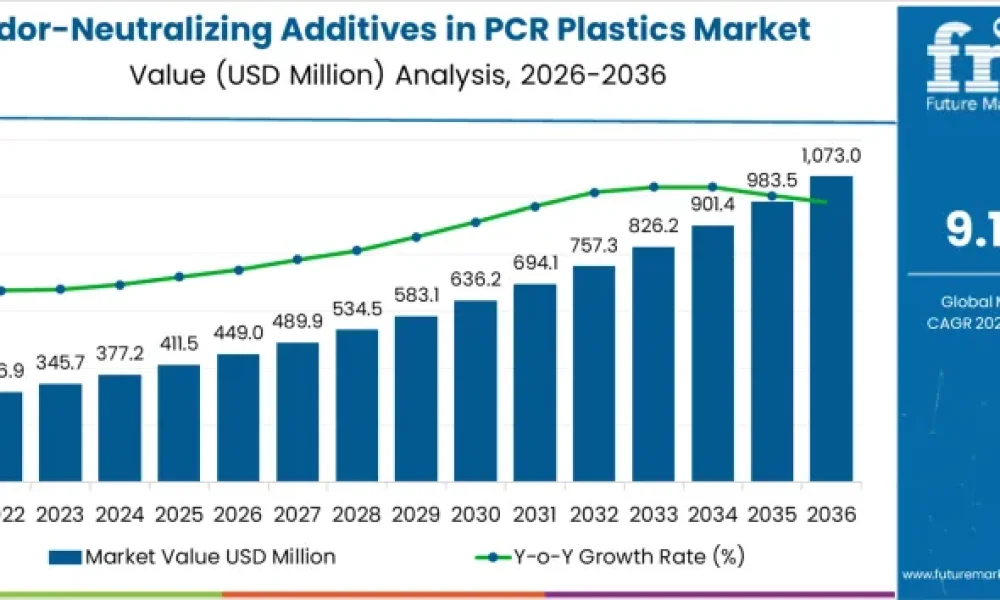
The global Odor-Neutralizing Additives in PCR Plastics Market is projected to surge from approximately USD 449 million in 2026 to USD 1,073 million by 2036, representing a robust 9.1 % CAGR through the forecast period as demand for high-quality recycled content accelerates across packaging and consumer goods sectors. This growth is propelled by heightened regulatory mandates for recycled content, rising consumer expectations for odor-free materials in direct-contact packaging, and expanded incorporation of PCR plastics in food, personal care, and household products. Market expansion is supported by adoption of advanced odor control technologies that enhance PCR resin sensory performance without compromising mechanical properties or processing efficiency.
Key Market Insights at a Glance
The market’s trajectory reflects structural adoption of odor solutions that enable PCR plastics to meet stringent sensory and quality criteria critical for consumer acceptance. At the outset of the forecast period, food and personal care packaging accounts for roughly 40 % of total product demand, underscoring the sector’s sensitivity to residual odors and brand quality imperatives. Across packaging formats, bottles, caps, and closures capture the largest application share, benefiting from their high surface area contact with contents and direct consumer interaction that amplifies odor perception challenges. Technology adoption is dominated by adsorptive and reactive odor scavenger systems, favored for their broad-spectrum effectiveness in neutralizing volatile compounds inherent to post-consumer recycled streams.
Segment Overview
The market segmentation reveals differentiated growth drivers across end-use applications and packaging formats. Food and personal care packaging leads demand due to uncompromising sensory standards that make odor control indispensable for maintaining product integrity and consumer confidence. Cosmetic and homecare segments also adopt odor neutralizing additives where fragrances and product purity are priorities. FMCG packaging further broadens demand as major brands pursue aggressive recycled content commitments. Bottles, caps, and closures account for the largest share of additive usage, followed by rigid containers and smaller format packaging, reflecting how functional design influences additive loading and performance requirements in PCR materials.
To access the complete data tables and in-depth insights — Request Your Sample Report Now
Regional Overview
Regionally, demand patterns highlight significant growth momentum across Asia, North America, and Europe. India and China are among the fastest-growing markets, with compound annual growth rates of approximately 12.0 % and 10.8 % respectively, driven by expanding recycling infrastructure, rapid urbanization, and strong commitments to sustainability in packaging and automotive sectors. The United States demonstrates steady expansion at an 8.2 % CAGR, underpinned by corporate sustainability targets and progressive PCR utilization policies. Mature markets like Germany and Japan exhibit stable adoption supported by stringent regulatory frameworks and robust quality norms that favor high-performance odor control solutions.
Competitive Landscape
The competitive environment is anchored by global chemical and additive specialists who offer tailored solutions adaptable to diverse PCR streams and processing conditions. Major players shaping the market include Avient, Clariant, Kingfa, Plastiblends, Braskem Additives, ADEKA, Ampacet, BASF, Baerlocher, and Shanghai Pret — firms that combine deep formulation expertise with regional manufacturing footprints to address localized recyclate challenges. Competition is defined by formulation adaptability, technical support, and consistency of odor suppression in repeated processing cycles, rather than sheer portfolio breadth alone.
Market Outlook: Powering the Next Decade
Looking ahead, the market is poised for sustained expansion as global recycled content mandates tighten and brand owners elevate recycled materials into core product portfolios. Odor-neutralizing additives will increasingly function as enablers of circular economy goals, enabling PCR plastics to meet both regulatory compliance and consumer expectations. Innovation trends point toward integrated additive systems that combine odor control with stabilizers, compatibilizers, and colorants tailored to specific feedstocks, further unlocking value across end-use segments. As manufacturers refine odor management strategies upstream in material design and processing, demand is expected to shift from corrective interventions to proactive integration at initial compounding stages, reducing rework costs and enhancing supply chain efficiencies.
Key Players of Sustainable Label Industry
Industry leaders are aligning R&D investments with sustainability imperatives, focusing on advanced chemistries that deliver consistent odor mitigation while supporting high PCR incorporation rates. Collaboration between additive providers, recyclers, and brand owners is fostering ecosystem-wide solutions that elevate PCR performance benchmarks — a strategic shift that reinforces long-term adoption and accelerates recycled content utilization across global markets.
Recent Strategic Developments
Recent strategic activities in the market include partnerships aimed at co-developing tailored odor control solutions for specific resin streams, expansion of regional production capacities to serve emerging economies, and formulation improvements that enhance compatibility with diverse processing technologies. Such initiatives reflect a broader industry commitment to scalable, high-performance odor control that enables PCR plastics to fulfill sustainability directives without compromising on sensory or mechanical quality.
Have a specific Requirements and Need Assistant on Report Pricing or Limited Budget please contact us – [email protected]
About Future Market Insights (FMI)
Future Market Insights, Inc. (FMI) is an ESOMAR-certified, ISO 9001:2015 market research and consulting organization, trusted by Fortune 500 clients and global enterprises. With operations in the U.S., UK, India, and Dubai, FMI provides data-backed insights and strategic intelligence across 30+ industries and 1200 markets worldwide.
Why Choose FMI: https://www.futuremarketinsights.com/why-fmi



