
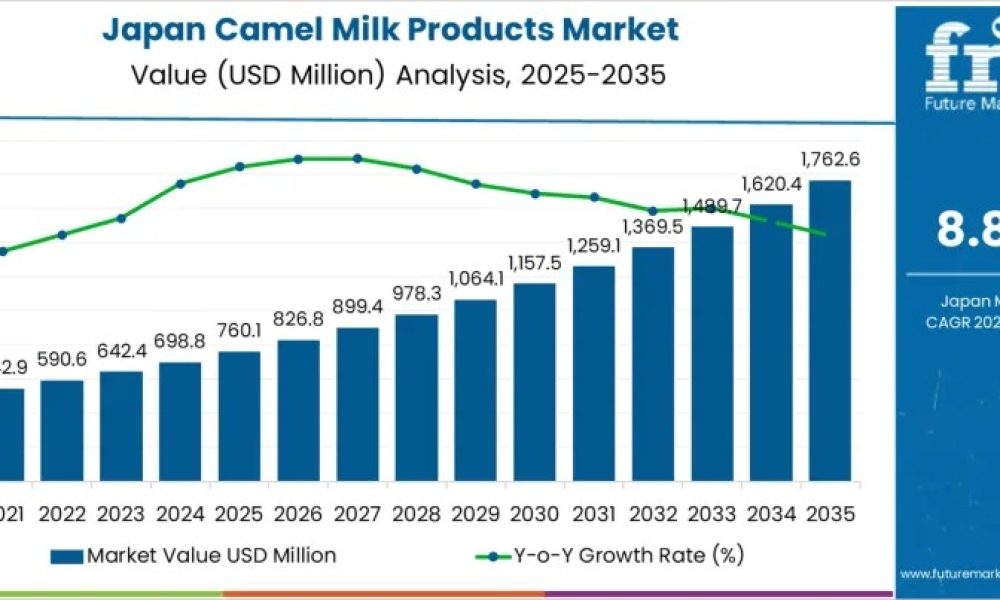
Japan’s camel milk products market is entering a high-growth phase, supported by health-driven consumption trends and expanding retail access. Demand is projected to rise from USD 760.1 million in 2025 to USD 1,762.6 million by 2035, reflecting a compound annual growth rate (CAGR) of 8.8%. The growth trajectory highlights increasing consumer interest in nutrient-rich, digestible, and clean-label dairy alternatives within Japan’s competitive food and beverage sector.
Camel milk is gaining recognition for its higher protein content, lower fat levels, and easier digestibility compared to cow’s milk. As Japanese consumers grow more health-conscious and explore functional food options, camel milk products such as milk, yogurt, cheese, and powdered forms are steadily integrating into daily diets. The trend aligns with broader interest in natural, minimally processed foods.
Request For Sample Report | Customize Report | Purchase Full Report – https://www.futuremarketinsights.com/reports/sample/rep-gb-29412
From 2025 to 2030, market demand is expected to expand from USD 760.1 million to USD 1,064.1 million, adding USD 304.0 million in new value. This phase of growth is closely linked to improved availability across supermarkets, specialty health stores, and e-commerce channels. Increased awareness of camel milk’s digestive and immune-support properties is also encouraging trial among lactose-sensitive and wellness-focused consumers.
Between 2030 and 2035, demand is forecast to climb further to USD 1,762.6 million, contributing an additional USD 698.5 million in value. During this period, camel milk products are expected to achieve stronger mainstream acceptance, supported by product diversification, fortified formulations, and flavored offerings that appeal to a broader demographic.
Key Market Snapshot
- Market value (2025): USD 760.1 million
- Forecast value (2035): USD 1,762.6 million
- Forecast CAGR (2025–2035): 8.8%
- Leading product type: Plain camel milk
- Dominant distribution channel: Offline retail (75%)
Plain camel milk accounts for 60% of total demand, driven by its versatility and nutritional profile. It serves as a base ingredient for flavored drinks, powders, and frozen desserts while appealing directly to health-conscious buyers seeking nutrient-dense dairy alternatives. Its hypoallergenic reputation and digestibility advantages continue to support adoption among consumers with lactose intolerance.
Offline retail channels remain the primary sales avenue, accounting for 75% of demand. Health food stores, specialty retailers, and supermarkets provide strong product visibility and consumer education opportunities. Physical retail also allows shoppers to compare new and niche dairy alternatives firsthand, strengthening trust in emerging categories like camel milk.
Sustainability and ethical consumption trends are reinforcing long-term demand. Consumers are increasingly evaluating environmental impact, ingredient transparency, and production practices. Camel milk products, positioned within the natural and clean-label space, benefit from this shift toward mindful purchasing decisions.
Regional growth varies across Japan. Kyushu & Okinawa lead with an 11.0% CAGR, supported by a strong wellness culture and interest in functional beverages. Kanto follows at 10.1%, driven by urban demand and specialty retail expansion. Kansai (8.9%), Chubu (7.8%), and Tohoku (6.8%) show steady growth, while the Rest of Japan advances at 6.5%, reflecting gradual penetration into rural markets.
Industry innovation is helping overcome traditional supply and shelf-life limitations. Advances in pasteurization, packaging, and cold-chain logistics are improving product stability and distribution efficiency. Manufacturers are also expanding portfolios beyond liquid milk into powdered, fermented, and flavored formats, increasing accessibility across consumer preferences.
However, challenges remain. Camel milk yields per animal are lower than cow’s milk, contributing to higher production costs and premium pricing. Import regulations and stringent food-safety standards in Japan also create sourcing complexities. Additionally, consumer familiarity with camel milk remains limited, requiring ongoing education and marketing investment.
Despite these barriers, the outlook remains strong. Growing interest in functional foods, immunity-supportive nutrition, and alternative dairy sources positions camel milk products for continued expansion through 2035.
Key players shaping the competitive landscape include:
- Camelicious
- Desert Farms, Inc.
- The Camel Milk Co. Australia Pty Ltd.
- Camilk
- CAMEL DAIRY SMITS
These companies are expanding distribution networks, diversifying product portfolios, and investing in consumer awareness to strengthen market presence.
About Future Market Insights (FMI)
Future Market Insights, Inc. (FMI) is an ESOMAR-certified, ISO 9001:2015 market research and consulting organization, trusted by Fortune 500 clients and global enterprises. With operations in the U.S., UK, India, and Dubai, FMI provides data-backed insights and strategic intelligence across 30+ industries and 1200 markets worldwide.



