
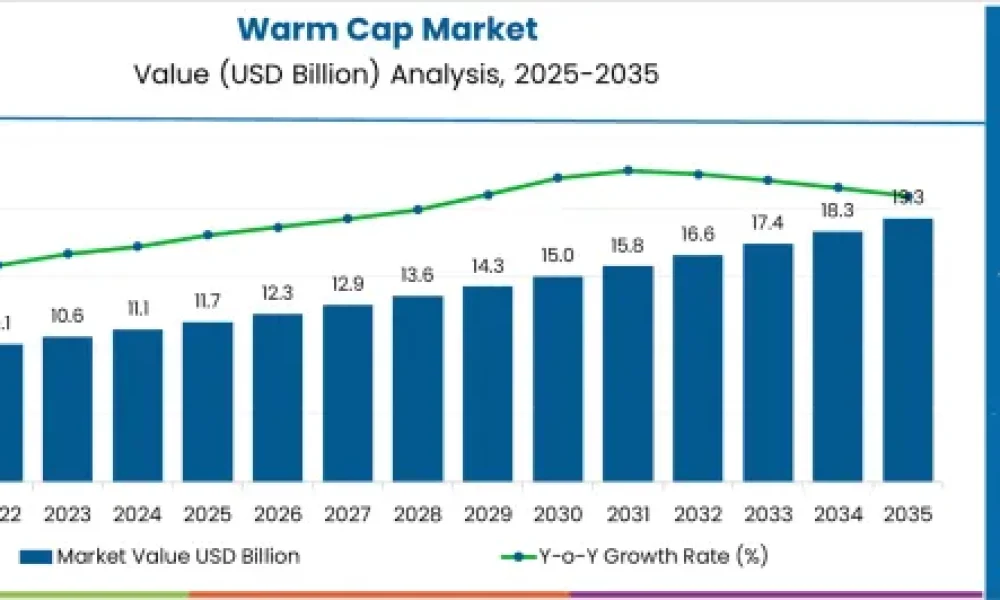
The global warm cap market is projected to grow from USD 11.7 billion in 2025 to USD 19.3 billion by 2035, expanding at a compound annual growth rate (CAGR) of 5.1% over the forecast period. The outlook reflects steady, moderate growth supported by rising demand for functional cold-weather apparel, increased participation in outdoor activities, and broader acceptance of warm caps as both a utility and fashion accessory across regions.
Market Overview:
The warm cap market includes beanies, knit caps, trapper hats, sport caps, and fashion caps designed for thermal comfort, outdoor use, workwear, and everyday wear. Demand is driven by adult and kids’ consumer groups across urban and rural climates, with adoption spanning casual users, outdoor enthusiasts, professionals, and fashion-conscious buyers.
The forecast period spans 2025 to 2035, with consistent year-on-year (YoY) growth observed throughout. Key growth regions include North America, Europe, and Asia-Pacific, with China and India leading in growth rates. Rising awareness of thermal comfort, evolving winter fashion trends, sustainability priorities, and unpredictable weather patterns are reinforcing demand. Innovation in fabric technologies, fiber blends, customization, and omnichannel retail strategies is shaping market expansion.
Gain access to detailed segment-wise analysis and forecast statistics – Request the Sample Report Today
Market Size and Growth Outlook
In 2025, the warm cap market is valued at USD 11.7 billion. Between 2025 and 2026, the market grows to USD 12.3 billion, reflecting a YoY growth rate of 5.1% and an incremental gain of USD 0.6 billion, driven by steady demand in the apparel and textiles sector.
From 2026 to 2030, the market accelerates, expanding from USD 12.3 billion to USD 15.0 billion, contributing USD 2.7 billion in additional value at an average YoY growth rate of 6.2%. This phase is characterized by innovation in fabric construction, increased production of specialized warm caps, and heightened interest in outdoor recreation.
Between 2030 and 2035, growth moderates as the market matures, rising from USD 15.0 billion to USD 19.3 billion. This stage adds USD 4.3 billion in value at a YoY growth rate of 4.9%, reflecting stable demand across a wider consumer base.
Key Takeaways and Quick Stats
- Market value (2025): USD 11.7 billion
- Forecast value (2035): USD 19.3 billion
- CAGR (2025–2035): 5.1%
- Leading product segment (2025): Beanies, with 28.4% revenue share
- Leading material segment (2025): Natural fibers, 41.6% share
- Dominant price segment (2025): Medium-priced caps, 41.6% share
Segmental Insights: Beanies, Natural Fibers, and Mid-Priced Products Lead
- Beanies are expected to remain the largest product segment, accounting for 4% of market revenue in 2025. Their lightweight design, universal fit, and suitability for both functional and fashion-oriented use support mass-market adoption. Ease of production and compatibility with customization further reinforce their appeal to retailers and brands.
- By material, natural fibers are projected to hold 6% of total revenue in 2025, driven by consumer preference for biodegradable, skin-friendly, and thermally efficient materials such as wool, cotton, and alpaca. Growing environmental regulation and sustainability standards are accelerating this shift.
- The medium price segment is anticipated to dominate the market with a 6% share, offering a balance between affordability and performance. Brands in this tier focus on durability, improved lining technologies, and seasonal promotions, particularly across online and offline retail channels.
Regional and Country-Level Growth Dynamics
The global CAGR of 5.1% masks notable regional variation. China leads with a projected CAGR of 6.9%, followed by India at 6.4% and Germany at 5.9%. The United Kingdom is forecast to grow at 4.8%, while the United States records 4.3% growth.
Growth in China and India is supported by large populations, expanding middle classes, rising disposable incomes, and increasing participation in outdoor activities. In OECD markets such as the U.S., UK, and Germany, demand is driven by premium, high-performance winter apparel and established retail infrastructure.
Competitive Landscape and Industry Structure
The warm cap market features a mix of global brands and specialized manufacturers. Companies such as The North Face, Patagonia, Carhartt, Columbia Sportswear, AmeriCap, Artex Knits, Kuiu, Marmot, Minus33, Smartwool, REI Co-op, Under Armour, Union Wear, Wear A Knit, and Wisconsin Knitwear compete on material quality, design innovation, and functional performance. Competitive differentiation is shaped by sustainability initiatives, customization capabilities, and brand loyalty, with barriers to entry including manufacturing expertise and scale.
Outlook
Looking ahead, the warm cap market is expected to benefit from climate-aware product diversification, premiumization, and continued integration of sustainable materials. While seasonality and competitive pressure remain structural challenges, consistent demand for functional winter accessories positions the market for stable, long-term growth through 2035.
Have a specific Requirements and Need Assistant on Report Pricing or Limited Budget please contact us – [email protected]
About Future Market Insights (FMI)
Future Market Insights, Inc. (FMI) is an ESOMAR-certified, ISO 9001:2015 market research and consulting organization, trusted by Fortune 500 clients and global enterprises. With operations in the U.S., UK, India, and Dubai, FMI provides data-backed insights and strategic intelligence across 30+ industries and 1200 markets worldwide
Why Choose FMI: https://www.futuremarketinsights.com/why-fmi



