
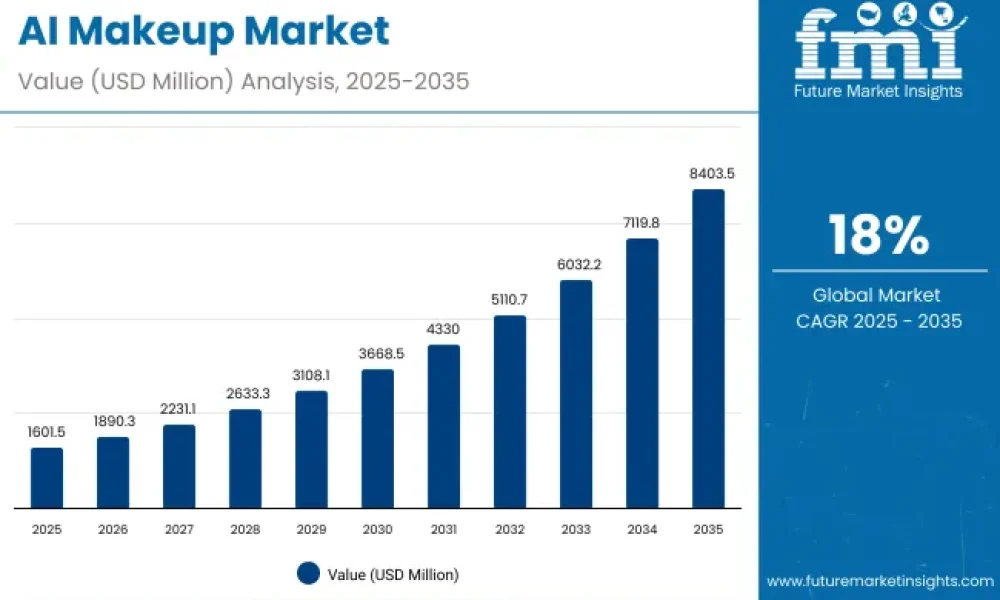
The global AI Makeup Market is entering a decade of accelerated growth, driven by the convergence of artificial intelligence, augmented reality (AR), and digital commerce within the beauty industry. According to the latest industry analysis, the market is valued at USD 1,601.5 million in 2025 and is forecast to reach USD 8,403.5 million by 2035, reflecting an absolute increase of USD 6,802.0 million and a 425% expansion over ten years. This growth trajectory represents a compound annual growth rate (CAGR) of 18.0%, translating into a 5.25x increase in market size over the forecast period.
Explore the full market insights and exclusive data breakdowns – Request Your Sample Report Now
Market Context: From Experimental Tools to Core Retail Infrastructure
From 2020 to 2024, AI makeup solutions transitioned from pilot-stage innovations into mainstream digital beauty tools. Early growth was fueled by mobile AR filters, influencer-driven campaigns, and virtual try-on (VTO) features embedded in camera apps and social platforms. During this phase, AI technology vendors and platform providers accounted for nearly 60% of total revenue, with limited monetization beyond app engagement and brand partnerships.
By 2025, AI makeup technologies have become a core component of omnichannel beauty strategies. The market is increasingly defined by consumer-facing applications, which account for 45% of total value, and by mobile-first deployment, reflecting changing consumer behavior and retail economics.
Growth Outlook: Two Phases of Expansion
Between 2025 and 2030, the AI Makeup Market is projected to grow from USD 1,601.5 million to USD 3,668.5 million, adding USD 2,067.0 million, or 30.4% of total decade growth. This phase is characterized by steady adoption of mobile-based virtual try-on tools, AR-powered beauty filters, and AI recommendation engines. Virtual Try-On Simulation dominates this period, supporting more than 40% of real-time application use cases where accuracy and engagement are critical.
The period from 2030 to 2035 marks a sharper acceleration, contributing USD 4,735.0 million, or 69.6% of total growth. Expansion during this stage is driven by brand-owned AI platforms, in-store AR and AI kiosks, and deeper integration of AI across e-commerce ecosystems. Mobile applications and AR-based technologies are expected to capture over 70% of total market share by 2035, while software-led SaaS licensing and cloud analytics exceed 42%, reflecting a shift toward recurring revenue models.
Why the AI Makeup Market Is Growing
The market’s expansion is closely tied to the beauty industry’s move away from static online catalogs toward interactive, try-before-you-buy experiences. AI-powered virtual try-on tools allow consumers to test products instantly across mobile apps, brand websites, and social platforms. These tools reduce return rates, increase purchase confidence, and improve average order value, positioning AI makeup solutions as direct revenue enablers rather than marketing add-ons.
At the same time, AI-driven personalization engines are transforming consumer engagement. By analyzing skin tone, facial features, and purchasing behavior, these systems generate highly targeted recommendations that outperform traditional segmentation models. This capability supports higher engagement, stronger brand loyalty, and more effective cross-selling across both B2C and B2B beauty channels.
Segment Insights: Mobile, Gen Z, and B2C Lead Adoption
- Deployment Mode: Mobile applications account for 60.5% of market revenue in 2025, supported by widespread smartphone adoption and integration with e-commerce and social media platforms.
- Consumer Type: Gen Z and Millennials hold 62.4% market share, driven by digital-first shopping habits, frequent use of AR filters, and preference for personalized experiences.
- End User: The consumer (B2C) segment leads with 55.8% share, reflecting strong demand for AI-enabled try-ons, shade matching, and personalized beauty recommendations.
Regional Outlook: Asia-Pacific Drives Growth, North America Stabilizes
Asia-Pacific leads global expansion, with India (22.4% CAGR) and China (22.2% CAGR) emerging as the fastest-growing markets. Growth is supported by mobile-first beauty apps, social commerce, and AI integration into super-app ecosystems. Europe follows, led by the UK (12.9% CAGR) and Germany (9.7% CAGR), where sustainability goals and premium retail innovation accelerate adoption.
North America shows steady but moderate growth, with the U.S. market expanding at 8.6% CAGR, driven by AR-enabled consultations, AI-powered skin diagnostics, and hybrid online-offline retail models.
Competitive Landscape and Industry Direction
The AI Makeup Market is moderately fragmented. Perfect Corp. leads with a 25.2% market share, followed by ModiFace (L’Oréal), Revieve, Banuba, and YouCam Makeup, which focus on B2B SaaS and white-label solutions. Competitive differentiation is shifting away from standalone AR tools toward integrated beauty ecosystems combining predictive AI, immersive retail, and subscription-based services.
As AI makeup technologies mature, the market is evolving from novelty-driven engagement toward scalable, data-driven platforms that support personalization, sustainability, and long-term customer value—positioning AI as a foundational layer of the global beauty industry through 2035.
Have a specific Requirements and Need Assistant on Report Pricing or Limited Budget please contact us – [email protected]
About Future Market Insights (FMI)
Future Market Insights, Inc. (FMI) is an ESOMAR-certified, ISO 9001:2015 market research and consulting organization, trusted by Fortune 500 clients and global enterprises. With operations in the U.S., UK, India, and Dubai, FMI provides data-backed insights and strategic intelligence across 30+ industries and 1200 markets worldwide
Why Choose FMI: https://www.futuremarketinsights.com/why-fmi



