
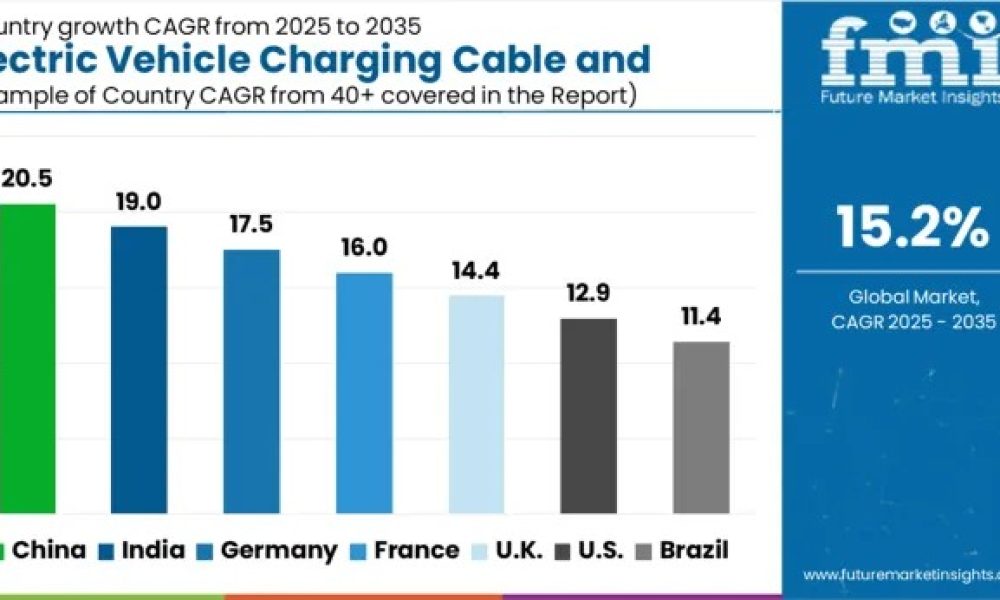
The global electric vehicle (EV) charging cable and plug market is entering a period of sustained high-growth, underpinned by accelerating electric vehicle adoption, rapid charging infrastructure deployment, and increasing standardization across charging ecosystems. Valued at USD 2.4 billion in 2025, the market is projected to reach USD 9.8 billion by 2035, expanding at a CAGR of 15.2% over the forecast period. This trajectory positions charging cables and plugs as one of the fastest-growing hardware segments within the broader EV infrastructure landscape.
Growth Rate Volatility Index analysis indicates that the market exhibits accelerating momentum rather than erratic fluctuation, with early-stage volatility driven by infrastructure milestones and policy-driven adoption cycles. Between 2025 and 2030, annual market additions are expected to rise from USD 0.3 billion to USD 0.6 billion, reflecting rapid scaling of EV fleets and charging networks. Beyond 2030, annual additions are forecast to exceed USD 1 billion, as EV adoption reaches mass-market levels and grid-integrated charging becomes mainstream.
Structural Growth Supported by Policy and OEM Commitments
The market benefits from strong structural support, with limited downside risk indicated by volatility analysis. Regulatory mandates for vehicle electrification, public funding for charging corridors, and long-term commitments by automotive OEMs have created a stable demand foundation. While competition among charging standards, connector formats, and safety specifications may redistribute market share, overall demand growth remains resilient.
Charging cables and plugs are no longer viewed as peripheral components but as mission-critical interfaces between vehicles, power grids, and end users. Their performance directly impacts charging speed, safety, and user experience, elevating their strategic importance within EV ecosystems.
Get access to comprehensive data tables and detailed market insights — request your sample report today!
https://www.futuremarketinsights.com/reports/sample/rep-gb-25324
Market Composition Highlights OEM and Infrastructure Dominance
Demand is heavily concentrated in two core parent segments. Automotive OEM integration accounts for 40% of total market demand, as manufacturers increasingly bundle standardized charging solutions with new EV models to ensure compatibility and consumer confidence. Public charging infrastructure contributes 30%, driven by government-backed rollouts, urban electrification initiatives, and private investment in fast-charging networks. Together, these segments represent 70% of total market demand, underscoring their central role in shaping long-term growth.
Residential charging represents 15%, focused primarily on AC charging solutions optimized for safety, affordability, and ease of installation. Commercial fleets and logistics account for 10%, reflecting the electrification of delivery vehicles, ride-hailing fleets, and corporate transport. The remaining 5% comes from specialty and industrial applications, including buses and heavy-duty EV platforms.
AC Charging Cables and CCS Connectors Lead Adoption
By cable type, AC charging cables dominate with a 57.3% revenue share in 2025, driven by widespread use in residential and workplace charging environments. Their compatibility with existing electrical grids, lower installation costs, and adaptability across charging speeds continue to support large-scale deployment. Expansion of Level 2 charging infrastructure further reinforces the dominance of AC solutions.
On the connector side, Combined Charging System (CCS) connectors lead with a 49.6% market share, reflecting broad acceptance across regions and vehicle platforms. CCS’s ability to support both AC and DC charging through a single interface simplifies infrastructure planning and vehicle design. As fast-charging capability becomes a key consumer expectation, CCS connectors remain central to public and commercial charging networks.
Optimal Cable Lengths and User-Centric Design Drive Differentiation
Cable length preferences also shape demand patterns. The 6 to 10 meters segment holds a 54.1% revenue share, offering an optimal balance between flexibility and manageability. This length range supports common charging scenarios across homes, workplaces, and public stations without introducing handling or storage challenges. As charging environments diversify, ergonomic design and user convenience are becoming important differentiation factors alongside electrical performance.
Fast-Charging and Safety Standards Reshape Competitive Dynamics
Fast-charging infrastructure is a critical growth catalyst, driving demand for high-capacity, liquid-cooled, and thermally optimized cables capable of handling higher currents safely. Commercial operators and logistics fleets prioritize these solutions to minimize downtime, shifting revenue growth toward higher-value cable assemblies.
At the same time, regulatory compliance and safety standards are reshaping product development priorities. Fire resistance, insulation integrity, electromagnetic compatibility, and durability under repeated use are now baseline requirements. Certification has become a prerequisite for market access, particularly in Europe, North America, and Asia-Pacific. Manufacturers that demonstrate consistent compliance and long-term reliability are better positioned to secure large-scale OEM and infrastructure contracts.
Asia-Pacific Leads Global Growth Momentum
Regional analysis highlights Asia-Pacific as the fastest-growing market, led by China (20.5% CAGR) and India (19.0%). Growth in these markets is driven by large-scale EV manufacturing, government-backed charging infrastructure programs, and rapid consumer adoption. China’s expansion is concentrated in DC fast-charging cables and high-capacity plugs, supported by vertically integrated supply chains and aggressive policy incentives. India’s growth reflects a mix of affordability-driven residential AC charging and accelerating deployment of commercial fast-charging hubs.
Europe shows strong momentum, with Germany (17.5%), France (16.0%), and the UK (14.4%) emphasizing premium connectors, CCS standardization, and integration with renewable-powered charging networks. The United States, growing at 12.9%, remains a critical market due to its scale, federal funding for charging corridors, and close collaboration between OEMs and infrastructure providers.
Drive Your Business Growth Strategy: Checkout the Report for Key Insights
https://www.futuremarketinsights.com/checkout/25324
Competitive Landscape Anchored in Engineering and Compatibility
Competition in the electric vehicle charging cable and plug market centers on reliability, durability, and global standard compatibility. Leading players such as TE Connectivity, Aptiv, Leoni AG, Phoenix Contact, and Prysmian Group leverage advanced materials, thermal management, and OEM partnerships to maintain strong positions. Other manufacturers differentiate through affordability, ruggedized designs, or specialization in high-voltage and industrial-grade applications.
Strategic partnerships with automakers, charging network operators, and regulatory bodies are increasingly decisive, as scale and compliance become critical to long-term success.
Outlook
Over the next decade, the electric vehicle charging cable and plug market is expected to transition from rapid infrastructure build-out to sustained, high-volume replacement and upgrade cycles. With EV adoption accelerating globally and fast-charging becoming the norm, demand for safe, high-performance, and interoperable charging solutions will continue to rise. The market’s combination of strong structural drivers, policy alignment, and technological evolution positions it as a compelling growth segment within the global electrification ecosystem.
Why Choose FMI: Empowering Decisions that Drive Real-World Outcomes: https://www.futuremarketinsights.com/why-fmi
About Future Market Insights (FMI)
Future Market Insights, Inc. (FMI) is an ESOMAR-certified, ISO 9001:2015 market research and consulting organization, trusted by Fortune 500 clients and global enterprises. With operations in the U.S., UK, India, and Dubai, FMI provides data-backed insights and strategic intelligence across 30+ industries and 1200 markets worldwide.



