
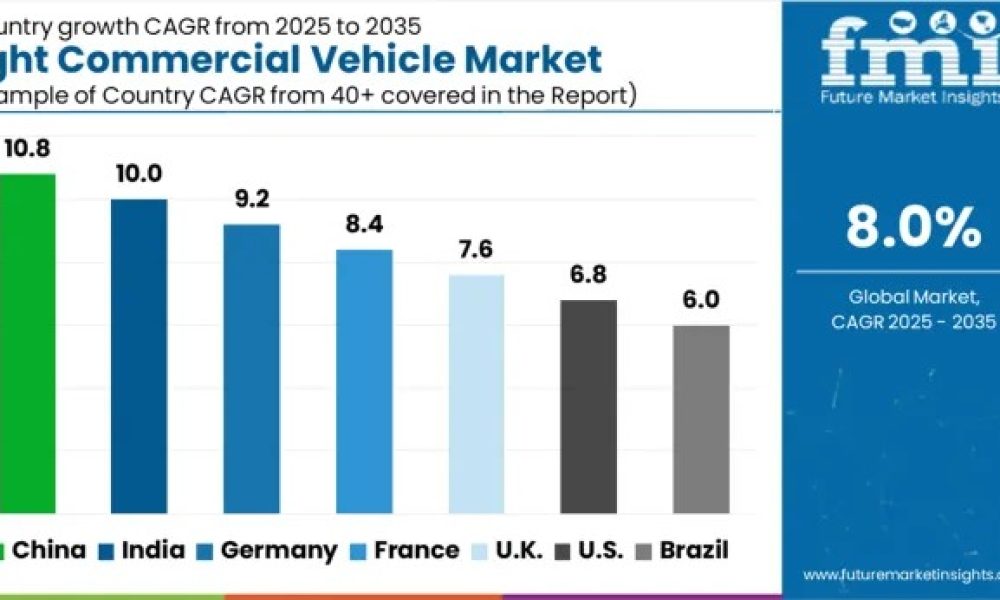
The global light commercial vehicle (LCV) market is entering a decade of accelerated value expansion, underpinned by structural shifts in logistics, urban mobility, and fleet operations. Valued at USD 7.1 trillion in 2025, the market is forecast to reach USD 15.4 trillion by 2035, advancing at a strong compound annual growth rate (CAGR) of 8.0%. This trajectory reflects not only rising unit demand but also increasing dollar value per vehicle as fleets modernize and adopt technology-driven solutions.
Rolling CAGR analysis indicates that growth momentum remains remarkably consistent throughout the forecast period. Early years such as 2026 and 2027 sustain growth near 7.9–8.1%, while mid-term phases around 2029 and 2030 edge toward 8.2%, supported by surging last-mile delivery requirements and infrastructure-led vehicle deployment. Post-2031, expansion strengthens further as electrification, connected fleet management, and urban logistics platforms reshape purchasing behavior. Annual dollar additions rise from approximately USD 0.6 trillion in the initial years to more than USD 1 trillion by 2033, underscoring scale-driven value creation.
Logistics and Infrastructure Anchor Market Demand
The LCV market’s expansion is anchored by demand from core end-use industries. Logistics and e-commerce account for 38% of total market demand, driven by online retail growth, time-sensitive deliveries, and the need for flexible, fuel-efficient fleets. Construction and infrastructure represent 25%, as light commercial vehicles remain essential for site mobility, material transport, and utility services across global development projects.
Small and medium enterprises (SMEs) contribute 15%, leveraging vans, pickups, and light trucks for trade services, mobile operations, and regional distribution. Agriculture and rural mobility account for 12%, supporting farm-to-market connectivity and equipment movement, while passenger and shared mobility represent the remaining 10%. Collectively, logistics, construction, and SMEs generate nearly 80% of global demand, reinforcing the market’s reliance on operational reliability and cost efficiency.
Get access to comprehensive data tables and detailed market insights — request your sample report today!
https://www.futuremarketinsights.com/reports/sample/rep-gb-25321
Pickup Trucks and Mid-Weight Vehicles Lead the Market
By vehicle type, pickup trucks dominate with a 47.6% revenue share in 2025, reflecting their adaptability for both commercial and personal use. Their payload flexibility, durability, and suitability across urban and rural environments have positioned pickups as the preferred option for SMEs, construction operators, and service industries. Ongoing improvements in fuel efficiency, safety systems, and customization options continue to strengthen their leadership.
From a weight perspective, the 9,000–12,000 lbs gross vehicle weight segment commands 53.4% of market revenue, offering an optimal balance between load capacity and regulatory compliance. Vehicles in this category are increasingly favored for urban logistics and construction applications, where higher payloads are required without triggering heavier operational restrictions.
Diesel Remains Dominant as Electrification Gains Momentum
Despite rising electrification, diesel-powered LCVs retain a 49.7% market share in 2025, supported by superior torque performance, fuel efficiency, and established fueling infrastructure. For long-haul logistics, construction, and agriculture, diesel continues to offer a lower total cost of ownership. At the same time, advancements in emission-control technologies are extending diesel’s relevance in regulated markets.
Electrification, however, is emerging as a decisive growth vector beyond 2030. Electric vans and pickups are gaining traction in urban delivery and regulatory-driven markets, supported by government incentives, lower operating costs, and fleet sustainability targets. This transition is expected to elevate average vehicle values and reshape competitive dynamics.
Asia-Pacific Drives Growth, While Mature Markets Deliver Stability
Geographically, Asia-Pacific leads global growth, with China and India recording forecast CAGRs of 10.8% and 10.0%, respectively. China’s dominance is fueled by expansive logistics networks, rapid e-commerce penetration, and government-backed electrification initiatives. India’s growth reflects rising SME adoption, rural connectivity programs, and demand for cost-efficient multipurpose vehicles.
Europe maintains strong momentum, led by Germany (9.2%) and France (8.4%), where fleet electrification, premium vehicle adoption, and industrial logistics integration drive value growth. The United Kingdom (7.6%) shows steady expansion supported by SME activity and last-mile delivery services.
North America, particularly the United States (6.8%), demonstrates slower but highly stable growth. Construction, agriculture, and regional logistics underpin demand, with pickup trucks continuing to dominate. While electrification adoption remains at an early stage, infrastructure investment and premium vehicle preferences sustain long-term value.
Drive Your Business Growth Strategy: Checkout the Report for Key Insights
https://www.futuremarketinsights.com/checkout/25321
Competitive Landscape Focused on Technology and Fleet Solutions
Competition in the LCV market centers on performance, adaptability, and lifecycle cost optimization. Ford Motor Company and General Motors Company lead with extensive pickup and van portfolios, emphasizing durability and advanced safety features. Fiat Chrysler Automobiles (FCA) and Volkswagen Group compete through versatile product ranges tailored for urban and regional logistics.
Toyota Motor Corporation and Isuzu Commercial Truck of America differentiate through fuel efficiency and reliability, particularly in SME and agricultural segments. Mercedes-Benz (Daimler AG) targets the premium fleet segment with advanced driver assistance, connectivity, and service-led business models, while Hino Trucks strengthens its position in construction and logistics through efficiency-focused designs.
Outlook: A High-Value, Resilient Market Through 2035
The light commercial vehicle market is evolving into a high-value, technology-driven ecosystem, where consistent demand from logistics, infrastructure, SMEs, and rural mobility ensures resilience across economic cycles. Stable rolling CAGR trends confirm that growth is not speculative but structurally embedded, supported by long-term shifts in commerce, mobility, and fleet management.
As electrification, connected technologies, and urban logistics accelerate post-2030, the market’s value expansion is expected to outpace unit growth. Stakeholders seeking deeper insights into country-level performance, segment-specific opportunities, and competitive positioning can explore the full market report for a comprehensive strategic perspective on this rapidly expanding global industry.
Why Choose FMI: Empowering Decisions that Drive Real-World Outcomes: https://www.futuremarketinsights.com/why-fmi
About Future Market Insights (FMI)
Future Market Insights, Inc. (FMI) is an ESOMAR-certified, ISO 9001:2015 market research and consulting organization, trusted by Fortune 500 clients and global enterprises. With operations in the U.S., UK, India, and Dubai, FMI provides data-backed insights and strategic intelligence across 30+ industries and 1200 markets worldwide.



