
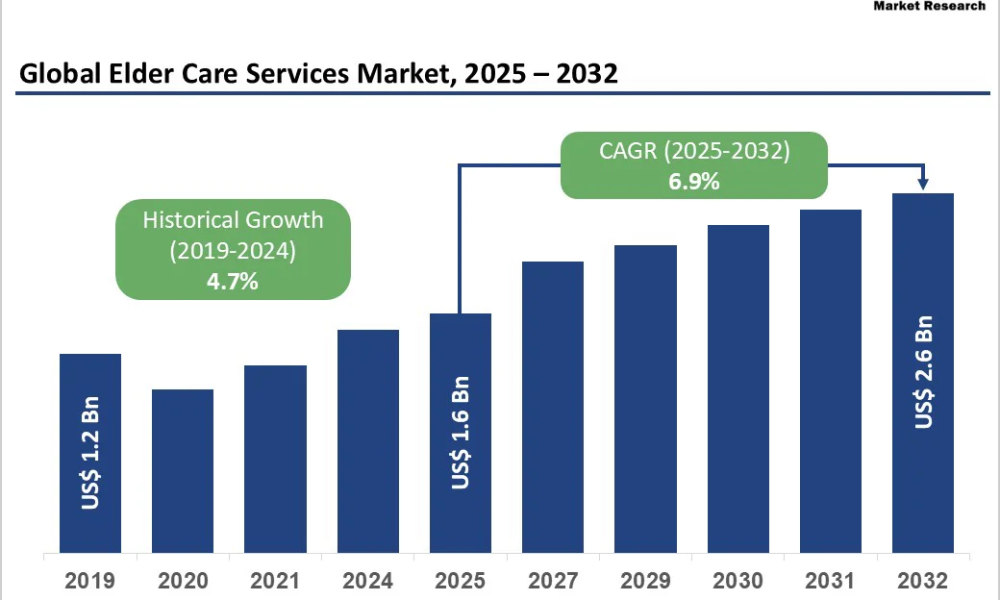
The global elder care services market is witnessing a significant transformation, driven by an aging population, increasing life expectancy, and rising prevalence of chronic conditions among older adults. Valued at US$1.6 billion in 2025, the market is expected to grow at a Compound Annual Growth Rate (CAGR) of 6.9%, reaching US$2.6 billion by 2032. This growth is reshaping how elder care is delivered, with innovations in home healthcare, assisted living, and technology-enabled remote care services taking center stage.
Market Overview and Key Industry Insights
The global elder care services market is evolving due to several factors, including a growing elderly population, advancements in healthcare, and a shift toward home-based care models. The trend is also being fueled by a shift from traditional institutionalized care to more personalized, in-home services. The market’s growth is closely tied to innovations in telehealth, remote monitoring, and AI-driven caregiving platforms that enhance efficiency and patient outcomes.
Home healthcare is currently the dominant segment of the market, driven by its convenience, cost-effectiveness, and the increasing preference of seniors for receiving care in their own homes. Assisted living and nursing facilities are also key players, providing additional options for seniors who require more extensive care and support.
Download Your Free Sample & Explore Key Insights
Market Dynamics: Drivers, Restraints, and Opportunities
The elder care services market is propelled by several key drivers, including a snowballing global demand for retirement living. As traditional family structures shift due to urbanization, more seniors are seeking independence and community-oriented living arrangements. This trend is further supported by affluent retirees who are willing to invest in premium care services that offer both medical support and recreational amenities.
However, the market also faces significant challenges, particularly in rural and semi-urban regions. Limited infrastructure, lack of healthcare facilities, and poor transportation networks make it difficult for seniors in these areas to access timely and quality care. Additionally, the shortage of trained healthcare professionals in these regions exacerbates the situation, further hindering the widespread adoption of advanced elder care services.
Despite these challenges, there are significant opportunities in the market. One such opportunity is the growing potential of tele-rehabilitation services. This innovative solution allows seniors to receive physiotherapy, occupational therapy, and other rehabilitation services remotely, using secure video consultations, wearable sensors, and AI-guided exercise programs. Tele-rehabilitation not only improves the convenience of care but also ensures better adherence to rehabilitation plans and minimizes the need for frequent hospital visits.
Category-wise Market Analysis: Services, Financing, and Regional Insights
Service Insights
Home-based care services dominate the elder care services market, driven by the growing demand for personalized care in familiar environments. Seniors prefer to stay in their homes as they age, avoiding the costs and stress of institutional care. Advances in technology, such as telehealth and wearable monitoring devices, have further enhanced the quality and safety of home-based care, making it the preferred choice for many families.
Home healthcare services range from non-medical support, such as assistance with daily living activities, to medical services like chronic disease management and rehabilitation. The rise of nuclear families and dual-income households has led to a surge in demand for professional caregivers who can provide support at home, allowing seniors to age in place with dignity and comfort.
Financing Source Insights
Out-of-pocket spending remains the primary method of financing elder care services globally. Many families, particularly in emerging markets, bear the full cost of home-based care, nursing facilities, and rehabilitation services. This trend is driven by the high demand for personalized, flexible, and timely care, which is often not covered adequately by insurance or public healthcare systems. Even in regions with insurance schemes, coverage gaps, particularly for chronic conditions and long-term custodial care, force seniors and their families to pay out-of-pocket.
In some developed regions, government programs like Medicaid and Medicare in the United States provide financial support for elder care services. However, these programs often have limitations, especially when it comes to covering advanced technologies or personalized home-based services, further reinforcing the reliance on out-of-pocket spending.
Get Custom Insights Designed for Your Business
Regional Insights
North America: The Leading Market for Elder Care Services
North America currently holds the largest share of the global elder care services market, largely due to its aging population, high healthcare expenditure, and advanced infrastructure. The preference for home-based care, assisted living, and skilled nursing facilities is widespread, reflecting the region’s focus on high-quality, personalized services.
Technological integration is also a key trend in North America, with innovations in telehealth, remote monitoring, and AI-assisted caregiving enhancing the accessibility and efficiency of elder care. Government support through Medicare, Medicaid, and long-term care insurance policies further ensures that elder care services remain accessible, despite rising healthcare costs. The growing prevalence of chronic diseases and the region’s focus on aging-in-place models are expected to drive further market expansion in the coming years.
Asia-Pacific: The Fastest-Growing Elder Care Services Market
The Asia-Pacific region is experiencing rapid growth in the elder care services market, driven by an aging population, increasing life expectancy, and rising rates of chronic diseases. Urbanization, nuclear family structures, and growing disposable incomes are fueling demand for professional home-based care and community-based elder services. This shift is also supported by government efforts to address the increasing demand for elder care, with subsidies, pilot programs, and regulatory reforms emerging in several countries.
The adoption of technology in elder care, such as telehealth, wearable monitoring devices, and AI-driven caregiving platforms, is accelerating in Asia-Pacific. As awareness of senior health needs rises and cultural shifts towards modern caregiving practices take hold, the region is poised to become a dynamic market for innovative elder care solutions.
Checkout Now & Download Complete Market Report
Market Segmentation
By Service
- Home-based Care
- Community-based Care
- Institutional Care
By Financing Source
- Public Expenditure
- Private Source
- Out-of-Pocket Spending
By Region
- North America
- Europe
- East Asia
- South Asia and Oceania
- Latin America
- Middle East and Africa
Competitive Landscape
The elder care services market is highly competitive, with private operators, non-profit organizations, and public institutions all vying for market share. Private players dominate the home-based care, assisted living, and rehabilitation service segments, with many leveraging technology to offer personalized, premium services. Non-profit and government-run facilities focus on making elder care services accessible and affordable while adhering to regulatory compliance.
Strategic mergers and acquisitions are common in the industry, as players seek to expand geographically and diversify their service portfolios. Companies such as Korian Group, Home Instead, Living Assistance Services, and Econ Healthcare Group are some of the key players in the market, each offering a range of elder care services designed to meet the unique needs of seniors worldwide.
Conclusion
The elder care services market is evolving rapidly in response to the needs of an aging global population. Innovations in technology, home healthcare, and personalized care models are transforming how services are delivered, improving quality of life for seniors. Despite challenges such as infrastructure gaps in rural areas, the growing demand for retirement living, tele-rehabilitation, and government support for elder care will continue to drive market growth. With North America leading the charge and Asia-Pacific emerging as the fastest-growing region, the elder care services market is poised for sustained growth and innovation in the years ahead.




