
Future Market Insights (FMI), a leading provider of market intelligence and consulting services, today released its latest in-depth report on the Cabozantinib (Cometriq) market stands out as a beacon of progress for advanced cancer therapies. As a multi-kinase inhibitor, Cabozantinib addresses critical unmet needs in treatment-refractory cases, offering hope to patients battling renal cell carcinoma (RCC), hepatocellular carcinoma (HCC), and medullary thyroid cancer (MTC). Industry leaders are increasingly recognizing its role in extending progression-free survival and integrating into personalized treatment protocols, driven by compelling clinical evidence and expanding regulatory approvals.
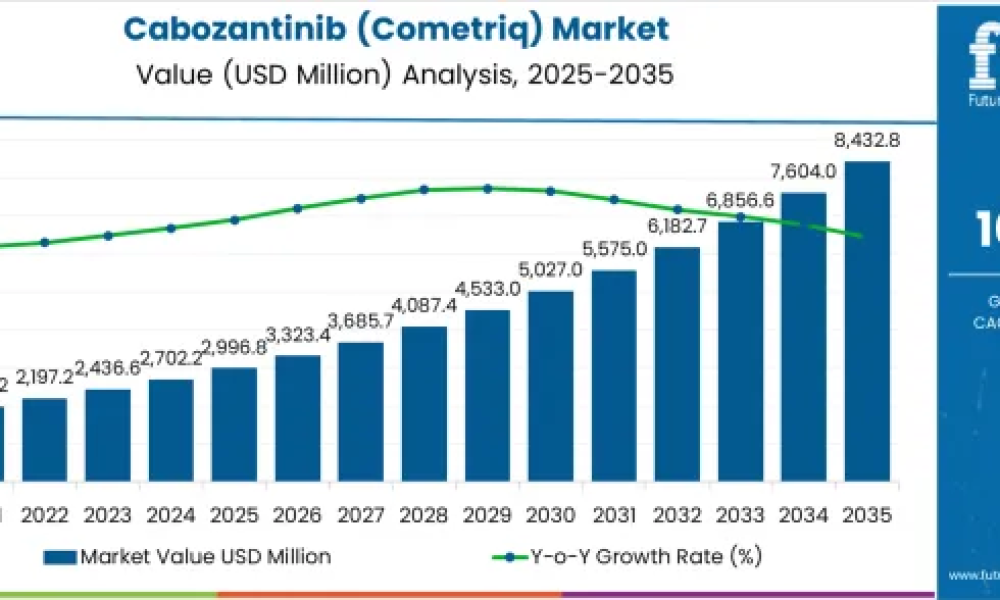
The global Cabozantinib market is on a trajectory of significant expansion, forecasted to grow from USD 2,996.8 million in 2025 to an impressive USD 8,432.8 million by 2035. This represents a compound annual growth rate (CAGR) of 10.9%, underscoring the therapy’s escalating adoption in oncology practices worldwide. Over the decade, the market is expected to add USD 5,436 million in absolute growth, with the first half (2025-2030) contributing USD 2,030.3 million—about 37.3% of the total surge—fueled by heightened demand in RCC treatments and ongoing clinical innovations. The latter period (2030-2035) will see an even steeper acceleration, adding USD 3,405.7 million or 62.7%, as personalized medicine and reimbursement frameworks mature.
At the heart of this growth is the therapy’s proven efficacy across key indications. Renal cell cancer commands the largest share, accounting for 62% of the market in 2025, thanks to its demonstrated benefits in improving survival rates for patients who have exhausted other options. Endorsed by leading oncology guidelines, Cabozantinib supports combination therapies, making it a cornerstone for advanced RCC management. Hepatocellular cancer follows as a high-potential segment, positioned as a vital second-line therapy amid rising global incidences and limited alternatives. Research into combinations and earlier-line applications is expanding its footprint, while medullary thyroid cancer benefits from orphan drug status, appealing to specialized care for rare, aggressive cases where progression management is paramount.
Dosage forms further highlight patient-centric innovations, with tablets dominating at 58% market share in 2025 due to superior compliance and ease of administration. This preference aligns with broader trends in oncology toward convenient, at-home therapies that reduce hospital burdens and enhance quality of life.
Distribution channels reflect regional nuances in healthcare delivery. Hospital pharmacies lead in specialized markets like South Korea, holding 72% share in 2025, driven by regulatory controls for high-cost drugs and the need for expert patient counseling. Retail and specialty pharmacies contribute around 14% each in such regions, while online channels are gaining traction for accessibility. Globally, this segmentation emphasizes the importance of robust supply chains to ensure timely access in oncology settings.
Regionally, the market narrative is one of balanced yet dynamic growth. North America, spearheaded by the United States with a 10.4% CAGR, leverages mature infrastructure, clinical innovation, and favorable reimbursements to maintain leadership. Europe follows closely, with Germany at 12.5% CAGR, the UK at 9.3%, and a focus on evidence-based protocols and quality standards. Asia Pacific emerges as the growth powerhouse, with China (14.7% CAGR), India (13.6%), Japan (8.2%), and South Korea leading the charge through infrastructure expansions, insurance coverage enhancements, and medical tourism. Latin America, including Brazil at 11.4% CAGR, and the Middle East & Africa are modernizing access, while East and South Asia & Pacific regions offer granular opportunities across over 40 countries.
The competitive landscape is concentrated, with high entry barriers from patents, regulations, and clinical development costs. Industry frontrunners like Exelixis, Ipsen, and Takeda Pharmaceutical dominate through original development, evidence generation, and strong healthcare professional relationships. Other key players, including Royalty Pharma, GlaxoSmithKline, AstraZeneca, Bayer AG, Eisai, Roche, Merck, Bristol-Myers Squibb, and Pfizer, contribute to a collaborative ecosystem focused on clinical superiority rather than price wars.
Recent developments amplify this momentum, with expanded approvals for new indications and combination protocols, investments in biomarker-guided therapies, and strategic partnerships in emerging markets. Patient access programs and reimbursement frameworks are pivotal in addressing affordability challenges.
Driving forces include the therapy’s survival benefits, surging cancer rates, guideline inclusions, precision medicine breakthroughs, and improved healthcare access in developing regions. However, restraints such as high costs, patent expirations, adverse event management needs, and regulatory delays pose hurdles. Opportunities abound in emerging markets like China and India, through combination therapies, stakeholder collaborations, value-based pricing, and digital health integration for better monitoring and outcomes.
Subscribe for Year-Round Insights → Stay ahead with quarterly and annual data updates: https://www.futuremarketinsights.com/reports/brochure/rep-gb-26927
Request for Discount: https://www.futuremarketinsights.com/reports/sample/rep-gb-26927
This market narrative underscores a human-centered approach, where innovations not only extend lives but empower patients and providers alike. As decision-makers in pharma and healthcare navigate this space, prioritizing evidence-based strategies and equitable access will be key to unlocking Cabozantinib’s full potential. Stakeholders—from manufacturers to governments—are called to foster collaborations that scale these advancements, ensuring no patient is left behind in the fight against cancer.
For industry leaders, this represents a decision-grade opportunity: Invest in R&D for resistance management, advocate for reimbursement reforms, and expand into high-growth regions to capture market share in a therapy that’s redefining oncology standards. The future of Cabozantinib is not just about growth—it’s about transforming lives through targeted, effective care.
About Future Market Insights (FMI)
Future Market Insights, Inc. (FMI) is an ESOMAR-certified, ISO 9001:2015 market research and consulting organization, trusted by Fortune 500 clients and global enterprises. With operations in the U.S., UK, India, and Dubai, FMI provides data-backed insights and strategic intelligence across 30+ industries and 1200 markets worldwide.
Why FMI: Decisions that Change Outcomes- https://www.futuremarketinsights.com/why-fmi
Contact Us:
Future Market Insights Inc.
Christiana Corporate, 200 Continental Drive,
Suite 401, Newark, Delaware – 19713, USA
T: +1-347-918-3531
Website: https://www.futuremarketinsights.com
LinkedIn| Twitter| Blogs | YouTube
Have a specific Requirements and Need Assistant on Report Pricing or Limited Budget please contact us – [email protected]



