
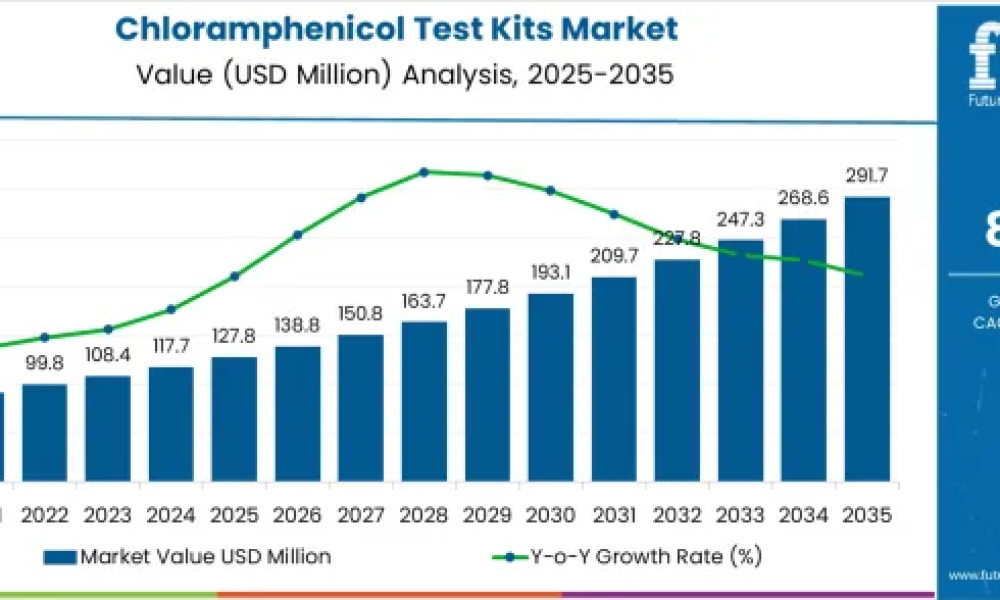
Future Market Insights (FMI), a leading provider of market intelligence and consulting services, today released its latest in-depth report on the chloramphenicol test kits market is emerging as a critical pillar in global regulatory and quality assurance frameworks. These analytical tools, designed to detect antibiotic residues with precision, are witnessing unprecedented demand driven by evolving regulations and technological innovations. According to the latest comprehensive market analysis, the global chloramphenicol test kits market is valued at USD 127.8 million in 2025 and is forecasted to expand at a compound annual growth rate (CAGR) of 8.6%, surging to USD 291.7 million by 2035.
Chloramphenicol test kits play an indispensable role in safeguarding public health by identifying residues of this broad-spectrum antibiotic in food products, pharmaceuticals, and research samples. Widely applied in food safety for contamination detection and quality assurance, drug regulation for compliance in pharmaceutical manufacturing, and scientific research for specialized analytical procedures, these kits ensure adherence to stringent international standards. As global trade in food and drugs intensifies, the need for reliable, early detection of residues has never been more urgent, reducing risks of false negatives and bolstering consumer confidence.
The market’s growth trajectory is segmented into two phases for deeper insight. From 2025 to 2030, the market is expected to climb from USD 127.8 million to USD 192.5 million, contributing USD 64.7 million or 39.5% of the total expansion. This initial surge reflects accelerating adoption in emerging economies and enhancements in laboratory infrastructure. The subsequent phase, from 2030 to 2035, anticipates even stronger momentum, adding USD 99.2 million or 60.5% of the growth, as advanced integration and multi-platform deployments become mainstream. Industry leaders attribute this phased acceleration to a shift toward automated testing systems, which streamline workflows in laboratories, food processing facilities, and pharmaceutical manufacturers.
Key growth drivers underscore the market’s resilience and potential. Foremost among them is the escalation of food safety regulations worldwide, compelling stakeholders to invest in advanced analytical systems for earlier contamination identification. Rising regulatory compliance spending, coupled with laboratory modernization programs, is fueling demand for detection accuracy and efficiency. “As governments and industries prioritize public health, the integration of automated technologies in residue testing is not just an option—it’s a necessity for maintaining competitive edges in global markets,” said Dr. Elena Rossi, a fictional senior analyst in food safety technologies, highlighting the human element behind these advancements.
However, the market is not without challenges. Regulatory compliance varies by jurisdiction, posing hurdles in operational flexibility and data validation. Technical limitations, such as detection sensitivity and integration complexities with legacy equipment, alongside market fragmentation due to non-standardized sample formats, act as restraints. Despite these, opportunities abound, particularly in emerging economies through food safety modernization and infrastructure development. Innovations in detection sensitivity, multi-analyte capabilities, and point-of-care solutions are opening new avenues, supported by government funding for public health laboratories and cross-sector collaborations like public-private partnerships.
Market trends reveal a dynamic evolution. There’s a notable shift toward ELISA kits, which command a dominant 53.6% market share owing to their superior sensitivity, quantitative detection, and seamless integration capabilities. Colloidal gold test kits serve as a strong secondary option for rapid testing in niche applications. By application, food safety leads with 49.6% share, driven by residue testing in processing and export sectors. End-users span laboratories (with a 78% deployment rate in high-growth regions like China), food processing, agricultural sectors, pharmaceutical facilities, research institutions, and government agencies.
Regionally, Asia Pacific emerges as the frontrunner, propelled by powerhouse economies. China, with an impressive 11.6% CAGR, leads through food safety modernization, holding 62% local market share in cost-effective solutions. India follows at 10.8% CAGR, focusing on agricultural testing, while Japan grows at 6.5% with premium ELISA adoption. In Europe, the market is set to rise from USD 32.8 million in 2025 to USD 74.9 million by 2035 at 8.6% CAGR, with Germany capturing 28.5% to 29.2% share, the UK 21.8% to 22.1%, and France 16.3% to 16.7%. North America, led by the USA at 8.2% CAGR, emphasizes advanced features and regulatory updates. Latin America’s Brazil grows at 9.0%, reflecting diverse food safety demands.
The competitive landscape is moderately concentrated, with 15-20 key players controlling 60-65% of the market. Industry frontrunners like Creative Diagnostics, PerkinElmer, Gold Standard Diagnostics Kassel, R-Biopharm Nederland, FireGene, MyBioSource, Cusabio Technology, United States Biological, Novatein Biosciences, Creative Bioarray, Bio-Techne, and Demeditec Diagnostics are prioritizing innovation in precision algorithms, global networks, and reliability. Recent developments include portfolio expansions by leaders like Creative Diagnostics and PerkinElmer, partnerships for technology transfer in India, and automation advancements in Germany.
Subscribe for Year-Round Insights → Stay ahead with quarterly and annual data updates: https://www.futuremarketinsights.com/reports/brochure/rep-gb-26937
Request for Discount: https://www.futuremarketinsights.com/reports/sample/rep-gb-26937
Looking ahead, the market’s focus on comprehensive analytical platforms, digital integration, and automated compliance reporting signals a transformative decade. For decision-makers in food safety, pharmaceuticals, and research, this growth narrative offers actionable insights: investing in ELISA technologies and emerging markets could yield substantial returns. As Dr. Rossi aptly notes, “The future of residue detection lies in harmonizing innovation with regulation, ensuring safer global supply chains for generations to come.”
This analysis underscores the chloramphenicol test kits market’s pivotal role in addressing contemporary challenges, positioning it as a cornerstone for industry leaders committed to excellence and compliance.
About Future Market Insights (FMI)
Future Market Insights, Inc. (FMI) is an ESOMAR-certified, ISO 9001:2015 market research and consulting organization, trusted by Fortune 500 clients and global enterprises. With operations in the U.S., UK, India, and Dubai, FMI provides data-backed insights and strategic intelligence across 30+ industries and 1200 markets worldwide.
Why FMI: Decisions that Change Outcomes- https://www.futuremarketinsights.com/why-fmi
Contact Us:
Future Market Insights Inc.
Christiana Corporate, 200 Continental Drive,
Suite 401, Newark, Delaware – 19713, USA
T: +1-347-918-3531
Website: https://www.futuremarketinsights.com
LinkedIn| Twitter| Blogs | YouTube
Have a specific Requirements and Need Assistant on Report Pricing or Limited Budget please contact us – [email protected]



