
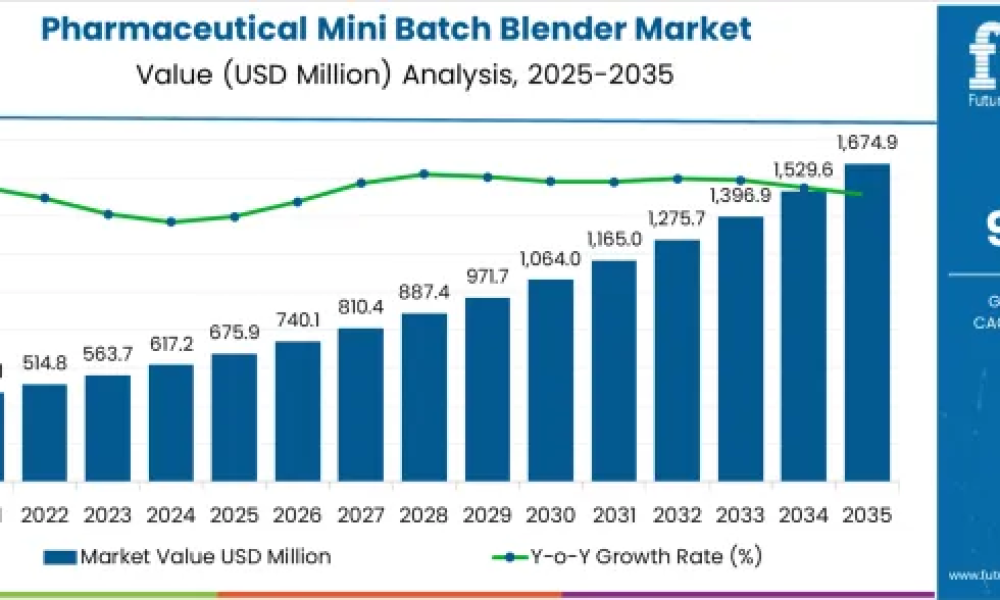
Future Market Insights (FMI), a leading provider of market intelligence and consulting services, today released its latest in-depth report on the pharmaceutical mini-batch blender market is on the cusp of transformative expansion, driven by the escalating demand for flexible, precise manufacturing solutions in an era of personalized medicine and specialty drug production. According to a comprehensive analysis, the market is expected to surge from USD 675.9 million in 2025 to USD 1,674.9 million by 2035, registering a robust compound annual growth rate (CAGR) of 9.5%. This growth trajectory underscores the industry’s shift toward agile production technologies that cater to small-scale drug development, clinical trials, and high-value formulations, positioning mini-batch blenders as indispensable tools for pharmaceutical leaders navigating regulatory complexities and market demands.
In the short term, from 2025 to 2030, the market is forecasted to climb to USD 1,064 million, delivering an absolute increase of USD 388.1 million – accounting for nearly 39% of the total projected growth over the decade. This acceleration reflects broader trends in pharmaceutical manufacturing, where mini-batch blenders command a 5% share of the overall pharmaceutical equipment market, 7% in industrial mixing equipment, 6% in pharmaceutical manufacturing, 4% in processing equipment, and 3% in laboratory equipment. Industry executives and decision-makers are increasingly recognizing these blenders as critical enablers for maintaining product quality, ensuring process validation, and adapting to the complexities of modern formulations.
At the heart of this market’s momentum are key drivers reshaping pharmaceutical production. The rapid proliferation of personalized medicine demands equipment capable of handling ultra-small batches with unwavering precision, allowing for individualized therapies that address specific patient needs. Similarly, the need for consistent blending in clinical trial manufacturing and specialty drug production is fueling adoption, as these blenders facilitate frequent changeovers and documented performance metrics essential for regulatory compliance. “As pharmaceutical formulations grow more intricate, leaders must invest in technologies that offer agility without compromising on quality or efficiency,” notes a market insight. The requirement for standardized procedures, coupled with the expertise of trained process engineers, further amplifies the value of mini-batch blenders in high-stakes environments like oncology and hormone drug manufacturing.
However, the path forward is not without challenges. Higher per-unit costs compared to large-scale alternatives, coupled with rigorous validation protocols and varying regional regulations, pose restraints that savvy industry players must navigate. These hurdles, while significant, are offset by burgeoning opportunities that could unlock USD 350-450 million in incremental revenue by 2035. Forward-thinking companies can capitalize on pathways such as mobile blending systems, which emphasize multi-product capabilities and automated changeovers for containment solutions, potentially yielding USD 100-130 million. Specialty pharmaceutical manufacturing for high-potency APIs and complex formulations offers another USD 80-110 million, while personalized medicine production targets USD 60-80 million through ultra-small batch innovations.
Emerging trends are also pivotal in this narrative. The integration of continuous manufacturing processes promises seamless batch handling, boosting efficiency and consistency. Advanced process control systems, incorporating real-time monitoring and process analytical technology, are enhancing blending precision and facilitating digital quality documentation. Moreover, the advent of Industry 4.0 with IoT-enabled smart manufacturing is opening doors to USD 15-25 million in opportunities, enabling predictive maintenance and optimized operations. Clinical trial support, particularly for Phase I-III, and high-containment applications for potent compounds, add further layers of potential, with estimates ranging from USD 40-55 million and USD 30-45 million, respectively.
Market segmentation reveals targeted growth areas. By type, mobile blenders dominate with a 58% share in 2025, prized for their flexibility, space efficiency, and compliance in multi-line setups. Stationary variants complement this, serving fixed production needs. In applications, small-batch production leads with 64% market share, driven by demands in precision medicine, orphan drugs, and personalized therapies. Pilot applications round out the segment, supporting early-stage development.
Regionally, the landscape is diverse and dynamic. Europe is set to expand from USD 176.5 million in 2025 to USD 437.5 million by 2035 at a 9.5% CAGR, with Germany holding a commanding 35% share, followed by the UK at 27.5% and France at 21%. High-growth hotspots include China (12.8% CAGR), India (11.9%), and Germany (10.9%), with Brazil (10%), the US (9%), the UK (8.1%), and Japan (7.1%) also showing strong potential. Emerging markets in Asia, Latin America, and the Middle East & Africa present cost-effective expansion avenues, estimated at USD 25-35 million. North America, East Asia, South Asia & Pacific, and other regions contribute to a global footprint covering over 40 countries, from the US and Canada to Saudi Arabia and South Africa.
Subscribe for Year-Round Insights → Stay ahead with quarterly and annual data updates: https://www.futuremarketinsights.com/reports/brochure/rep-gb-26950
Request for Discount: https://www.futuremarketinsights.com/reports/sample/rep-gb-26950
The competitive arena is vibrant, featuring specialized players like Gericke, known for cGMP-compliant powder processing; Servolift GmbH, excelling in containment and integration; AEC, with a focus on validation; MUNSON, for industrial mixing; Pharmag, targeting small-scale applications; and Conta, emphasizing material handling. These companies are investing in blending algorithms, process optimization, and strategic partnerships to bolster their portfolios amid rising manufacturing complexity. Recent developments highlight expansions in mini-batch capabilities to meet regulatory demands and support the penetration of flexible technologies in personalized medicine.
For pharmaceutical executives, this market narrative signals a call to action: Embrace mini-batch blenders to future-proof operations, enhance compliance, and tap into high-value niches. As the industry evolves, those who prioritize innovation in small-scale production will lead the charge toward a more personalized, efficient future in drug manufacturing.
About Future Market Insights (FMI)
Future Market Insights, Inc. (FMI) is an ESOMAR-certified, ISO 9001:2015 market research and consulting organization, trusted by Fortune 500 clients and global enterprises. With operations in the U.S., UK, India, and Dubai, FMI provides data-backed insights and strategic intelligence across 30+ industries and 1200 markets worldwide.
Why FMI: Decisions that Change Outcomes- https://www.futuremarketinsights.com/why-fmi
Contact Us:
Future Market Insights Inc.
Christiana Corporate, 200 Continental Drive,
Suite 401, Newark, Delaware – 19713, USA
T: +1-347-918-3531
Website: https://www.futuremarketinsights.com
LinkedIn| Twitter| Blogs | YouTube
Have a specific Requirements and Need Assistant on Report Pricing or Limited Budget please contact us – [email protected]



