
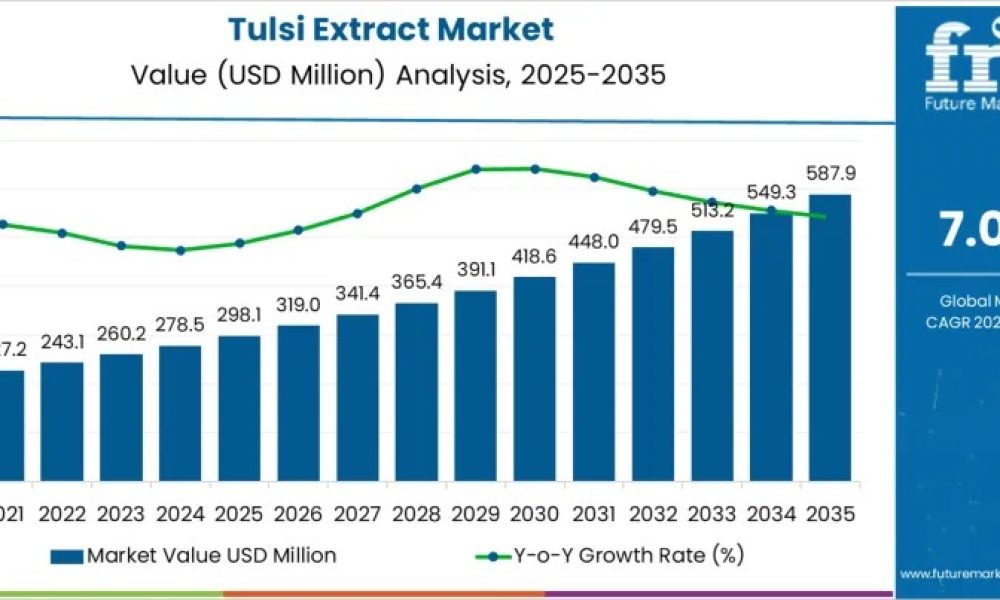
The global tulsi extract market is valued at USD 298.1 million in 2025 and is projected to reach USD 587.9 million by 2035, expanding at a 7.0% CAGR. Growth is strongly linked to the rising use of plant-derived actives in personal-care formulations and the broader acceptance of traditional botanicals in dermatology-led skincare.
Tulsi extract, known for its calming, antioxidant, and antimicrobial properties, is increasingly used in daily skincare routines. Manufacturers focus on extract standardization and controlled processing to ensure consistent bioactive performance across finished products.
Explore trends before investing – request a sample report today!
Skin care remains the leading application segment, supported by product launches targeting irritation reduction, pollution defense, and skin-balancing benefits. Clean-beauty positioning and consumer preference for gentle botanical actives continue to strengthen demand.
Regional Growth Outlook
Asia Pacific, Europe, and North America represent the fastest-growing regions due to strong herbal awareness, regulatory support, and expanding clean-label portfolios. Established supply networks and compliance frameworks in these regions enable safe integration of tulsi extract into personal-care systems.
Market Highlights
- 2025 Market Value: USD 298.1 Mn
- 2035 Forecast Value: USD 587.9 Mn
- Forecast CAGR (2025–2035): 7.0%
- Top Application: Skin Care
- Key Growth Regions: Asia Pacific, Europe, North America
Growth Dynamics
Acceleration in demand is supported by rising interest in natural wellness ingredients, improved extraction standards, and wider retail distribution. Tulsi’s adaptogenic and anti-inflammatory profile encourages adoption beyond traditional Ayurveda into dermocosmetics and wellness-linked personal care.
Deceleration may occur in mature supplement markets and due to competition from botanicals like ashwagandha and moringa. Regulatory validation cycles in pharmaceutical and advanced skincare categories can also slow short-term commercialization, although overall growth remains positive.
Application & Form Trends
Skin care accounts for a significant share of tulsi extract use, especially in acne-control, soothing, and detoxifying products. Hair-care applications benefit from dandruff-control and scalp-purifying properties.
Powder remains the dominant form due to stability and formulation flexibility, while liquid formats support serums and leave-on products.
Why Global Demand for Tulsi Extract Is Rising
Demand is increasing as consumers seek herbal ingredients linked to stress balance, immune support, and daily wellness. Nutraceutical brands incorporate tulsi into capsules, powders, and functional beverages, encouraging recurring use among health-focused consumers. Personal-care companies adopt tulsi extract for anti-inflammatory and antimicrobial benefits in skin care, oral care, and scalp care formulations, particularly within sensitive-skin categories.
E-commerce expansion has further improved global accessibility, especially in North America and Europe, where interest in traditional botanical remedies continues to grow. Standardized extracts help manufacturers maintain quality consistency, though reliable cultivation and region-specific regulatory compliance remain important considerations.
Country-Level Growth
India leads with a 9.5% CAGR, driven by strong Ayurvedic heritage and export-focused extraction. China follows at 8.8%, supported by functional beverage integration. Japan records 8.1%, emphasizing standardized, mild-flavor formulations. The UK (7.4%), Germany (6.7%), and the U.S. (6.0%) show steady expansion through herbal teas, supplements, and stress-support products.
Get the full scoop—view the complete report!
Competitive Landscape
Key suppliers include BASF SE, Croda International, Evonik Industries, Symrise, and Dow. Development priorities include:
- Stability enhancement
- Compatibility across oil- and water-based systems
- Compliance with global safety and sustainability standards
Agricultural sourcing remains centered in India, pushing suppliers to strengthen traceability and residue-control programs for regulated markets.
Sustained innovation in standardized extracts, cross-category use in personal care and wellness, and rising global consumer education position tulsi extract for stable, long-term market expansion.
About Future Market Insights (FMI)
Future Market Insights, Inc. (ESOMAR certified, recipient of the Stevie Award, and a member of the Greater New York Chamber of Commerce) offers profound insights into the driving factors that are boosting demand in the market. FMI stands as the leading global provider of market intelligence, advisory services, consulting, and events for the Packaging, Food and Beverage, Consumer Technology, Healthcare, Industrial, and Chemicals markets. With a vast team of over 400 analysts worldwide, FMI provides global, regional, and local expertise on diverse domains and industry trends across more than 110 countries.



