
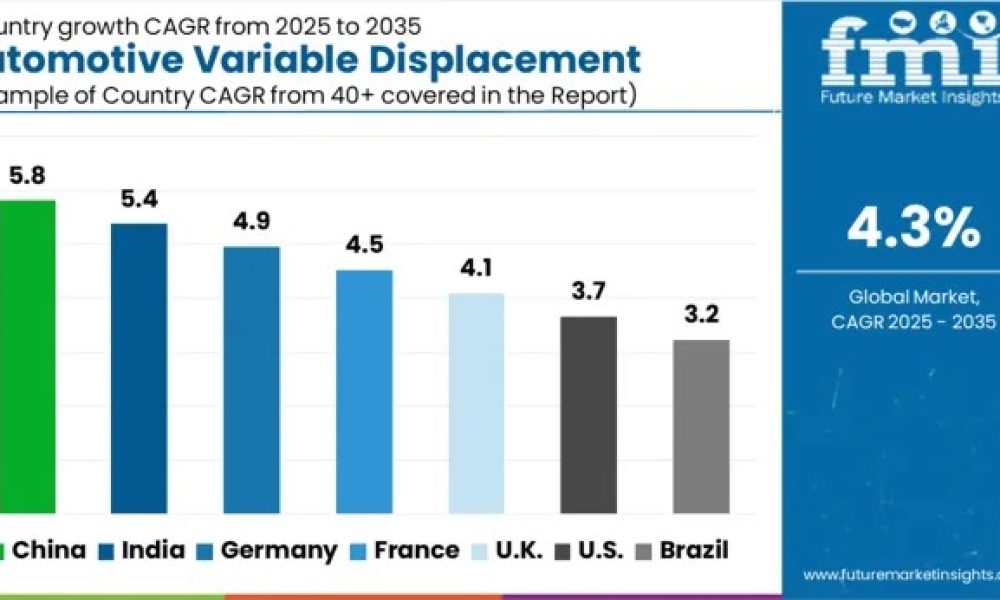
The global automotive variable displacement pumps market is projected to expand from USD 3.2 billion in 2025 to USD 4.9 billion by 2035, registering a compound annual growth rate (CAGR) of 4.3% over the forecast period. The market demonstrates a stable, low-volatility growth profile, underpinned by its structural role in improving fuel efficiency, hydraulic performance, and adaptive vehicle operation across passenger and commercial automotive platforms.
A peak-to-trough analysis highlights the market’s resilience and maturity. The only minor trough occurs during 2025–2026 at approximately USD 3.2 billion, reflecting early saturation in developed regions and slower initial adoption in select emerging markets. From 2025 to 2030, the market rises steadily to USD 4.0 billion, supported by incremental integration in fuel-efficient internal combustion engine (ICE) vehicles and hybrid platforms. The market reaches its projected peak of USD 4.9 billion by 2035, driven by cumulative gains in passenger cars, light commercial vehicles, and advanced electronically controlled hydraulic systems.
This narrow peak-to-trough spread signals limited cyclicality and predictable demand behavior, reinforcing the market’s attractiveness for long-term supplier investment, OEM integration programs, and platform-level component standardization.
Efficiency Mandates and Powertrain Evolution Sustain Market Momentum
Growth in the automotive variable displacement pumps market is closely linked to fuel efficiency regulations, emission reduction mandates, and the automotive industry’s shift toward adaptive powertrain architectures. These pumps dynamically regulate fluid flow based on operating conditions, reducing parasitic losses and improving overall vehicle efficiency compared with fixed-displacement alternatives.
The automotive power steering segment accounts for approximately 40–45% of total market demand, reflecting widespread adoption in hydraulic and electro-hydraulic steering systems across passenger and commercial vehicles. Engine systems contribute an additional 20–22%, as variable displacement pumps optimize lubrication, cooling, and thermal management. Hydraulic systems and components represent 15–17%, while commercial vehicles account for 10–12% of demand due to increasing hydraulic complexity in trucks and utility vehicles. The aftermarket contributes 5–6%, supported by long vehicle lifecycles and replacement needs.
Together, these parent markets define a robust integration ecosystem in which variable displacement pumps function as enablers of efficiency, reliability, and regulatory compliance.
Get access to comprehensive data tables and detailed market insights — request your sample report today!
https://www.futuremarketinsights.com/reports/sample/rep-gb-25564
Water Pumps Anchor Demand as Core Thermal Management Components
By pump type, water pumps lead the market with a 34.7% share, reflecting their critical role in engine temperature regulation across ICE, hybrid, and select electric vehicle platforms. Advances in variable displacement water pump technology now allow real-time flow adjustment, significantly improving thermal efficiency while reducing mechanical drag.
Lightweight materials, improved sealing systems, and electronically controlled actuation have enhanced durability and reduced maintenance frequency. These improvements align closely with tightening emission standards, prompting OEMs to favor advanced water pump designs as standard equipment rather than optional upgrades. Rising passenger vehicle production volumes, particularly in Asia-Pacific, continue to reinforce this segment’s dominance.
Hydraulic Technology Maintains Leadership Through Proven Performance
From a technology perspective, hydraulic systems account for 52.6% of market share, maintaining leadership due to their proven reliability, scalability, and precise flow control under variable load conditions. Hydraulic variable displacement pumps offer a balance of cost efficiency and performance consistency, making them particularly attractive for high-volume vehicle platforms.
Ongoing innovation in integrated control modules, actuator responsiveness, and pressure regulation has strengthened the value proposition of hydraulic solutions. Established manufacturing infrastructure further supports competitive pricing and global scalability. As regulatory pressure intensifies around fuel consumption and emissions, hydraulic variable displacement pumps remain central to next-generation auxiliary system design.
Passenger Cars Drive Volume Through Scale and Regulation
By vehicle category, passenger cars represent 68.3% of total demand, reflecting their dominance in global automotive production and high penetration of efficiency-enhancing technologies. Variable displacement pumps are increasingly integrated into cooling, steering, transmission, and fuel management systems to meet stringent fuel economy and emission standards.
Growth in passenger car demand is especially pronounced in Asia-Pacific, where expanding middle-class vehicle ownership coincides with stricter efficiency regulations. Adoption spans both conventional and hybrid vehicles, supported by electronically controlled pumps that deliver adaptive flow management and improved operational precision.
Regional Growth Led by Asia, Supported by Mature Markets
Regionally, Asia-Pacific emerges as the fastest-growing market, led by China at a CAGR of 5.8% and India at 5.4%. Growth is driven by rising vehicle production, rapid hybrid and EV adoption, and government policies promoting energy efficiency. Strong domestic manufacturing ecosystems and collaborations with global technology suppliers accelerate deployment of advanced pump solutions.
Europe continues to demonstrate solid growth, with Germany (4.9%), France (4.5%), and the UK (4.1%) benefiting from stringent emission standards and advanced powertrain engineering. North America, led by the United States at 3.7% CAGR, shows steady expansion supported by hybrid adoption, fleet efficiency initiatives, and technology upgrades in passenger and commercial vehicles.
Across all regions, growth is characterized by incremental technology integration rather than abrupt platform shifts, reinforcing market stability.
Drive Your Business Growth Strategy: Checkout the Report for Key Insights
https://www.futuremarketinsights.com/checkout/25564
Competitive Landscape Defined by Precision, Integration, and Scale
Competition in the automotive variable displacement pumps market centers on flow control accuracy, energy efficiency, durability, and system integration capability. Leading players such as Bosch, Continental, Eaton Corporation, Danfoss, Bucher Industries, GKN Automotive, Magna International, Parker Hannifin, Schaeffler AG, and Valeo leverage advanced engineering, global manufacturing footprints, and close OEM collaboration.
Differentiation increasingly depends on lightweight designs, hybrid compatibility, electronic control integration, and long service life under variable operating conditions. Suppliers capable of delivering application-ready, scalable, and digitally supported pump solutions are best positioned to capture future growth.
Market Outlook
The automotive variable displacement pumps market is set to deliver predictable, efficiency-driven growth through 2035, supported by regulatory pressure, powertrain evolution, and steady global vehicle production. With limited volatility, strong technological relevance, and expanding application scope, the market represents a strategically resilient segment within the automotive value chain, offering sustained opportunities across OEM, Tier-1, and aftermarket channels.
Why Choose FMI: Empowering Decisions that Drive Real-World Outcomes: https://www.futuremarketinsights.com/why-fmi
About Future Market Insights (FMI)
Future Market Insights, Inc. (FMI) is an ESOMAR-certified, ISO 9001:2015 market research and consulting organization, trusted by Fortune 500 clients and global enterprises. With operations in the U.S., UK, India, and Dubai, FMI provides data-backed insights and strategic intelligence across 30+ industries and 1200 markets worldwide.



