
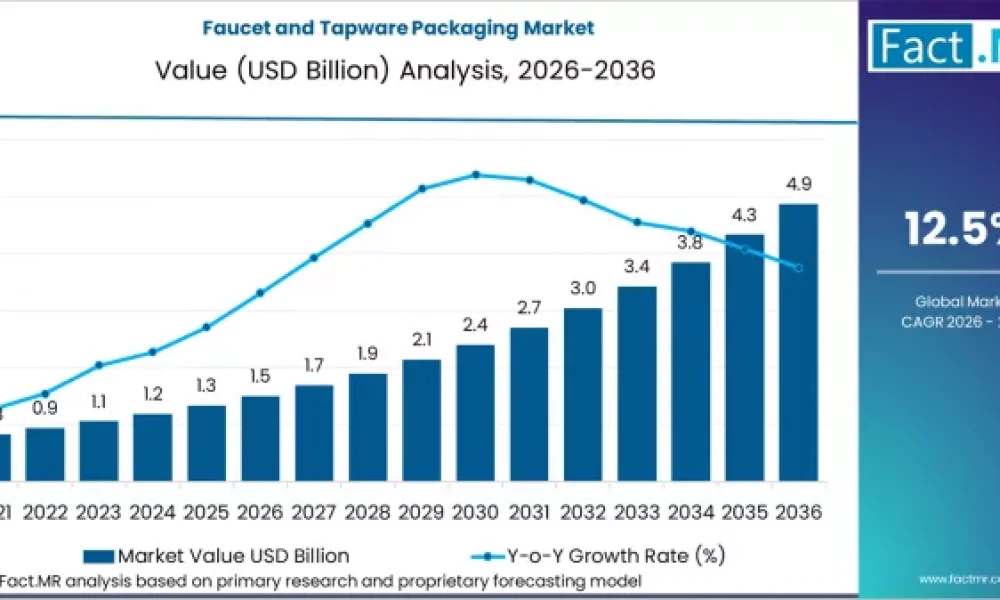
The global faucet and tapware packaging market is entering a transformative growth phase, driven by a surge in residential construction, a heightened focus on luxury home aesthetics, and a critical industry-wide pivot toward sustainable materials. As the broader faucet market is projected to reach a valuation of approximately $50.34 billion by the end of 2026, the demand for specialized, protective, and eco-friendly packaging solutions is scaling in tandem.
This growth reflects a fundamental shift in how plumbing fixtures are handled, shipped, and presented to both commercial contractors and retail consumers. With a projected compound annual growth rate (CAGR) of over 10% through 2030, the packaging sector is evolving from a purely functional logistical requirement into a strategic touchpoint for brand differentiation and environmental compliance.
Request for Sample Report | Customize Report |purchase Full Report – https://www.factmr.com/connectus/sample?flag=S&rep_id=13896
The 5Ws of the Faucet and Tapware Packaging Evolution
Who: Leading packaging manufacturers are collaborating with global tapware giants—including Kohler, Moen, and Jaquar—to develop next-generation housing for high-value fixtures.
What: The market is seeing a transition from traditional plastic-heavy packaging to molded pulp, corrugated fiberboard, and biodegradable inserts designed to protect heavy chrome and matte-finish products.
When: The shift is accelerating throughout 2026, spurred by new international regulations regarding plastic waste and the rapid maturation of the e-commerce sector.
Where: While North America remains a leader in premium packaging innovation, the Asia-Pacific region—specifically China and India—is the fastest-growing market due to massive urbanization projects.
Why: Rising disposable incomes and a trend toward spa-like home renovations are driving the demand for premium, unboxing-ready packaging that ensures products arrive without micro-scratches or structural damage.
Key Market Drivers: Sustainability and the E-commerce Effect
A primary catalyst for the market’s expansion is the sustainability mandate. As consumers increasingly prioritize brands with low environmental footprints, faucet manufacturers are abandoning non-recyclable expanded polystyrene (EPS) in favor of FSC-certified paperboard and water-based coatings. This transition not only aligns with global ESG (Environmental, Social, and Governance) goals but also addresses the logistical need for lighter, more efficient materials that reduce carbon emissions during transit.
Furthermore, the e-commerce effect has fundamentally altered packaging architecture. With online sales of branded faucets growing at nearly 9.12% annually, packaging must now be engineered to withstand the last-mile delivery cycle. Traditional retail packaging, designed for static shelving, is being replaced by Frustration-Free Packaging (FFP) models that prioritize durability and ease of recycling.
Market Segmentation and Technical Insights
The market is categorized by material type, application, and region, with the following highlights:
Material Innovation: Corrugated boxes remain the dominant segment, accounting for over 60% of the market share. However, the use of anti-corrosive VCI (Volatile Corrosion Inhibitor) papers and protective bio-films is rising to protect sensitive finishes like brushed gold and matte black.
Product Specificity: Packaging for touchless and smart faucets—a segment growing at a 9.2% CAGR—requires additional shock-absorbent layers and specialized compartments for electronic sensors and battery packs.
Regional Dominance: The Asia-Pacific region holds a significant revenue share, fueled by government-backed housing schemes and the Smart Cities initiatives in emerging economies.
Strategic Outlook for Investors and Analysts
Industry analysts suggest that the next three years will be defined by automation in packaging lines. As labor costs rise and production volumes increase, faucet manufacturers are investing in automated cartoning and labeling systems to ensure consistency and reduce waste.
The faucet and tapware packaging market is no longer just about protection; it’s about the intersection of engineering and environmental responsibility, notes a lead industry analyst. In 2026, the brands that win will be those that can deliver a heavy brass fixture in a 100% recyclable kit without compromising the premium user experience.
About the Faucet and Tapware Packaging Market Report
This press release is based on current market trends, industrial data, and economic indicators for the 2026 fiscal year. It highlights the critical role of packaging in the global plumbing and sanitary ware supply chain, providing a comprehensive overview for stakeholders, investors, and industry professionals.
Related Reports



