
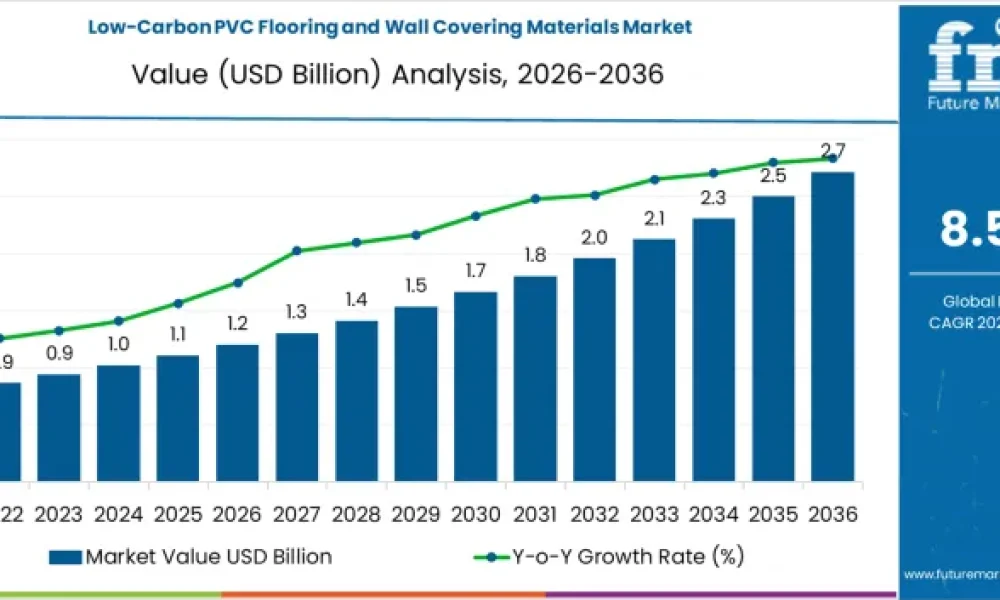
The Global Low-Carbon PVC Flooring and Wall Covering Materials Market is poised for substantial expansion, with market value projected to climb from approximately USD 1.2 billion in 2026 to USD 2.7 billion by 2036, driven by a strong compound annual growth rate of 8.5% over the forecast period. This impressive growth trajectory underscores an accelerating shift among manufacturers, builders, and end-users toward low-carbon, environmentally preferable building materials that align with global sustainability and net-zero goals. Demand is being propelled by stringent environmental regulations, rising green building certifications, and increasing consumer preference for products that minimize carbon intensity without sacrificing quality or performance.
The global push for eco-conscious construction solutions, especially in residential and commercial sectors, is creating fertile ground for low-carbon PVC products that deliver durability, design flexibility, and reduced life-cycle emissions. As sustainability becomes a core differentiator in material selection, industry participants are intensifying efforts to innovate and scale production of low-carbon PVC flooring and wall covering solutions that meet evolving environmental criteria and market expectations.
Key Market Insights at a Glance
The global low-carbon PVC flooring and wall covering materials market value is forecast to more than double over the next decade, from an estimated USD 1.2 billion in 2026 to USD 2.7 billion in 2036, at a notable 8.5% CAGR. Among product categories, flooring materials capture the largest share, accounting for approximately 55% of total applications, reflecting strong preference for sustainable floor solutions across residential, commercial, and institutional segments. Residential construction leads end-use demand, supported by rising green homebuilding practices and consumer awareness of eco-friendly materials.
Segment Overview
The market is categorized by application and end-use sectors, with flooring materials dominating and wall covering materials, baseboards & trim, and specialty architectural elements rounding out the broader offering. The residential construction end-use segment currently commands a significant share, reflecting sustained investment in energy-efficient, low-emission building practices in new home development and renovation projects. Commercial fits follow closely, driven by corporate commitments to sustainability and regulatory compliance in public and private buildings.
Flooring materials maintain dominance due to their broad functional appeal—offering wear resistance, low-maintenance performance, and the ability to emulate natural aesthetics like wood or stone while reducing overall carbon footprint. Low-carbon PVC solutions continue to gain traction as they combine environmental benefits with cost-efficient performance, making them ideal for both high-traffic commercial spaces and contemporary residential interiors.
Regional Overview
Geographically, North America emerges as a key growth region, supported by advanced sustainability frameworks, strong green building adoption, and proactive environmental policy incentives. Markets in Germany, China, Japan, and South Korea are also forecast to experience fast growth, reflecting expanding green infrastructure initiatives and increasing emphasis on sustainable building materials. Across Asia Pacific, urbanization and rising disposable incomes are further stimulating demand for eco-friendly flooring and wall covering products, positioning the region for accelerated adoption.
In mature markets, stringent regulations and consumer demand for certified low-carbon materials are key drivers. Emerging markets benefit from rapid construction activity and rising awareness of environmental impacts, leading to broader adoption of low-carbon PVC solutions across residential and commercial projects.
To access the complete data tables and in-depth insights — Request Your Sample Report Now
Competitive Landscape
The competitive landscape is dynamic and increasingly focused on sustainability innovation. Leading players in the sustainable flooring and wall covering space include major industry names such as Tarkett, Shaw Industries, Mohawk Industries, Armstrong Flooring, Gerflor, Forbo Flooring, LG Hausys, Polyflor, Beaulieu International Group, and Mannington Mills. These companies are investing heavily in product development that lowers carbon footprints, enhances performance, and delivers environmentally responsible solutions at scale. Their strategies include improving manufacturing efficiencies, expanding product portfolios with certified low-carbon formulations, and aligning with global green building standards.
To stay ahead in this competitive environment, market participants are prioritizing material innovations that offer both sustainability credentials and commercial viability. This includes leveraging recycled content, low-VOC plasticizers, and novel production methods that lower emissions while maintaining product quality and durability.
Market Outlook: Powering the Next Decade
Looking forward, the market is expected to transition from early adoption to broad mainstream integration of low-carbon PVC materials. Optimization of production technologies will play a central role in reducing costs and enhancing material performance, further supporting growth. Continued advancement in green building programs, along with increased transparency through environmental product declarations and life-cycle assessments, will bolster confidence among architects, builders, and specifiers.
Furthermore, as climate goals and net-zero targets gain prominence, low-carbon PVC flooring and wall coverings are set to become integral components of sustainable design strategies around the world. The convergence of regulatory pressure, technological progress, and consumer demand places the market on a strong growth trajectory, aligning economic opportunity with environmental stewardship.
Recent Strategic Developments
To capture the expanding opportunity, key players are accelerating investments in sustainable manufacturing, expanding low-carbon product lines, and forming strategic partnerships to meet rising demand. Global brands are enhancing their environmental credentials and committing to circular economy principles, positioning themselves as leaders in the shift toward greener, healthier built environments.
Have a specific Requirements and Need Assistant on Report Pricing or Limited Budget please contact us – [email protected]
About Future Market Insights (FMI)
Future Market Insights, Inc. (FMI) is an ESOMAR-certified, ISO 9001:2015 market research and consulting organization, trusted by Fortune 500 clients and global enterprises. With operations in the U.S., UK, India, and Dubai, FMI provides data-backed insights and strategic intelligence across 30+ industries and 1200 markets worldwide.
Why Choose FMI: https://www.futuremarketinsights.com/why-fmi



