
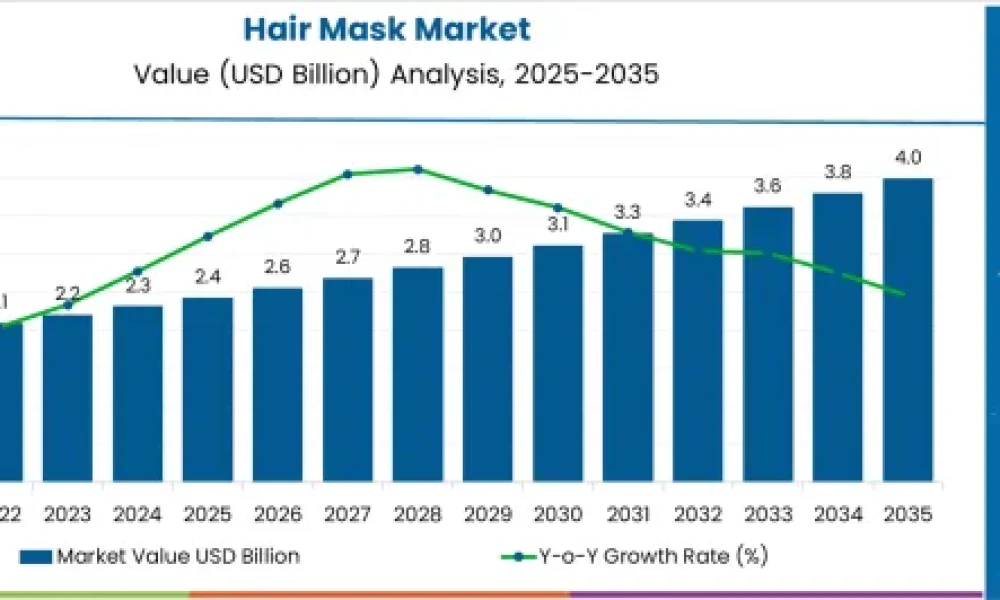
The global hair mask market is forecast to grow from an estimated USD 2.4 billion in 2025 to USD 4.0 billion by 2035, registering a compound annual growth rate (CAGR) of 5.1% over the forecast period. The expansion reflects rising consumer demand for intensive hair treatment solutions, growing awareness of hair health, and increasing regulatory oversight shaping product formulation and market access across major regions.
According to the latest market outlook, growth is being supported by shifts toward natural and botanical ingredients, wider adoption of at-home hair care routines, and continued innovation in formulation and packaging. Regulatory alignment is also emerging as a central strategic priority for manufacturers seeking to sustain long-term growth and maintain market legitimacy.
To access full datasets and expert analysis — Request A Sample Report Today
Regulatory Frameworks Reshape Product Development and Market Access
- Regulatory requirements are playing an increasingly critical role in the hair mask industry, influencing ingredient selection, labeling standards, and production timelines. In Asia-Pacific, authorities are enforcing stricter limits on chemical usage, preservatives, and heavy metals in hair care formulations. Europe continues to uphold the EU Cosmetics Regulation, requiring standardized ingredient lists, rigorous safety assessments, and transparent labeling.
- In North America, U.S. Food and Drug Administration (FDA) cosmetic regulations and state-level initiatives such as California’s Proposition 65 mandate disclosure of potential carcinogens and reproductive toxins, affecting both formulation strategies and consumer communication. These requirements are accelerating the shift toward paraben-free, sulfate-free, and naturally derived ingredients.
- Testing protocols and certification standards, including cruelty-free and hypoallergenic labels, are also shaping manufacturing processes and supply chain compliance. Collectively, regulatory adherence is reinforcing consumer trust, strengthening market legitimacy, and driving innovation across the hair mask segment.
Market Size, Growth Outlook, and Segment Leadership
The hair mask market is projected to expand steadily at a CAGR of 5.1% from 2025 to 2035. Steam-free masks are expected to dominate by type, accounting for 55.2% of market revenue in 2025. Their leadership is attributed to convenience, compatibility with various hair types, and suitability for at-home use without specialized equipment.
By nature, the natural segment is forecast to hold 41.6% of revenue share in 2025, supported by growing demand for ingredient transparency and chemical-free formulations. In terms of pricing, the medium price range segment is anticipated to lead with 48.9% of market revenue, reflecting consumer preference for products that balance affordability with visible performance.
Why the Hair Mask Market Is Growing
Growth in the hair mask market is being driven by rising consumer focus on moisture restoration, damage repair, and scalp health. Industry announcements indicate that targeted formulations addressing frizz, hair fall, and heat damage are gaining traction. Increasing disposable incomes, particularly in emerging markets, are expanding access to premium and specialized hair care products.
The transition toward clean and sustainable ingredients, including sulfate-free, paraben-free, and cruelty-free formulations, is reinforcing demand. E-commerce platforms and salon partnerships are also extending market reach, while evolving preferences for customized and natural hair care regimens continue to support expansion.
Product Innovation and Distribution Expansion
Innovations in encapsulated nutrients, time-release technologies, and lightweight conditioning agents are improving product efficacy without residue buildup. New formats, including overnight masks, leave-in variants, and sheet masks, are enhancing convenience for consumers. Packaging innovations such as airless pumps and recyclable containers are extending product shelf life and supporting sustainability goals.
Distribution is being reshaped by e-commerce growth and omnichannel strategies. Online platforms are enabling access to international brands, reviews, and subscription models, while supermarkets, specialty beauty stores, and professional salons are strengthening physical retail presence. Social media marketing, influencer campaigns, and digital tutorials are further increasing product visibility and adoption.
Regional Growth and Country-Level Insights
- Asia-Pacific is emerging as a key growth region, supported by rising beauty consciousness and expanding retail infrastructure. China is projected to grow at a CAGR of 6.9% from 2025 to 2035, driven by urban consumer demand, premium product adoption, and expanding e-commerce platforms. Domestic brands account for 60% of hair mask sales, and online hair care sales grew by 18% in 2025.
- India is forecast to record a CAGR of 6.4%, supported by growing demand for herbal and premium hair masks. Herbal products represented nearly 35% of sales in 2025, while more than 70 million consumers purchased hair care products online.
- Germany is expected to grow at 5.9% CAGR, driven by demand for certified organic and cruelty-free formulations. Organic hair masks contributed 25% of revenue in 2025, and e-commerce sales rose by 15% year on year.
- The United Kingdom is projected to expand at 4.8% CAGR, supported by premium and DIY treatment trends, while the United States is expected to grow at 4.3%, driven by natural and vegan formulations and rising professional salon partnerships.
Competitive Landscape and Market Structure
The hair mask market is defined by a mix of global beauty conglomerates and specialized hair care brands. L’Oréal Paris leads through extensive distribution and consistent product launches. Unilever and Procter & Gamble maintain significant market presence through multi-brand strategies combining mass-market and premium offerings.
Premium and professional-focused brands such as Aveda, OLAPLEX, Wella, and Shiseido are gaining traction through salon partnerships and high-performance formulations. Henkel and Kao are reinforcing market share through ingredient innovation and targeted solutions, while niche players including Arvazallia, EVA NYC, Leonor Greyl, and Mielle are focusing on specialty and vegan-friendly products.
Outlook Through 2035
With sustained regulatory alignment, continued product innovation, and expanding digital distribution, the global hair mask market is positioned for steady growth through 2035. Rising emphasis on natural ingredients, preventive hair care, and personalized treatment solutions is expected to further strengthen demand across both mature and emerging markets.
Have a specific Requirements and Need Assistant on Report Pricing or Limited Budget please contact us – [email protected]
About Future Market Insights (FMI)
Future Market Insights, Inc. (FMI) is an ESOMAR-certified, ISO 9001:2015 market research and consulting organization, trusted by Fortune 500 clients and global enterprises. With operations in the U.S., UK, India, and Dubai, FMI provides data-backed insights and strategic intelligence across 30+ industries and 1200 markets worldwide
Why Choose FMI: https://www.futuremarketinsights.com/why-fmi



