
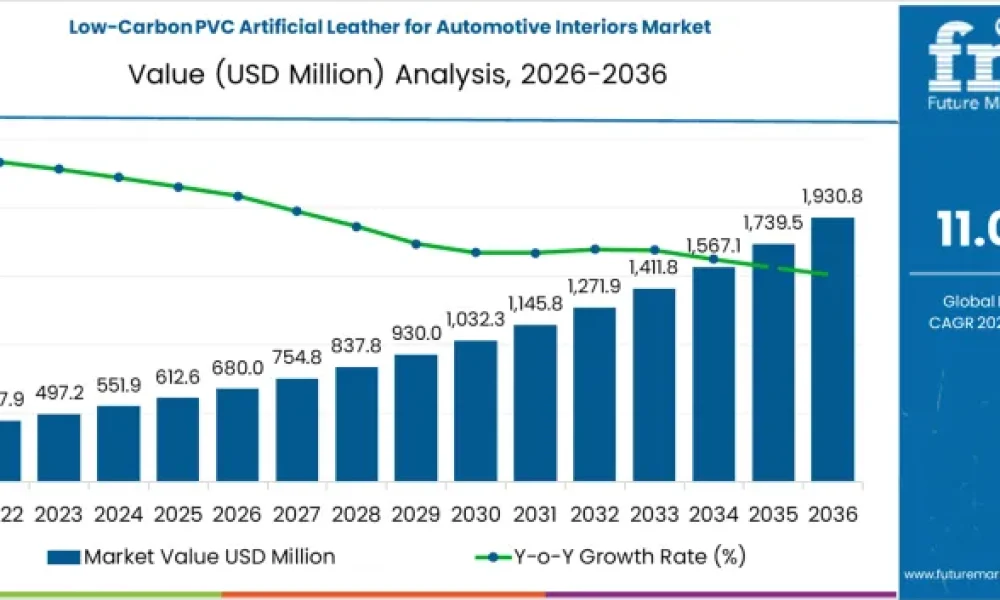
The global Low-Carbon PVC Artificial Leather for Automotive Interiors Market is projected to grow from an estimated USD 680 million in 2026 to USD 1.93 billion by 2036, representing a robust 11% compound annual growth rate (CAGR) over the decade as automotive OEMs and suppliers increasingly adopt sustainable interior materials to meet regulatory and consumer demands for reduced carbon footprints. This compelling growth trajectory showcases the accelerating shift toward eco-friendly interior materials that deliver durability, aesthetic appeal, and environmental compliance within the passenger vehicle segment.
Key Market Insights at a Glance
Automotive manufacturers are prioritizing low-carbon PVC artificial leather to replace traditional materials, driven by tightening emissions regulations globally and a surge in EV production where lifecycle sustainability is a competitive differentiator. Passenger car interiors, especially seat covers and upholstery, remain the largest application category due to aesthetic preferences and performance requirements. OEM adoption continues to outpace aftermarket demand, underlining the strategic integration of low-carbon PVC solutions into new vehicle production lines rather than retrofit markets.
In terms of segmentation, seat covers & upholstery command the largest share, capturing more than half of total global uptake due to their high visibility and wear-resistance demands. End-use analysis shows OEM automotive production contributing nearly 68% of market value, reflecting strong commitments by original manufacturers to mainstream low-carbon interior materials. PVC types are diversified across bio-attributed or certified mass balance options, recycled content variants, and low-VOC or low-carbon formulations, enabling flexibility for different sustainability strategies and performance specifications.
Segment Overview
The market’s segmentation by application reveals that seat covers and upholstery dominate, supported by consumer preference for sustainable interiors that do not compromise comfort or performance. Other applications such as door panels, armrests, and headliners are gaining traction as automakers emphasize integrated eco-designs throughout the cabin. End-use by OEM production highlights the strategic focus on embedding low-carbon PVC from the point of vehicle assembly, whereas aftermarket and specialty custom interiors represent niche growth pockets where personalization and retrofitting are key drivers.
PVC type segmentation shows a clear trend toward bio-attributed and recycled content materials, as brands seek to balance environmental claims with a functional product. Low-VOC and certified mass balance approaches are becoming industry standards, offering measurable carbon reduction without sacrificing the durability and finish expected by mainstream vehicle buyers.
To access the complete data tables and in-depth insights — Request Your Sample Report Now
Regional Overview
North America and Europe are poised to lead market expansion, supported by stringent emissions regulations and strong consumer preference for sustainable products. The United States exhibits high adoption rates driven by regulatory pressures and increasing environmental consciousness among buyers. Germany and other Western European markets have substantial growth due to a mature automotive industry and early implementation of life cycle assessment frameworks. In Asia Pacific, China, Japan, and South Korea are registering steady gains as automotive manufacturers in those regions align sustainability with rapid vehicle production growth. Each geography reveals a unique blend of regulatory incentives and market readiness for low-carbon materials, offering a diversified growth landscape for suppliers and OEMs alike.
Competitive Landscape
The competitive landscape features both established chemical and material innovators and emerging sustainability-focused suppliers. Leading players are aggressively investing in research and development to refine performance attributes while lowering carbon intensity. Product innovation, quality consistency, and traceability of supply chains are differentiating factors as OEMs tighten specifications for interior materials. Companies are collaborating with automotive brands on co-development programs to ensure materials meet exacting standards for texture, wear resistance, and environmental certifications.
Market Outlook: Powering the Next Decade
Looking forward, the market is expected to transition from rapid adoption to a more stable but sustained growth phase as low-carbon PVC becomes an industry norm rather than a differentiator. Continued innovation in formulations that combine recycled content with low VOC emissions will be central to maintaining momentum. Lifecycle carbon accounting and expanded certification initiatives will further embed sustainability into procurement decisions, particularly for electric and hybrid vehicle portfolios where material emissions carry heightened scrutiny.
Key Players of Sustainable Label Industry
Key stakeholders shaping the market’s direction are those that harmonize performance with sustainability. This includes established chemical manufacturers and PVC material specialists who are scaling low-carbon production capabilities. Their focus on comprehensive sustainability credentials and lifecycle transparency positions them as preferred partners for automotive OEMs undertaking large-scale transitions to eco-friendly interiors.
Recent Strategic Developments
Recent industry developments highlight strategic moves such as partnerships between materials suppliers and vehicle manufacturers to co-innovate next-generation low-carbon solutions. Investment in certification capabilities, expansion of recycled content offerings, and pilot programs in new EV platforms demonstrate the market’s evolution toward actionable sustainability. These trends underline a broader momentum where environmental stewardship intersects with commercial opportunity, shaping a resilient future for low-carbon PVC artificial leather in automotive interiors.
Have a specific Requirements and Need Assistant on Report Pricing or Limited Budget please contact us – [email protected]
About Future Market Insights (FMI)
Future Market Insights, Inc. (FMI) is an ESOMAR-certified, ISO 9001:2015 market research and consulting organization, trusted by Fortune 500 clients and global enterprises. With operations in the U.S., UK, India, and Dubai, FMI provides data-backed insights and strategic intelligence across 30+ industries and 1200 markets worldwide.
Why Choose FMI: https://www.futuremarketinsights.com/why-fmi



