
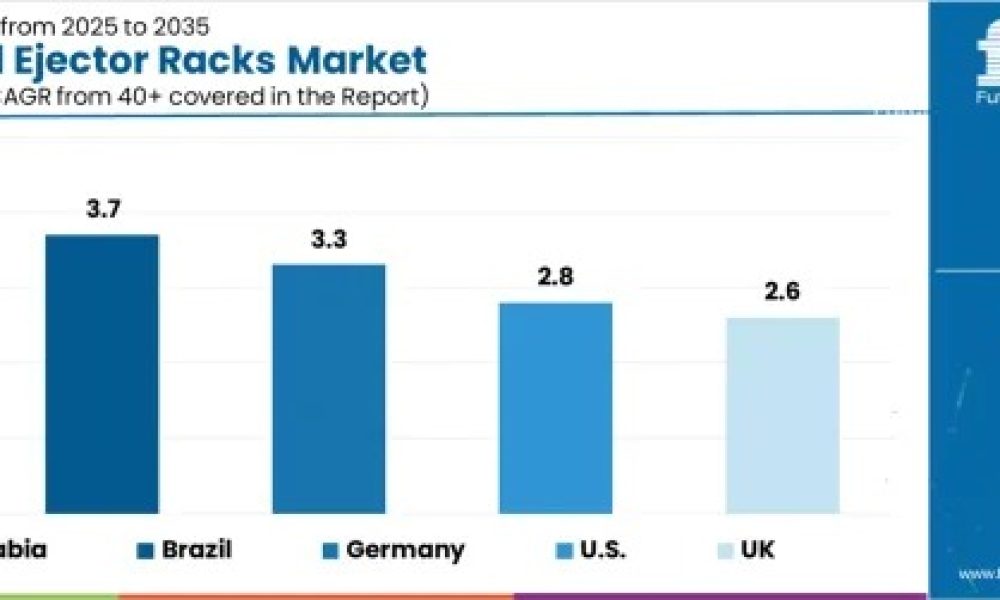
The global air-to-ground ejector racks market is projected to grow from USD 644.3 million in 2025 to approximately USD 874.3 million by 2035, representing an absolute value increase of USD 230.2 million over the forecast period. This expansion reflects a total market growth of 35.7%, translating into a compound annual growth rate (CAGR) of 3.1% between 2025 and 2035. Over the decade, the market is expected to expand by nearly 1.36×, underpinned by rising adoption of advanced munition systems and sustained demand for specialized ejector rack solutions across global military aviation platforms.
Air-to-ground ejector racks remain mission-critical subsystems within combat aircraft, enabling safe, precise, and reliable carriage and release of munitions. As air forces worldwide modernize fleets and adopt increasingly complex weapon systems, ejector racks are evolving from standardized mechanical components into highly engineered, platform-specific integration systems central to mission effectiveness and operational flexibility.
Growth Trajectory Anchored in Aircraft Modernization Programs
Between 2025 and 2030, the air-to-ground ejector racks market is expected to expand from USD 644.3 million to USD 750.6 million, generating USD 106.3 million in incremental value, accounting for 46.2% of total forecast growth. This phase is primarily driven by ongoing military aircraft modernization initiatives, increased defense spending focused on precision strike capabilities, and upgrades to legacy fighter platforms. Defense contractors are scaling ejector rack capabilities to accommodate evolving munition integration requirements and enhanced interoperability standards.
From 2030 to 2035, market value is forecast to rise further to USD 874.3 million, adding USD 123.9 million, or 53.8% of total ten-year growth. This latter phase will be shaped by the expansion of next-generation fighter aircraft programs, growing adoption of smart and network-enabled munitions, and the increasing standardization of ejector rack interfaces across aircraft manufacturers. The integration of unmanned combat aerial vehicles (UCAVs) and advanced multi-role fighters is expected to accelerate demand for more sophisticated, lightweight, and modular ejector rack solutions.
Get access to comprehensive data tables and detailed market insights — request your sample report today!
https://www.futuremarketinsights.com/reports/sample/rep-gb-25457
Fighter and Strike Aircraft Dominate Demand
By aircraft platform, fighter and strike aircraft account for 60% of global market share in 2025, reinforcing their position as the primary demand drivers. Multi-role fighters such as the F-35, F-16, Rafale, Su-30, and comparable platforms require advanced ejector rack systems capable of supporting diverse air-to-ground payloads, including guided bombs, missiles, and precision-guided munitions. The increasing complexity of mission profiles and frequent weapon system upgrades necessitate ejector racks with higher compatibility, reliability, and certification rigor.
As nations prioritize versatile strike capabilities and rapid mission reconfiguration, the fighter/strike segment is expected to remain the cornerstone of ejector rack procurement throughout the forecast period.
Regional Demand Concentrated in North America and Emerging Defense Markets
From a regional perspective, North America represents 35% of global market demand in 2025, supported by extensive fighter fleets, sustained defense budgets, and large-scale modernization programs. Platforms such as the F-35 Joint Strike Fighter, F-15EX, and upgraded legacy aircraft continue to drive consistent replacement and retrofit cycles. The region also benefits from the presence of major defense contractors specializing in weapon release and integration technologies.
Beyond North America, growth momentum is strengthening across Europe and Asia-Pacific, supported by NATO interoperability requirements, indigenous fighter programs, and expanding defense aviation capabilities. Emerging defense markets are increasingly investing in advanced ejector rack systems to support both imported and domestically produced aircraft.
MER/TER and Pyrotechnic Systems Retain Operational Importance
By munition interface, Multiple Ejector Rack (MER) and Triple Ejector Rack (TER) systems account for 35% of market share, reflecting their enduring role in multi-mission operations. These systems enable aircraft to carry multiple munitions on a single hardpoint, enhancing payload flexibility and mission endurance. Their compatibility with both modern and legacy aircraft ensures continued relevance across diverse operational environments.
By actuation type, pyrotechnic ejector racks dominate with a 40% market share in 2025. Their ability to deliver instantaneous, reliable weapon separation under high-speed and low-altitude conditions makes them indispensable for mission-critical applications. Despite emerging alternatives such as pneumatic and hydraulic systems, pyrotechnic solutions remain widely preferred due to proven reliability, operational simplicity, and established qualification frameworks.
Smart Munition Integration and Modular Design Shape Market Evolution
The increasing deployment of precision-guided and smart munitions is reshaping ejector rack development priorities. Modern systems now incorporate advanced electronic interfaces, enabling weapon programming, real-time communication, and mission data recording. These capabilities enhance operational effectiveness while aligning with evolving digital battlefield requirements.
At the same time, defense contractors are advancing modular and multi-platform compatible ejector rack designs, reducing logistical complexity and supporting rapid mission reconfiguration. Standardized interfaces and cross-platform compatibility are becoming key differentiators as air forces seek greater flexibility across mixed aircraft fleets.
Drive Your Business Growth Strategy: Checkout the Report for Key Insights
https://www.futuremarketinsights.com/checkout/25457
Competitive Landscape Defined by Engineering Depth and Integration Capability
The air-to-ground ejector racks market is characterized by competition among established defense primes and specialized weapon system integrators. Companies such as BAE Systems, Boeing Defense, Lockheed Martin, Elbit Systems, MBDA, Mitsubishi Heavy Industries, Rafael Advanced Defense Systems, Raytheon (RTX), Saab AB, and HAL are investing heavily in advanced manufacturing, modular architectures, and comprehensive testing infrastructure.
Strategic partnerships, technology transfer agreements, and alignment with national defense modernization goals are central to strengthening market positions. Differentiation increasingly depends on the ability to deliver certified, interoperable, and future-ready ejector rack solutions that support evolving aircraft and munition ecosystems.
Outlook
While growth in the air-to-ground ejector racks market is steady rather than explosive, its strategic importance continues to intensify. As military aviation shifts toward multi-role platforms, smart weapons, and unmanned systems, ejector racks are becoming critical enablers of air-to-ground combat capability. Stakeholders positioned at the intersection of advanced engineering, standardization, and integration are expected to capture disproportionate value as global defense aviation evolves through 2035.
Why Choose FMI: Empowering Decisions that Drive Real-World Outcomes: https://www.futuremarketinsights.com/why-fmi
About Future Market Insights (FMI)
Future Market Insights, Inc. (FMI) is an ESOMAR-certified, ISO 9001:2015 market research and consulting organization, trusted by Fortune 500 clients and global enterprises. With operations in the U.S., UK, India, and Dubai, FMI provides data-backed insights and strategic intelligence across 30+ industries and 1200 markets worldwide.



