
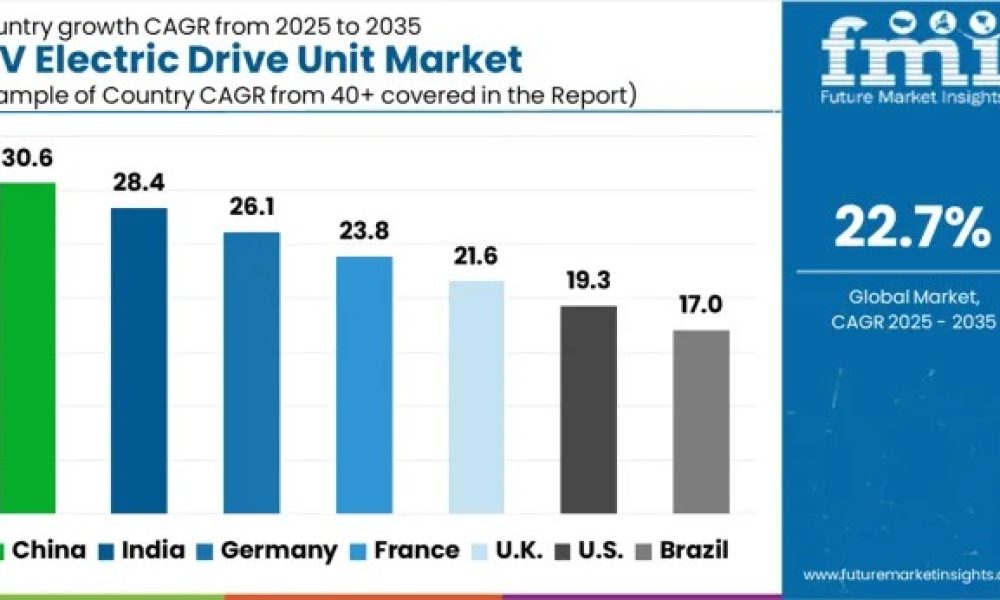
The global battery electric vehicle (BEV) electric drive unit market is entering a high-growth phase as electrification accelerates across automotive and transportation ecosystems worldwide. Valued at USD 13.1 billion in 2025, the market is forecast to surge to USD 101.3 billion by 2035, expanding at a robust compound annual growth rate (CAGR) of 22.7% over the forecast period. This exceptional growth reflects a structural shift in powertrain architecture, driven by regulatory mandates, technological innovation, and rapidly evolving consumer preferences toward zero-emission mobility.
Inflection point analysis highlights how market momentum is shaped by discrete phases of adoption. Between 2025 and 2027, the market grows from USD 13.1 billion to USD 16.1 billion, supported by early adoption of high-efficiency electric powertrains and the increasing integration of compact electric drive units combining motor, inverter, and transmission. During this phase, government incentives, tightening emission norms, and continuous improvements in motor efficiency and vehicle range act as primary catalysts, encouraging automakers to accelerate BEV platform rollouts.
From 2028 to 2031, the market enters a steeper growth curve, expanding from USD 19.7 billion to USD 29.7 billion. This period represents a critical inflection point, as stricter global emission regulations and heightened consumer demand for sustainable mobility compel manufacturers to scale BEV production aggressively. Integrated electric drive systems gain traction as standard configurations, with features such as regenerative braking, advanced thermal management, and enhanced battery integration becoming mainstream across passenger and commercial vehicle segments.
The most pronounced acceleration occurs between 2032 and 2035, when the market is projected to reach USD 101.3 billion. Growth during this phase is driven by the global electrification of transportation, expanding penetration of BEVs in emerging markets, rapid deployment of EV charging infrastructure, and convergence with autonomous vehicle technologies. These factors collectively reinforce electric drive units as the core enabler of next-generation mobility architectures.
Get access to comprehensive data tables and detailed market insights — request your sample report today!
https://www.futuremarketinsights.com/reports/sample/rep-gb-25633
Strong Demand Anchored in Core Parent Markets
The BEV electric drive unit market is shaped by demand from five interconnected parent industries. The automotive sector dominates with a 40% share, reflecting the rapid replacement of internal combustion engine powertrains with electric alternatives across passenger and commercial vehicles. The transportation sector contributes 25%, driven by electrification of buses, trucks, and public transit fleets. Renewable energy applications account for 15%, as electric drive systems are increasingly deployed in sustainable energy and electric-powered industrial equipment.
The industrial equipment and logistics and warehousing sectors, each contributing 10%, represent diversified growth avenues, supported by rising adoption of electric forklifts, automated guided vehicles (AGVs), and factory automation solutions. Collectively, automotive, transportation, and renewable energy applications account for nearly 80% of total demand, underscoring the central role of electric mobility and clean energy transitions in shaping long-term market growth.
Technology Integration and Regulatory Alignment Drive Momentum
Market expansion is fundamentally underpinned by the global transition toward vehicle electrification. Governments across major economies are enforcing stricter emission regulations while offering subsidies, tax incentives, and infrastructure investments to accelerate BEV adoption. Electric drive units, which integrate motor, power electronics, and transmission into a single compact module, are increasingly favored for their efficiency, reduced system complexity, and improved vehicle performance.
Technological advancements in lightweight materials, thermal management systems, and modular architectures are enabling higher power densities and scalability across vehicle classes. These innovations support both premium and mass-market BEVs, while allowing manufacturers to standardize platforms and reduce overall production costs. As automakers optimize for higher energy efficiency and modular drivetrain solutions, electric drive units are becoming a strategic focal point of powertrain design.
OEM Channel and Water Glycol Cooling Lead Market Structure
By sales channel, the OEM segment is projected to account for 58.2% of market revenue in 2025, reflecting the direct integration of electric drive units during vehicle assembly. Automakers are prioritizing in-house electrification strategies and closer collaboration with Tier-1 suppliers to ensure precise alignment between drivetrain performance and vehicle architecture. This trend toward vertical integration strengthens OEM control over design, scalability, and long-term cost structures.
From a thermal management perspective, water glycol coolant systems are expected to hold 63.5% of market revenue by 2025. Their strong thermal conductivity, corrosion resistance, and cost efficiency make them the preferred solution as power densities rise in compact drive units. Established usage across EV platforms and compatibility with aluminum and copper components reinforce water glycol’s leadership in maintaining reliability and performance under varied operating conditions.
Regional Dynamics Highlight Asia’s Leadership
Geographically, Asia-Pacific emerges as the fastest-growing region, led by China with a projected CAGR of 30.6% through 2035. Aggressive government policies, domestic manufacturing scale, and rapid charging infrastructure expansion position China at the forefront of electric drive unit adoption. India follows with a CAGR of 28.4%, driven by government incentives, urban electrification initiatives, and growth in electric two-wheelers and compact EVs.
In Europe, Germany’s 26.1% CAGR reflects strong automotive innovation, regulatory pressure, and demand for high-performance electric vehicles, while the UK (21.6%) benefits from policies phasing out internal combustion vehicles and expanding public transport electrification. The United States, with a 19.3% CAGR, continues to scale EV production supported by federal and state incentives, domestic manufacturing investments, and nationwide charging infrastructure expansion.
Drive Your Business Growth Strategy: Checkout the Report for Key Insights
https://www.futuremarketinsights.com/checkout/25633
Competitive Landscape Defined by Integration and Scale
The BEV electric drive unit market is highly competitive, characterized by rapid innovation and strong participation from global automakers and Tier-1 suppliers. Companies such as Bosch, Magna International, ZF Friedrichshafen, BorgWarner, Nidec, and LG Magna e-Powertrain leverage vertically integrated production, advanced R&D capabilities, and long-standing OEM partnerships. Competition increasingly centers on efficiency, compact design, thermal performance, software integration, and ease of platform integration.
Emerging suppliers, particularly in Asia, are intensifying competition through cost-competitive solutions and high-volume manufacturing. Strategic collaborations, joint ventures, and investments in inverter, motor, and battery integration are reshaping the competitive landscape, while economies of scale and modular designs remain critical to sustaining margins.
Market Outlook
As electrification reshapes global transportation, the BEV electric drive unit market stands at the core of this transformation. With strong regulatory backing, accelerating technology adoption, and expanding infrastructure, the market is positioned for sustained, high-velocity growth. These dynamics make electric drive units a critical focus area for stakeholders seeking to understand long-term value creation across the evolving electric mobility ecosystem.
Why Choose FMI: Empowering Decisions that Drive Real-World Outcomes: https://www.futuremarketinsights.com/why-fmi
About Future Market Insights (FMI)
Future Market Insights, Inc. (FMI) is an ESOMAR-certified, ISO 9001:2015 market research and consulting organization, trusted by Fortune 500 clients and global enterprises. With operations in the U.S., UK, India, and Dubai, FMI provides data-backed insights and strategic intelligence across 30+ industries and 1200 markets worldwide.



