
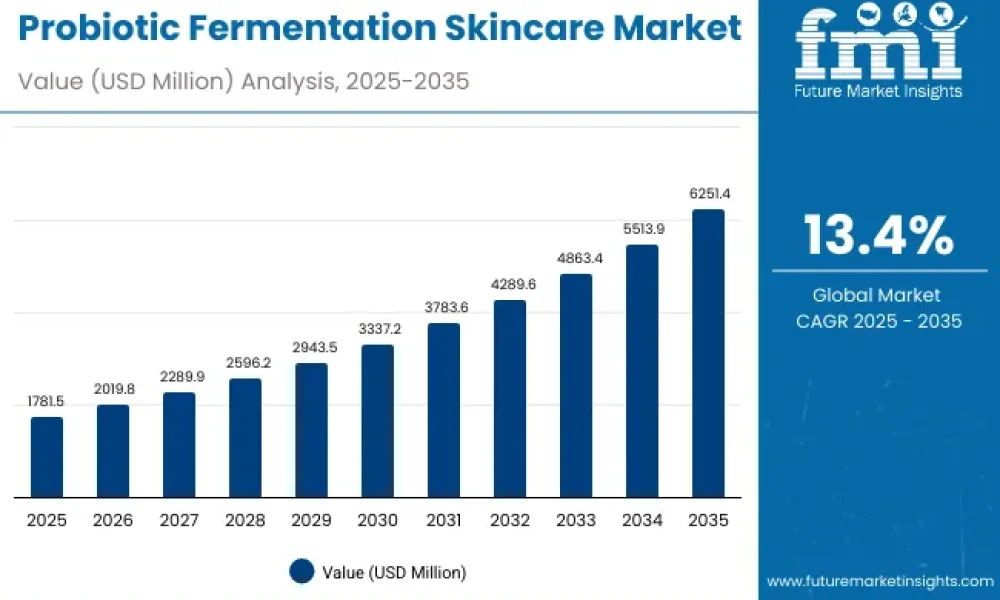
The global probiotic fermentation skincare market is entering a decade of accelerated expansion, with total market value projected to rise from USD 1,781.5 million in 2025 to USD 6,251.4 million by 2035. This growth represents an increase of more than USD 4.46 billion and a compound annual growth rate (CAGR) of 13.4%, resulting in a 3.5-fold expansion over ten years.
The market’s trajectory is being shaped by rising consumer awareness of skin microbiome health, advances in fermentation technology, and the rapid expansion of e-commerce and subscription-based skincare models. Demand is also being supported by growing dermatology endorsements and the integration of probiotics into mainstream anti-aging, hydration, and barrier-repair formulations.
Gain access to detailed segment-wise analysis and forecast statistics – Request the Sample Report Today
Market Context: From Niche Innovation to Mainstream Skincare Category
Between 2020 and 2024, the global probiotic fermentation skincare market expanded from USD 1,020 million to USD 1,640 million, driven by function-centric adoption and early interest in microbiome-supportive serums and creams. During this period, multinational beauty companies and established skincare specialists controlled nearly 80% of total revenue, with L’Oréal, TULA Skincare, and Amorepacific among the most visible players.
By 2025, total market value is estimated at USD 1,781.5 million, with microbiome balance emerging as the leading functional category, accounting for 43.2% of global revenue. Serums represent the dominant product format at 38.5% share, while e-commerce is the largest distribution channel, contributing 36.9% of total market value.
Growth Outlook: Two-Phase Expansion Through 2035
From 2025 to 2030, the market is expected to grow from USD 1,781.5 million to USD 3,337.2 million, adding USD 1,555.7 million in new revenue. This first phase accounts for nearly 35% of total decade growth and is being driven by steady adoption of microbiome-balancing formulations, hydration creams, and clean-label probiotic serums.
The second phase, from 2030 to 2035, is forecast to contribute USD 2,914.2 million—approximately 65% of total growth—as the market accelerates toward USD 6,251.4 million. This period is expected to be shaped by the widespread deployment of clinical-grade probiotics, hybrid probiotic-botanical actives, and AI-based customization across direct-to-consumer platforms. By the end of the decade, serums and creams together are projected to account for more than 60% of total product demand, while digital channels are expected to exceed 40% of total market value.
Why the Market Is Growing
The expansion of probiotic fermentation skincare is being driven by measurable advances in strain stability, encapsulation technologies, and fermentation methods that improve probiotic efficacy and shelf life. These developments have made it possible to deliver live and postbiotic cultures across a wider range of skincare formats, including serums, creams, cleansers, and masks.
Consumer interest in microbiome balance is also rising due to its relevance to barrier repair, acne management, and sensitivity reduction. The fermentation process enhances bioavailability and supports real-time efficacy, making products more appealing for hydration, soothing, and anti-aging needs. At the same time, e-commerce subscriptions, influencer-led education, and dermatology collaborations are strengthening market credibility and accelerating adoption.
Segment Insights: Functions, Formats, and Channels
- Microbiome balance is projected to retain its position as the dominant functional category, generating 43.2% of global revenue in 2025. This segment’s growth is supported by clinical validation and rising demand for formulations targeting acne-prone and sensitive skin.
- Serums lead product demand with a 38.5% share, reflecting consumer preference for lightweight, high-efficacy formats compatible with multi-step skincare routines. Advances in fermentation and encapsulation are improving probiotic stability and potency, reinforcing serum dominance.
- E-commerce is the leading channel with a 36.9% market share in 2025, driven by subscription models, influencer-driven launches, and AI-based skin diagnostics. Its role is expanding rapidly in North America, East Asia, and Europe.
Regional and Country-Level Growth Patterns
- East Asia, South Asia & Pacific, and North America are the key growth regions. India and China are the fastest-growing national markets, with projected CAGRs of 18.1% and 16.1%, respectively, between 2025 and 2035. Growth in these countries is being fueled by expanding middle-class populations, advanced e-commerce ecosystems, and strong adoption of fermentation-based serums and creams.
- The United States market is valued at USD 308.7 million in 2025 and is forecast to grow at a CAGR of 6.7% to reach USD 962.8 million by 2035. Demand is being led by premium microbiome-focused serums and creams recommended by dermatology clinics and sold through pharmacies, specialty beauty stores, and digital platforms.
Competitive Landscape and Industry Developments
The market is moderately fragmented. Multinational brands such as L’Oréal, Amorepacific, and Clinique are integrating probiotics into established product lines, while indie specialists including TULA Skincare, Gallinée, and Aurelia Probiotic Skincare are expanding through clean-label and vegan positioning.
Notable developments include the March 2024 launch of TULA Skincare’s Pro+ Collagen Probiotic Serum in the United States and L’Oréal’s September 2024 expansion of probiotic-enriched Lancôme sheet masks in China.
As competitive differentiation shifts from branding toward ecosystem strength, companies combining clinical credibility, digital personalization, and subscription-based revenue models are expected to secure long-term growth in the global probiotic fermentation skincare market.
Have a specific Requirements and Need Assistant on Report Pricing or Limited Budget please contact us – [email protected]
About Future Market Insights (FMI)
Future Market Insights, Inc. (FMI) is an ESOMAR-certified, ISO 9001:2015 market research and consulting organization, trusted by Fortune 500 clients and global enterprises. With operations in the U.S., UK, India, and Dubai, FMI provides data-backed insights and strategic intelligence across 30+ industries and 1200 markets worldwide
Why Choose FMI: https://www.futuremarketinsights.com/why-fmi



