
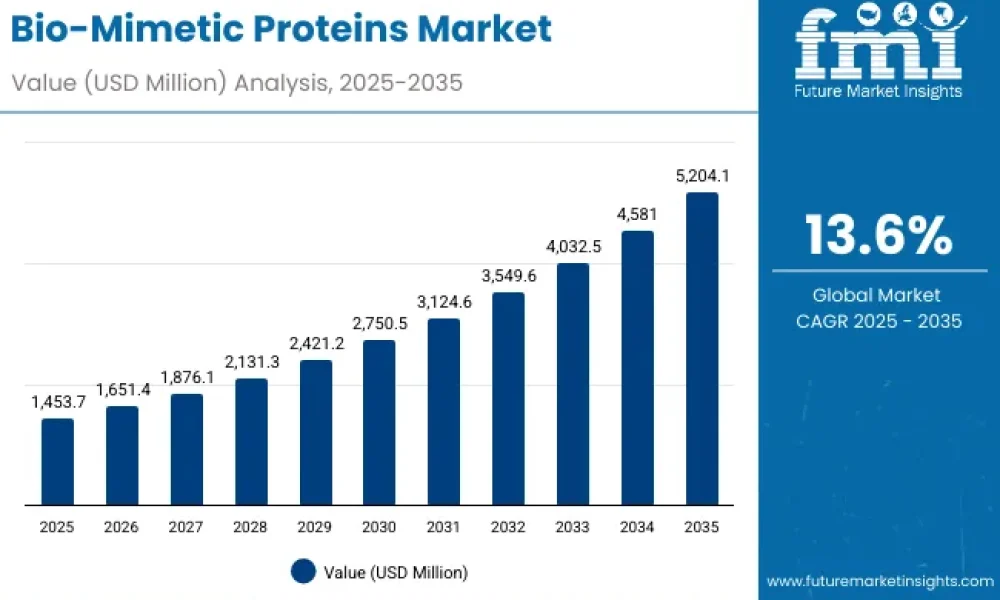
The global bio-mimetic proteins market is entering a decade of accelerated expansion, with revenues projected to rise from USD 1,453.7 million in 2025 to USD 5,204.1 million by 2035, according to the latest industry analysis. This growth trajectory represents a more than 2.5-fold increase and reflects a compound annual growth rate (CAGR) of 13.6% over the forecast period.
The market’s rapid scaling is being driven by advances in peptide engineering, recombinant protein technologies, and rising consumer demand for clinically validated, collagen-boosting skincare and nutricosmetic formulations. Asia-Pacific, North America, and Europe are identified as the leading growth regions, with Asia-Pacific expected to outpace others in adoption and revenue contribution.
To access full datasets and expert analysis — Request A Complimentary Sample Report Today
Market Overview: What Is Driving Growth and Where It Is Headed
Bio-mimetic proteins are engineered to replicate natural cellular signaling pathways involved in skin repair, collagen production, and barrier resilience. These ingredients are increasingly used in premium skincare, dermatology-backed serums, and emerging nutricosmetic applications.
Between 2025 and 2030, market revenues are expected to grow from USD 1,453.7 million to USD 2,750.5 million, contributing more than USD 1.29 billion—over one-third of total decade-long growth. This early-phase expansion is being shaped by strong uptake in collagen-focused formulations, efficacy-driven serums, and peptide-based innovations.
From 2030 to 2035, the market is forecast to add a further USD 2,453.6 million, representing nearly two-thirds of total growth. This second phase is expected to be driven by wider adoption of advanced delivery systems, regulatory acceptance of biomimetic claims, and integration into personalized skincare regimes.
Key Market Metrics and Structure
- Market value (2025): USD 1,453.7 million
- Forecast value (2035): USD 5,204.1 million
- CAGR (2025–2035): 13.6%
- Leading function (2025): Collagen synthesis stimulation (53.5% share; USD 776.8 million)
- Leading product type: Serums and concentrates (48.5% share; USD 703.0 million)
- Leading source: Synthetic peptides (47.5% share; USD 688.9 million)
Collagen synthesis stimulation is positioned as the dominant functional mechanism, reflecting demand for firmness, elasticity, and wrinkle-reduction benefits. Serums and concentrates are maintaining leadership due to their suitability for high-potency biomimetic actives and clinical positioning. Synthetic peptides are gaining traction for their reproducibility, scalability, and alignment with vegan-friendly and sustainable claims.
Regional Outlook: Asia-Pacific Leads, While the U.S. Retains Market Value Leadership
Asia-Pacific is expected to deliver the fastest growth, supported by biotechnology investment, premium skincare adoption, and strong demand for anti-aging formulations.
- India: CAGR of 23.4%, the fastest globally, driven by a young, aspirational consumer base and rapid e-commerce penetration.
- China: CAGR of 20.7%, supported by government-backed biotech innovation and strong demand for collagen-stimulating serums.
- Japan: CAGR of 16.8%, reflecting aging demographics and deep-rooted skincare culture.
The United States remains the largest single-country market, projected at USD 314.2 million in 2025 and growing at a CAGR of 13.2% through 2035. Demand is being shaped by dermatologist-backed formulations, luxury skincare portfolios, and subscription-based e-commerce models.
Europe is projected to expand steadily, with the United Kingdom and Germany recording CAGRs of 13.4% and 10.5%, respectively, supported by regulatory alignment, clinical validation standards, and sustainability preferences.
Why the Bio-Mimetic Proteins Market Is Growing
Market expansion is being driven by a convergence of technological, clinical, and consumer-driven factors:
- Advances in peptide engineering and recombinant technologies enabling higher efficacy and safety.
- Rising demand for vegan-friendly and sustainable ingredients aligned with global beauty preferences.
- Increased reliance on dermatologist-tested and clinically validated formulations creating consumer trust.
- Technological progress in encapsulation and delivery systems improving bioavailability and performance.
- Growth of e-commerce and personalized skincare regimes accelerating market access and adoption.
Competitive Landscape and Innovation Trends
The bio-mimetic proteins market remains moderately fragmented. Global ingredient leaders such as DSM-Firmenich, BASF, and Givaudan hold significant positions through advanced peptide technologies and large-scale manufacturing. Mid-sized innovators, including Croda, Evonik, and Symrise, are focusing on multifunctional and sustainable biomimetic actives. Specialist firms such as Ashland, Seppic, Kao Chemicals, and Roquette are targeting tailored solutions for sensitive skin, nutraceuticals, and regional markets.
Competitive differentiation is shifting from molecule innovation alone toward delivery technologies, sustainability credentials, and integrated clinical validation. The integration of multi-omics platforms and AI-based analytics is emerging as a key trend in ingredient discovery, enabling precision-designed biomimetic proteins and shorter R&D cycles.
Outlook
With a robust innovation pipeline, expanding clinical substantiation, and strong regional momentum, the bio-mimetic proteins market is positioned as a transformative growth category in global skincare and wellness. Collagen-stimulating peptides, serum-based formulations, and synthetic peptide sourcing are expected to remain the primary growth anchors through 2035, supported by Asia-Pacific outperformance and sustained premium demand in North America and Europe.
Have a specific Requirements and Need Assistant on Report Pricing or Limited Budget please contact us – [email protected]
About Future Market Insights (FMI)
Future Market Insights, Inc. (FMI) is an ESOMAR-certified, ISO 9001:2015 market research and consulting organization, trusted by Fortune 500 clients and global enterprises. With operations in the U.S., UK, India, and Dubai, FMI provides data-backed insights and strategic intelligence across 30+ industries and 1200 markets worldwide
Why Choose FMI: https://www.futuremarketinsights.com/why-fmi



