
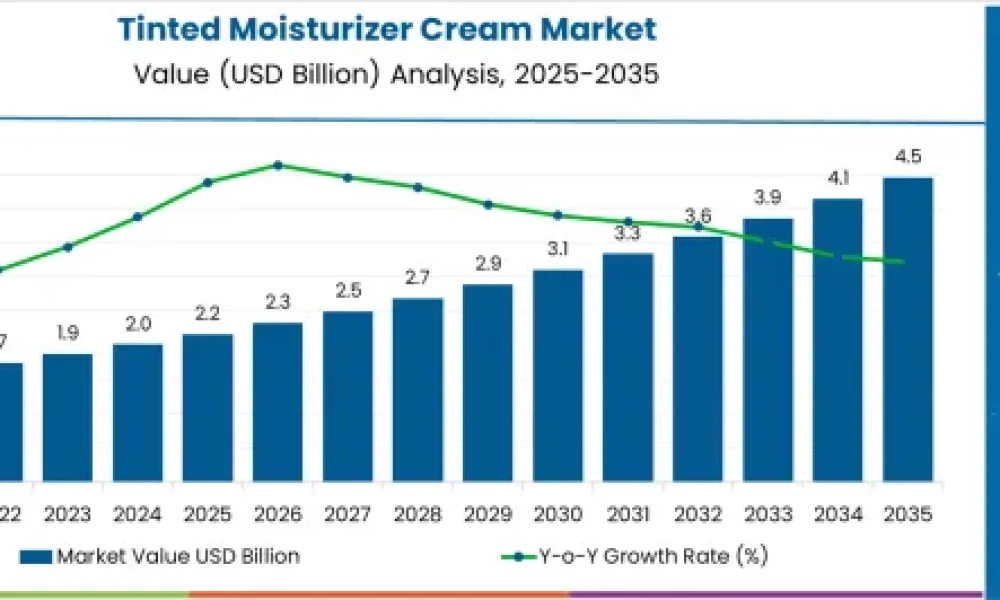
The global tinted moisturizer cream market is valued at USD 2.2 billion in 2025 and is forecast to expand to USD 4.5 billion by 2035, registering a compound annual growth rate (CAGR) of 7.5% over the period. The growth reflects rising consumer demand for hybrid beauty products that combine hydration, light coverage, and sun protection in a single application.
From 2021 to 2025, the market increased from USD 1.5 billion to USD 2.2 billion, supported by strong brand loyalty among established cosmetic companies and growing adoption of multifunctional formulations. Products offering hydration, SPF, and natural-looking coverage gained traction, while smaller brands faced moderate erosion in mature markets. Between 2026 and 2030, the market is expected to grow from USD 2.3 billion to USD 2.9 billion, followed by accelerated expansion from 2031 to 2035, when it is projected to reach USD 4.5 billion.
Gain access to detailed segment-wise analysis and forecast statistics – Request the Sample Report Today
Market Context: Skincare and Cosmetics Convergence Reshapes Demand
- The tinted moisturizer cream market sits at the intersection of several parent industries. Skincare and cosmetics account for 35% of total demand, reflecting consumer preference for simplified routines that merge skincare benefits with cosmetic coverage.
- Dermatology and clinical skincare contribute 25%, driven by dermatologist-recommended tinted moisturizers for sensitive, acne-prone, and hyperpigmented skin. The luxury and premium beauty segment represents 20%, supported by demand for specialty formulations and brand prestige.
- Retail and e-commerce distribution holds 12% of market share, underscoring the role of online platforms, specialty beauty stores, and supermarkets in driving accessibility. The travel and hospitality segment accounts for 8%, with tinted moisturizers increasingly used in spas, salons, and hotel wellness services.
Why the Market Is Growing
Growth is being fueled by consumer preference for lightweight, breathable alternatives to traditional foundation, particularly in warmer climates and urban environments. Rising skincare awareness, expanding shade inclusivity, and the clean beauty movement—emphasizing vegan, cruelty-free, and dermatologically tested products—are broadening market appeal.
Digital engagement is also influencing purchasing behavior. Online beauty tutorials, influencer campaigns, and virtual try-on tools are shaping product discovery and accelerating adoption. These trends have positioned tinted moisturizers as a staple in modern daily skincare routines.
Key Segments: SPF 25–35, Normal Skin Type, and Medium Coverage Lead
By sun protection level, the SPF 25–35 segment is projected to dominate with a 39.4% share in 2025. This range offers a balance between adequate UV protection and lightweight texture, making it suitable for daily use and commonly recommended by dermatologists.
Normal skin type is expected to account for 28.7% of market share, reflecting broad compatibility with standard formulations and its role as a benchmark category for product development. Medium coverage is forecast to lead with a 42.1% share, as consumers seek natural-looking results that even out skin tone without the heaviness of full foundation.
Regional Outlook: Asia-Pacific Drives Growth, While Europe and North America Emphasize Premiumization
Asia-Pacific is the fastest-growing region, led by China and India. China is projected to expand at a CAGR of 10.1% from 2025 to 2035, supported by urbanization, rising disposable incomes, and strong e-commerce penetration. India follows with a CAGR of 9.4%, driven by expanding middle-class income, influencer marketing, and demand for lightweight, multifunctional products tailored to local skin tones.
In Europe, France is forecast to grow at 7.9%, the United Kingdom at 7.1%, and Germany at 8.6%. These markets emphasize premium formulations, texture, fragrance, and skincare-makeup hybrid benefits. The United States is expected to grow at a CAGR of 6.4%, supported by digital marketing, packaging innovation, and rising adoption among urban professionals.
Competitive Landscape: Innovation and Inclusivity Define Strategy
Competition is shaped by formulation innovation, shade range expansion, and brand recognition. Maybelline New York leads through mass-market accessibility and wide shade ranges. bareMinerals and Bobbi Brown Professional Cosmetics emphasize clean and mineral-based formulations. Amorepacific US, Inc. leverages K-beauty expertise with hydrating, SPF-infused products. Premium players such as Comprof Milano S.r.l., Dr Irena Eris, and Dolce & Gabbana focus on anti-aging benefits, botanical extracts, and luxury presentation.
Brands are positioning tinted moisturizers as multifunctional products that combine foundation, moisturizer, and sun protection. Strategies include SPF integration, lightweight textures, dermatological testing, and digital engagement through influencer collaborations and virtual try-on platforms.
Outlook: Multifunctionality and Digital Engagement to Sustain Growth
Looking ahead, opportunities lie in lightweight textures, anti-aging additives, and customizable shade options. Packaging innovations such as airless pumps and compact designs are expected to improve shelf life and hygiene. Digital tools for shade matching and personalized recommendations are becoming central to consumer engagement.
With demand driven by convenience, inclusivity, and skincare integration, the tinted moisturizer cream market is expected to maintain steady expansion through 2035, reinforcing its role as a core segment within the global beauty and personal care industry.
Have a specific Requirements and Need Assistant on Report Pricing or Limited Budget please contact us – [email protected]
About Future Market Insights (FMI)
Future Market Insights, Inc. (FMI) is an ESOMAR-certified, ISO 9001:2015 market research and consulting organization, trusted by Fortune 500 clients and global enterprises. With operations in the U.S., UK, India, and Dubai, FMI provides data-backed insights and strategic intelligence across 30+ industries and 1200 markets worldwide
Why Choose FMI: https://www.futuremarketinsights.com/why-fmi



