
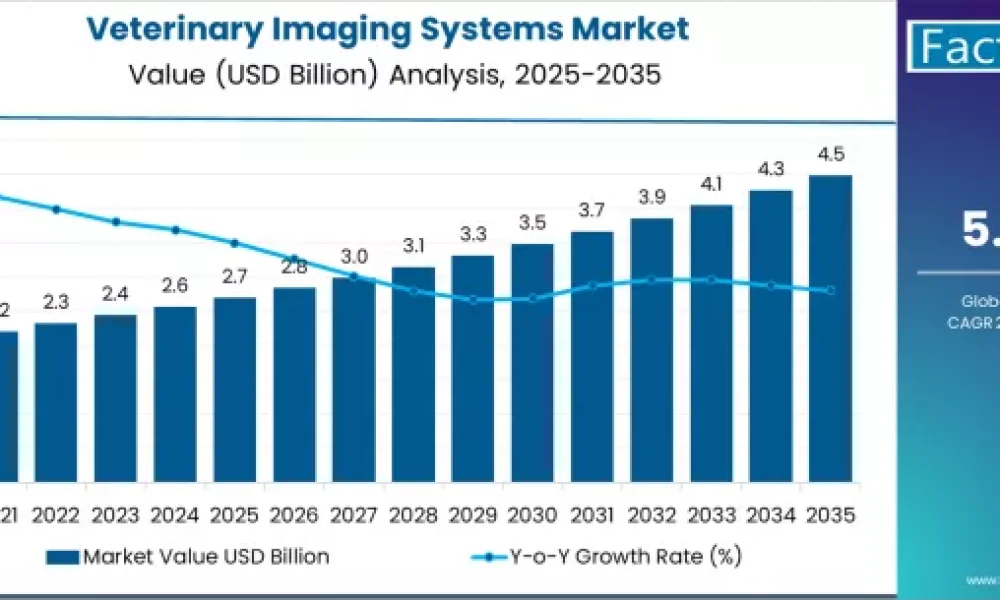
The global veterinary imaging systems market is undergoing a significant technological shift, with its valuation expected to rise from USD 2.7 billion in 2025 to USD 4.5 billion by 2035. According to a comprehensive new industry analysis by Fact.MR, the market is poised for a 5.2% compound annual growth rate (CAGR) over the next decade, reflecting an absolute dollar opportunity of USD 1.8 billion.
The expansion is primarily driven by a fundamental change in how veterinary practitioners approach animal health, moving from reactive treatments to proactive, non-invasive precision diagnostics. As pet humanization increases and livestock management becomes more data-centric, the demand for sophisticated imaging—ranging from portable ultrasound units to high-definition MRI systems—has reached a critical turning point.
Request for Sample Report | Customize Report |purchase Full Report – https://www.factmr.com/connectus/sample?flag=S&rep_id=177
Answering the Core Market Dynamics: Who, What, and Why?
What is driving the growth? The surge is fueled by increased pet adoption, a higher prevalence of zoonotic and orthopedic diseases, and the integration of Artificial Intelligence (AI) to enhance diagnostic accuracy.
Who are the primary beneficiaries? Companion animals (dogs and cats) dominate the landscape, representing roughly 72% of the market share. However, the equine and livestock sectors are increasingly adopting portable imaging for field-based diagnostics.
Where is the growth concentrated? North America remains the largest regional market due to high healthcare expenditure, while the Asia-Pacific region is identified as the fastest-growing territory, spurred by a burgeoning middle class and expanding veterinary infrastructure.
Why now? Technological maturation—specifically the miniaturization of ultrasound and the arrival of low-field MRI options—has decentralized advanced diagnostics, making them accessible to smaller practices that previously relied on external referral centers.
Modality Insights: Ultrasound Leads the Evolution
The ultrasound segment is projected to maintain its market dominance, accounting for 43.0% of total revenue in 2025. Practitioners favor ultrasound for its non-invasive nature and versatility across routine screenings and emergency triage.
While X-ray systems remain a foundational component for orthopedic and dental applications, the market is witnessing a rapid uptick in Computed Tomography (CT) and Magnetic Resonance Imaging (MRI). These modalities are becoming essential for neurology and oncology, where high-resolution imaging is required to navigate complex surgical interventions and tumor staging.
Strategic Regional and Sector Shifts
North America: Leads with a robust ecosystem of specialty imaging centers and high pet insurance penetration, which lowers the barrier for owners seeking expensive diagnostic procedures.
Asia-Pacific: Anticipated to experience the highest growth rate as countries like China and India professionalize their veterinary services and expand livestock disease surveillance programs.
Small Animals vs. Large Animals: Small companion animals continue to be the primary revenue driver, but the One Health initiative—which recognizes the link between animal and human health—is boosting investment in livestock imaging to prevent the spread of infectious diseases.
Technological Enablers: AI and Portability
The report highlights that the next five years will be defined by modality convergence. Software-driven enhancements and AI-powered image analysis are reducing the time required for diagnosis and minimizing human error. Manufacturers are also shifting toward subscription-based software services and modular hardware designs, allowing clinics to upgrade their capabilities without the prohibitive upfront costs of entirely new systems.
Future Outlook: 2030–2035
The latter half of the forecast period is expected to be even more lucrative. Between 2030 and 2035, the market is forecast to add USD 1.0 billion in value, representing over 55% of the total ten-year expansion. This acceleration will likely be supported by the stabilization of global supply chains and the mainstreaming of tele-radiology, where specialists provide remote consultations based on images captured at local clinics.
For industry leaders and investors, the veterinary imaging sector represents a resilient healthcare segment with high barriers to entry but significant long-term returns as animal care standards continue to align with human medical benchmarks.
Browse Full Report : https://www.factmr.com/report/177/veterinary-imaging-systems-market
To View Related Report :
Veterinary Eye Care Market
https://www.factmr.com/report/980/veterinary-eye-care-market
Veterinary Wound Sprays Market
https://www.factmr.com/report/997/veterinary-wound-sprays-market
About Fact.MR:
We are a trusted research partner of 80% of fortune 1000 companies across the globe. We are consistently growing in the field of market research with more than 1000 reports published every year. The dedicated team of 400-plus analysts and consultants is committed to achieving the utmost level of our client’s satisfaction.



