
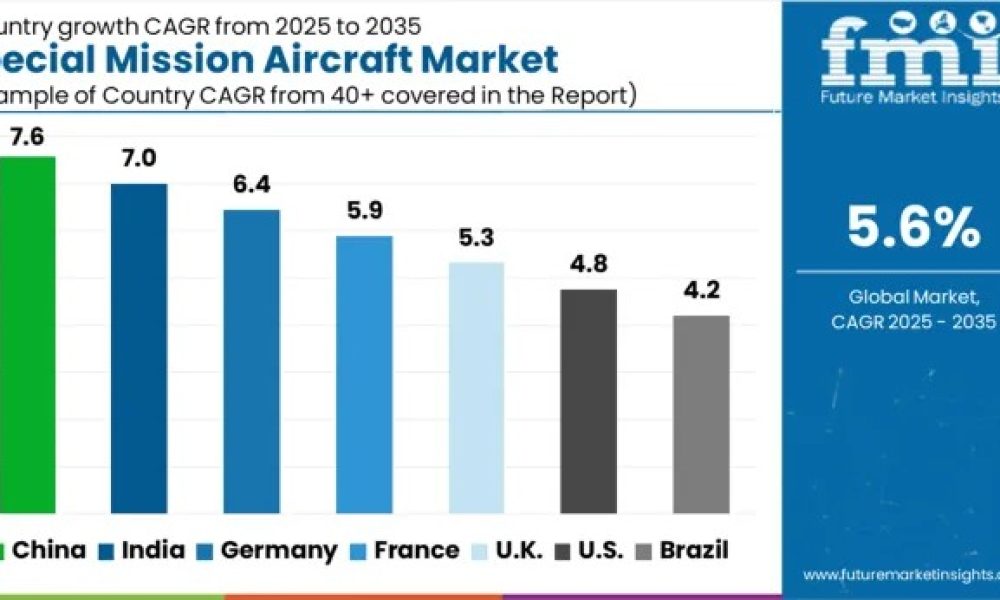
The special mission aircraft market is projected to grow steadily from USD 18.6 billion in 2025 to USD 32.0 billion by 2035, registering a compound annual growth rate (CAGR) of 5.6% over the forecast period. This consistent expansion reflects rising global demand for intelligence, surveillance, reconnaissance (ISR), electronic warfare, command and control, and other mission-critical aerial platforms across military and civil defense sectors.
The market demonstrates predictable year-on-year (YoY) growth, increasing from USD 17.6 billion in 2024 to USD 18.6 billion in 2025, and further to USD 19.6 billion in 2026. Annual increments of approximately 5–6% provide defense OEMs, governments, and system integrators with strong visibility for production planning, procurement cycles, and long-term contract execution.
Market Growth Characterized by Stability and Long-Term Planning Visibility
By 2035, the market is expected to add USD 13.4 billion in absolute value compared to 2025, highlighting sustained investment in specialized aerial platforms. Market values rise progressively from USD 20.7 billion in 2027 to USD 30.3 billion in 2034, underscoring a stable demand environment rather than cyclical volatility.
This consistency allows stakeholders to:
- Optimize capacity utilization and supply chain planning
- Secure multi-year defense procurement contracts
- Invest confidently in platform modernization and mission systems
- Scale aftermarket and lifecycle support services
The special mission aircraft segment is expected to retain a 12–13% share of the total defense aircraft market through 2035, reinforcing its strategic importance within global defense aviation portfolios.
Get access to comprehensive data tables and detailed market insights — request your sample report today!
https://www.futuremarketinsights.com/reports/sample/rep-gb-24800
Key Market Statistics at a Glance
- Market Size (2025): USD 18.6 billion
- Forecast Value (2035): USD 32.0 billion
- Forecast CAGR (2025–2035): 5.6%
- Leading Platform Segment: Military (47.9%)
- Top Application: Intelligence, Surveillance & Reconnaissance (33.6%)
- Dominant Sales Channel: OEM (71.4%)
- Key Regions: North America, Asia-Pacific, Europe
Defense Modernization and ISR Demand Fuel Market Expansion
The primary growth driver for the special mission aircraft market is the increasing need for multi-role airborne platforms capable of operating across surveillance, reconnaissance, electronic warfare, border security, maritime patrol, and humanitarian missions. Rising geopolitical tensions, asymmetric threats, and cross-border security challenges are pushing governments to expand and modernize specialized aviation fleets.
Technological integration plays a central role. Modern special mission aircraft increasingly feature:
- AI-enabled sensor suites
- Electronic warfare and signal intelligence systems
- Long-endurance and multi-payload capabilities
- Secure digital communication and real-time data links
Defense budgets across North America, Europe, and Asia-Pacific continue to allocate sustained funding for mission-specific aircraft procurement and lifecycle support, supporting long-term market stability.
Military Platforms Dominate by Platform Type
The military segment is projected to hold 47.9% market share in 2025, making it the largest platform category. Armed forces globally rely on special mission aircraft for combat support, counter-terrorism, border surveillance, and maritime security operations.
Military aircraft benefit from:
- High adaptability for mission-specific avionics and EW integration
- Dual-use deployment for combat and disaster response
- Continuous R&D in stealth, endurance, and sensor performance
These factors ensure sustained dominance of military platforms throughout the forecast period.
ISR Applications Lead Mission Demand
The Intelligence, Surveillance and Reconnaissance (ISR) segment is expected to account for 33.6% of market revenue in 2025, making it the leading application area. Governments increasingly prioritize real-time situational awareness, persistent monitoring, and data-driven decision-making.
Advancements such as multi-sensor fusion, hyperspectral imaging, and manned-unmanned interoperability are expanding ISR effectiveness, positioning ISR aircraft as indispensable assets in both peacetime and conflict scenarios.
Drive Your Business Growth Strategy: Checkout the Report for Key Insights
https://www.futuremarketinsights.com/checkout/24800
OEMs Retain Control of the Sales Channel
OEMs are anticipated to command 71.4% of total sales in 2025, driven by defense procurement policies favoring factory-new platforms equipped with integrated mission systems. Governments prefer OEMs for:
- End-to-end platform integration and certification
- Long-term maintenance and support contracts
- Rapid incorporation of next-generation technologies
Strategic partnerships between global OEMs and domestic manufacturers further strengthen this channel.
Regional Growth Highlights Emerging and Mature Markets
Asia-Pacific leads growth, with China (7.6% CAGR) and India (7.0%) benefiting from military modernization, UAV deployment, and indigenous aerospace programs. In Europe, Germany (6.4%), France (5.9%), and the UK (5.3%) show steady expansion supported by defense readiness and surveillance investments. The United States, growing at 4.8%, reflects mature but sustained demand across defense, border security, and intelligence operations.
Competitive Landscape Anchored by Global Defense Leaders
The market features a strong presence of global defense and aerospace leaders including Lockheed Martin, Airbus, Boeing, Northrop Grumman, BAE Systems, Saab, Raytheon Technologies, Leonardo, Dassault Aviation, Bombardier, and General Atomics, alongside specialized ISR and UAV providers such as Elbit Systems, AeroVironment, IAI, and Kratos.
Competition centers on payload flexibility, endurance, sensor integration, and mission adaptability, with manufacturers increasingly emphasizing modular and reconfigurable platform architectures.
Outlook
With stable YoY growth, predictable revenue contribution, and rising strategic relevance, the special mission aircraft market is positioned as a core pillar of global defense aviation through 2035. While procurement costs and operational complexity remain challenges, sustained government investment, technological innovation, and evolving security requirements ensure long-term expansion and opportunity across military, intelligence, and civil defense applications.
Why Choose FMI: Empowering Decisions that Drive Real-World Outcomes: https://www.futuremarketinsights.com/why-fmi
About Future Market Insights (FMI)
Future Market Insights, Inc. (FMI) is an ESOMAR-certified, ISO 9001:2015 market research and consulting organization, trusted by Fortune 500 clients and global enterprises. With operations in the U.S., UK, India, and Dubai, FMI provides data-backed insights and strategic intelligence across 30+ industries and 1200 markets worldwide.



