
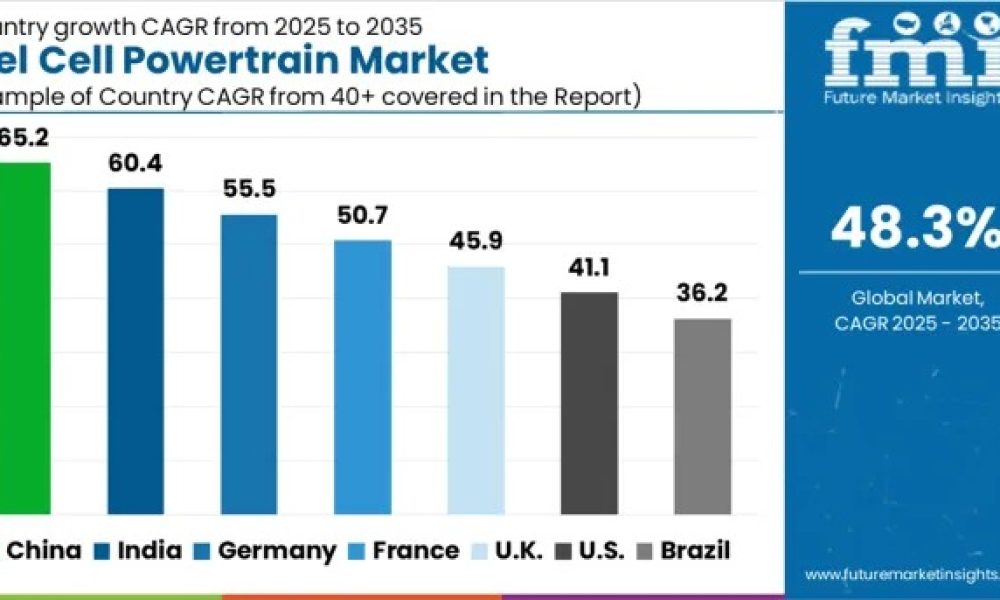
The global fuel cell powertrain market is entering a phase of unprecedented expansion, driven by accelerating hydrogen mobility adoption, strong government support, and growing demand for zero-emission heavy-duty transportation. The market is valued at USD 1,016.2 million in 2025 and is projected to surge to USD 52,286.6 million by 2035, registering a remarkable CAGR of 48.3% during the forecast period.
Early-stage growth reflects controlled adoption through pilot deployments and niche commercial applications. However, the long-term outlook highlights a rapid transition from demonstration-scale projects to large-scale commercial deployment across logistics, public transport, and industrial fleets.
Early Market Development Anchored by Pilot Projects and Policy Support
During the initial years of the forecast period, market expansion is supported by government-backed pilot programs, zero-emission mandates, and early investments in hydrogen refueling infrastructure. Commercial fleet operators and automotive OEMs are testing fuel cell powertrains in controlled environments to validate long-range performance, rapid refueling capability, and operational reliability.
These early deployments are laying the foundation for accelerated adoption by reducing technology risk, establishing refueling corridors, and enabling cost learning curves. Policy incentives across East Asia, Europe, and North America are playing a critical role in de-risking early investments and supporting infrastructure build-out.
Get access to comprehensive data tables and detailed market insights — request your sample report today!
https://www.futuremarketinsights.com/reports/sample/rep-gb-26219
Commercial Trucks and Buses Dominate Fuel Cell Powertrain Adoption
By application, commercial trucks and buses account for 87% of total market demand in 2025, making them the dominant adoption segment. Fuel cell powertrains are particularly well-suited for heavy-duty vehicles due to their ability to deliver extended driving range, fast refueling, and consistent power output without sacrificing payload capacity.
Fleet operators facing increasing pressure to decarbonize freight and public transportation view fuel cell powertrains as a practical alternative to battery-electric systems for long-haul and high-utilization routes. Government incentives targeting zero-emission buses and freight corridors further strengthen adoption in this segment, positioning commercial vehicles as the core growth engine of the market.
Integrated Fuel Cell Electric Powertrains Gain Preference
By product outlook, fuel cell electric powertrains represent 48% of total market demand, reflecting a strong preference for fully integrated, turnkey powertrain solutions. OEMs and fleet operators increasingly favor complete systems that integrate fuel cell stacks, hydrogen storage, electric drive units, and power electronics into a single optimized platform.
This trend aligns with broader electrification strategies, where system-level optimization reduces integration complexity, improves reliability, and accelerates vehicle development timelines. As commercialization accelerates, integrated powertrain solutions are expected to remain the preferred choice for large-scale fleet deployment.
Fuel Cell Modules Remain the Core Technology Driver
At the component level, fuel cell modules (stack + balance of plant) account for 34% of market share, underscoring their central role in powertrain performance and reliability. Advances in stack materials, membrane efficiency, and system durability are directly improving power density, lifespan, and cost competitiveness.
Ongoing innovation in fuel cell modules is critical to achieving broader commercialization, as these components define energy conversion efficiency and operating stability. Manufacturers continue to invest heavily in stack design optimization and cost reduction initiatives to support large-volume deployment.
Commercial Fleets Lead End-User Adoption
By end user, commercial vehicle manufacturers and fleet operators account for 47% of total demand, reflecting their role as early adopters of hydrogen mobility solutions. Fleet-scale deployment offers predictable usage patterns, centralized refueling, and clear emissions reduction benefits, making it an ideal entry point for fuel cell technology.
Fleet adoption also serves as market validation, encouraging further investment in infrastructure, component manufacturing, and supply chain development. As total cost of ownership improves, fleet-driven adoption is expected to expand rapidly across logistics, warehousing, and public transportation networks.
Drive Your Business Growth Strategy: Checkout the Report for Key Insights
https://www.futuremarketinsights.com/checkout/26219
East Asia, Europe, and North America Drive Global Growth
Regionally, East Asia leads global growth, supported by aggressive hydrogen strategies in China, Japan, and South Korea. Europe follows closely, driven by stringent emission regulations and strong public-private collaboration in hydrogen infrastructure development. North America demonstrates steady acceleration through federal and state-level support for clean transportation and commercial fleet electrification.
Country-level analysis highlights China (65.2% CAGR) and India (60.4% CAGR) as the fastest-growing markets, supported by large-scale infrastructure investments and industrial decarbonization initiatives. Germany, France, the UK, and the USA also show strong momentum as fuel cell technology moves from pilot to commercialization phases.
Competitive Landscape Shaped by Technology Leadership and Partnerships
The fuel cell powertrain market is highly innovation-driven, with competition centered on system efficiency, durability, cost reduction, and integration capability. Key players include Toyota Motor Corporation, Hyundai Motor Company, Ballard Power Systems, Plug Power Inc., Cummins Inc., Symbio, Bosch Hydrogen Powertrain Systems, AVL List GmbH, Horizon Fuel Cell Technologies, and Sinosynergy Hydrogen Energy Technology.
Market leaders are strengthening their positions through strategic partnerships, joint ventures, and hydrogen infrastructure collaborations. Technology leadership, manufacturing scale, and ecosystem integration remain decisive factors in shaping long-term competitive advantage.
Market Outlook
As hydrogen infrastructure matures and zero-emission mandates intensify, fuel cell powertrains are transitioning from emerging technology to core enablers of heavy-duty decarbonization. With exponential value growth projected through 2035, the fuel cell powertrain market is set to become a cornerstone of the global clean mobility ecosystem.
Why Choose FMI: Empowering Decisions that Drive Real-World Outcomes: https://www.futuremarketinsights.com/why-fmi
About Future Market Insights (FMI)
Future Market Insights, Inc. (FMI) is an ESOMAR-certified, ISO 9001:2015 market research and consulting organization, trusted by Fortune 500 clients and global enterprises. With operations in the U.S., UK, India, and Dubai, FMI provides data-backed insights and strategic intelligence across 30+ industries and 1200 markets worldwide.



