
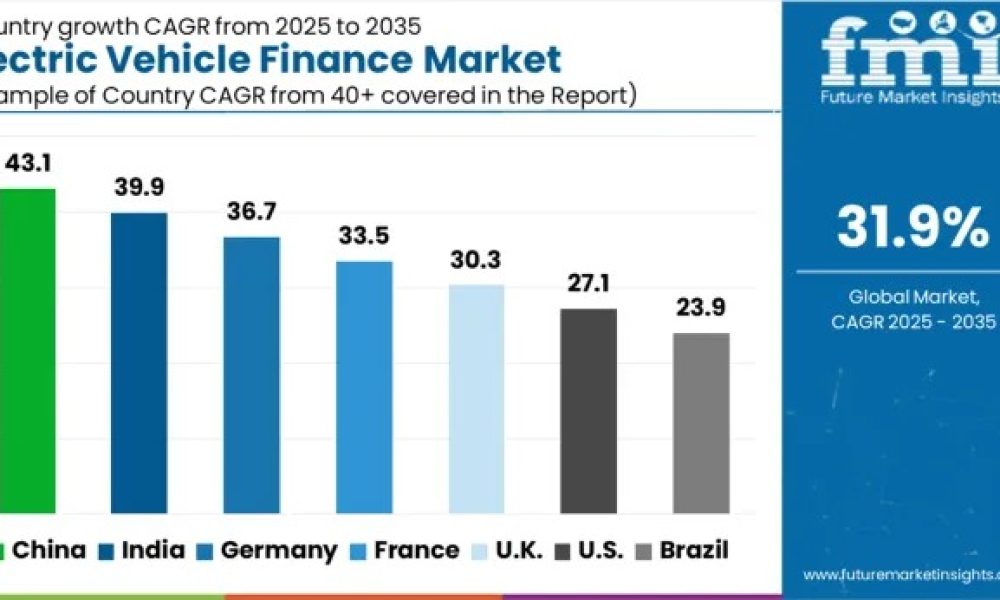
The global electric vehicle (EV) finance market is entering a phase of unprecedented expansion, underscored by its rapid rise from a valuation of USD 89.0 billion in 2025 to a projected USD 1,419.1 billion by 2035. This trajectory represents a striking compound annual growth rate (CAGR) of 31.9%, positioning EV finance as one of the fastest-scaling segments within automotive and sustainable finance ecosystems. The market’s growth reflects not only accelerating EV adoption but also the structural transformation of credit, leasing, and subscription models designed specifically to enable electric mobility at scale.
As EV penetration deepens across passenger, commercial, and shared mobility segments, financing has emerged as a critical enabler of demand. High upfront vehicle costs, evolving battery technologies, and infrastructure considerations have made tailored financial products essential. In response, financial institutions, automaker-backed lenders, and fintech platforms are rapidly expanding EV-focused portfolios, reshaping how capital flows into clean transportation.
Cost Structure and Value Chain Highlight Strategic Importance of Scale and Digitalization
The cost structure of the electric vehicle finance market is shaped by a combination of capital deployment, interest rate management, credit risk assessment, regulatory compliance, and advanced technology integration. Financial institutions incur significant expenditures in customer acquisition, underwriting operations, digital lending infrastructure, and continuous portfolio monitoring. Downstream costs related to collections, customer servicing, and asset management further influence margins, particularly as loan volumes scale sharply.
Despite these costs, efficiency gains from digitalization are becoming a defining factor in profitability. AI-driven credit scoring, automated underwriting, and data-led risk models are lowering per-loan processing costs while improving approval speed and accuracy. As the market scales nearly sixteenfold between 2025 and 2035, lenders that achieve early cost optimization through technology are expected to capture disproportionate value.
Get access to comprehensive data tables and detailed market insights — request your sample report today!
https://www.futuremarketinsights.com/reports/sample/rep-gb-25798
The EV finance value chain begins upstream with electric vehicle manufacturers and dealership networks that collaborate closely with banks, non-banking financial companies (NBFCs), and captive finance arms. Together, they structure loans, leases, and subscription offerings aligned with vehicle pricing, incentives, and residual value expectations. Financial intermediaries then manage credit evaluation, interest pricing, and repayment frameworks, supported by insurance providers and regulatory authorities that mitigate systemic risk.
Technology vendors form a critical layer of value creation, enabling secure digital contracts through blockchain, advanced analytics for credit assessment, and seamless digital payment infrastructure. Post-financing, the chain extends into refinancing, asset monitoring, and resale markets, ensuring recurring revenue streams across the vehicle lifecycle.
NBFCs and Passenger Cars Anchor Early Market Leadership
By 2025, NBFCs are expected to account for 47.5% of total EV finance market revenue, making them the dominant financial institution segment. Their leadership is driven by flexible lending structures, faster disbursement cycles, and stronger reach in semi-urban and emerging markets where traditional banking penetration remains limited. Strategic partnerships with EV manufacturers and dealers allow NBFCs to embed financing directly at the point of sale, accelerating adoption.
From a vehicle perspective, passenger cars are projected to represent 43.2% of financed EVs in 2025. Declining battery costs, expanding model availability, and favorable total cost of ownership metrics are driving consumer confidence in electric passenger vehicles. Financing solutions tailored to this segment—supported by subsidies, tax incentives, and improving resale value expectations—are reinforcing its position as the largest contributor to market revenues.
Financing Innovation Drives Adoption and Market Depth
The rapid growth of the EV finance market is closely linked to innovation in financing models. Traditional auto loans are increasingly complemented by leasing, battery-as-a-service, and subscription-based offerings that significantly reduce upfront ownership barriers. These structures are particularly attractive to urban consumers, fleet operators, and shared mobility providers seeking flexibility and predictable costs.
Leasing has gained strong traction in corporate fleets and high-value EV segments, while subscription models are emerging as a compelling option for consumers wary of long-term technology obsolescence. By aligning repayment structures with usage patterns and depreciation profiles, these models are broadening the addressable customer base and deepening market penetration.
Policy Support and Green Capital Strengthen Market Foundations
Government incentives and regulatory frameworks continue to play a pivotal role in shaping the EV finance ecosystem. Subsidies, tax rebates, and reduced registration fees are directly influencing loan affordability, while green financing guidelines encourage lenders to allocate capital toward EV portfolios. In several markets, government-backed guarantee schemes are lowering credit risk for financial institutions, improving approval rates and portfolio stability.
At the same time, green bonds and ESG-linked financing instruments are channeling large-scale institutional capital into EV lending. This convergence of public policy support and private capital is accelerating the market’s transition from niche financing activity to a core pillar of sustainable investment.
Drive Your Business Growth Strategy: Checkout the Report for Key Insights
https://www.futuremarketinsights.com/checkout/25798
Regional Growth Led by Asia-Pacific and Europe
Geographically, the electric vehicle finance market is expanding most rapidly in Asia-Pacific and Europe, alongside continued growth in North America. China leads with a projected CAGR of 43.1%, supported by its dominant EV sales volumes and large-scale financing programs. India follows at 39.9%, driven by strong policy backing, NBFC-led lending, and rapid adoption in two- and three-wheeler segments.
Europe shows robust momentum, with Germany forecast at 36.7% CAGR, underpinned by structured leasing models and corporate fleet electrification. The UK, at 30.3%, benefits from green loan initiatives and personal contract purchase schemes, while the United States grows at 27.1% through dealership financing, leasing, and fintech-driven subscription models.
Competitive Landscape Defined by Integration and Scale
The competitive environment spans global banks, specialized auto finance providers, and automaker-backed financial arms. Institutions such as JPMorgan Chase & Co, Wells Fargo, Bank of America, Ally Financial, and Santander Consumer USA are expanding EV-specific loan and lease products, while captive finance players including Tesla Finance, Toyota Financial Services, Ford Credit, and Volkswagen Financial Services offer integrated purchase-to-finance solutions.
As the market accelerates toward USD 1.4 trillion by 2035, competitive advantage will increasingly depend on digital capabilities, risk management sophistication, and ecosystem partnerships. With electrification reshaping mobility worldwide, the electric vehicle finance market is emerging as a central conduit for capital deployment, innovation, and long-term value creation across the global automotive landscape.
Why Choose FMI: Empowering Decisions that Drive Real-World Outcomes: https://www.futuremarketinsights.com/why-fmi
About Future Market Insights (FMI)
Future Market Insights, Inc. (FMI) is an ESOMAR-certified, ISO 9001:2015 market research and consulting organization, trusted by Fortune 500 clients and global enterprises. With operations in the U.S., UK, India, and Dubai, FMI provides data-backed insights and strategic intelligence across 30+ industries and 1200 markets worldwide.



