
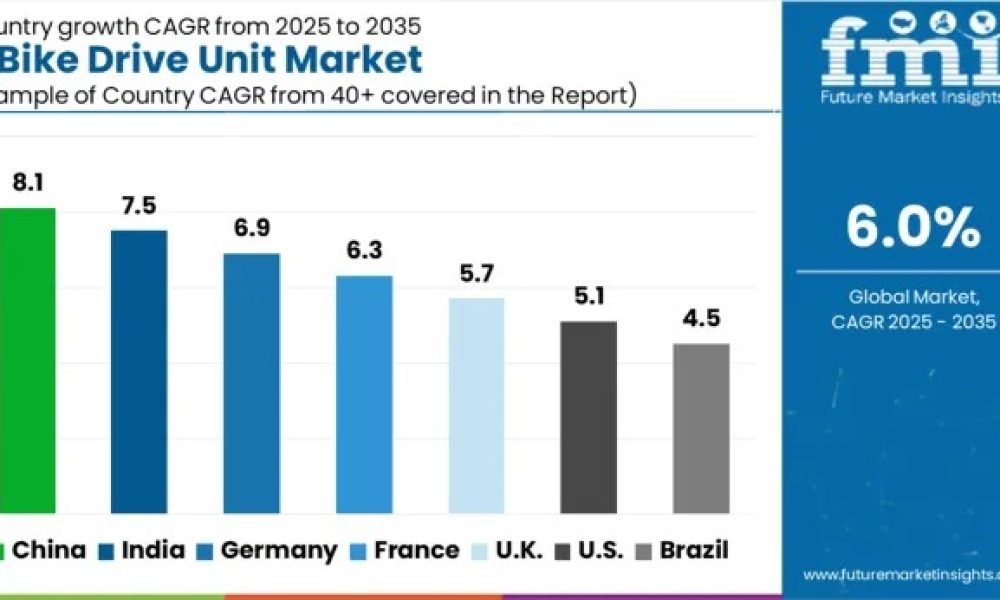
The global e-bike drive unit market is positioned for robust long-term growth as electric mobility continues to reshape urban transportation, logistics, and recreational cycling worldwide. Valued at USD 4.9 billion in 2025, the market is forecast to reach USD 8.9 billion by 2035, expanding at a compound annual growth rate (CAGR) of 6.0% over the forecast period. This growth trajectory underscores the rising strategic importance of drive units as the core propulsion technology enabling performance, efficiency, and reliability in modern electric bicycles.
E-bike drive units account for a significant share across multiple adjacent markets, representing approximately 9.1% of the global e-bike industry, 6.8% of electric motor systems, and 5.7% of the two-wheeler electrification segment. Their role continues to expand within the broader micro-mobility ecosystem, where they support last-mile connectivity, urban sustainability goals, and lightweight electric drivetrain innovation.
Asia-Pacific Maintains Market Leadership
Asia-Pacific emerges as the dominant regional market, driven by dense urban populations, extensive cycling networks, and strong government support for low-emission transportation. China remains the epicenter of global production and consumption, benefiting from cost-efficient manufacturing, vertically integrated supply chains, and rapid consumer adoption. High population density and affordability have accelerated diffusion of e-bike technologies, positioning the region as the primary engine of global market expansion.
China alone accounts for a substantial share of global output, supported by local manufacturers that continue to refine motor efficiency, torque delivery, and system integration. India also contributes to regional momentum, supported by urban mobility initiatives, government subsidies, and rising demand for affordable electric transportation in congested cities.
Get access to comprehensive data tables and detailed market insights — request your sample report today!
https://www.futuremarketinsights.com/reports/sample/rep-gb-25807
Europe Advances Through Premium Adoption and Policy Support
Europe represents the second-largest growth region, characterized by a mature cycling culture and strong regulatory backing for green mobility. Western European countries such as Germany, France, and the Netherlands are driving demand, particularly in urban and suburban commuting applications. Growth in the region is increasingly linked to premium e-bike adoption, where advanced drive units with higher torque, quieter operation, and smart integration are key differentiators.
European manufacturers and consumers show a strong preference for mid-drive motor systems, especially for trekking, cargo, and performance e-bikes operating across varied terrain. Government incentives, emission reduction targets, and expanding cycling infrastructure continue to reinforce demand, supporting steady market expansion through 2035.
North America Shows Gradual but Strategic Growth
North America exhibits comparatively slower growth, reflecting lower cycling penetration and higher dependence on personal vehicles. However, adoption is gradually expanding in metropolitan areas with active mobility programs, cycling infrastructure investment, and recreational e-bike use. Demand in the region is increasingly focused on premium and connected e-bike models, where advanced drive units enhance riding experience, performance, and diagnostics.
Although overall penetration remains modest, the region presents long-term potential as urban congestion, fuel costs, and sustainability priorities continue to influence transportation choices.
Mid-Drive Motors Define the Competitive Landscape
By motor type, mid-drive systems dominate the market, accounting for 66.3% of total revenue in 2025. Their leadership is driven by superior torque performance, improved weight distribution, and enhanced climbing capability compared to hub motors. Positioned at the crankset, mid-drive units leverage the bicycle’s gearing system, delivering higher efficiency and extended battery range.
Manufacturers increasingly favor mid-drive architectures for their adaptability across city, trekking, mountain, and cargo e-bikes. Integration of torque sensors, pedal-assist technologies, and smart controllers has further elevated performance expectations, reinforcing mid-drive systems as the preferred solution for advanced and premium e-bike platforms.
Optimal Power Range Drives Capacity Demand
From a capacity perspective, the 250 W to 550 W segment leads the market with a 59.1% revenue share. This range offers an optimal balance between power output, energy efficiency, and regulatory compliance across major global markets. Motors in this category provide sufficient torque for urban commuting and light cargo applications while maintaining compact size and manageable battery consumption.
Regulatory wattage limits in Europe and other regions have further reinforced adoption within this capacity range. Ongoing improvements in thermal management and power-to-weight ratios are enhancing durability and ride quality, strengthening this segment’s market position.
Drive Your Business Growth Strategy: Checkout the Report for Key Insights
https://www.futuremarketinsights.com/checkout/25807
Cargo E-Bikes Accelerate Application Growth
By application, cargo e-bikes represent the largest segment, accounting for 42.9% of market revenue in 2025. Growth is fueled by the rising use of electric cargo bikes for last-mile delivery, urban logistics, and commercial transportation. Cities seeking to reduce congestion and emissions are increasingly encouraging cargo e-bike deployment as alternatives to vans and scooters.
Drive units designed for cargo applications emphasize high torque, reinforced durability, and load-handling capability. Integration with fleet management systems and predictive maintenance tools further enhances operational efficiency, positioning cargo e-bikes as a critical growth driver in the market.
Innovation and Connectivity Shape Market Evolution
Technological advancement remains central to market expansion. Manufacturers are developing lighter, quieter, and more compact drive units with integrated controllers and modular architectures. Connectivity-enabled systems featuring IoT sensors and app-based monitoring allow real-time performance tracking and predictive maintenance, enhancing user experience and fleet reliability.
As electrification accelerates across personal mobility and urban logistics, the e-bike drive unit market is evolving into a strategically important segment of the global electric mobility value chain. With strong regional differentiation, ongoing innovation, and expanding application scope, the market is positioned for sustained growth—making it a critical area for deeper analysis and strategic insight through 2035.
Why Choose FMI: Empowering Decisions that Drive Real-World Outcomes: https://www.futuremarketinsights.com/why-fmi
About Future Market Insights (FMI)
Future Market Insights, Inc. (FMI) is an ESOMAR-certified, ISO 9001:2015 market research and consulting organization, trusted by Fortune 500 clients and global enterprises. With operations in the U.S., UK, India, and Dubai, FMI provides data-backed insights and strategic intelligence across 30+ industries and 1200 markets worldwide.



