
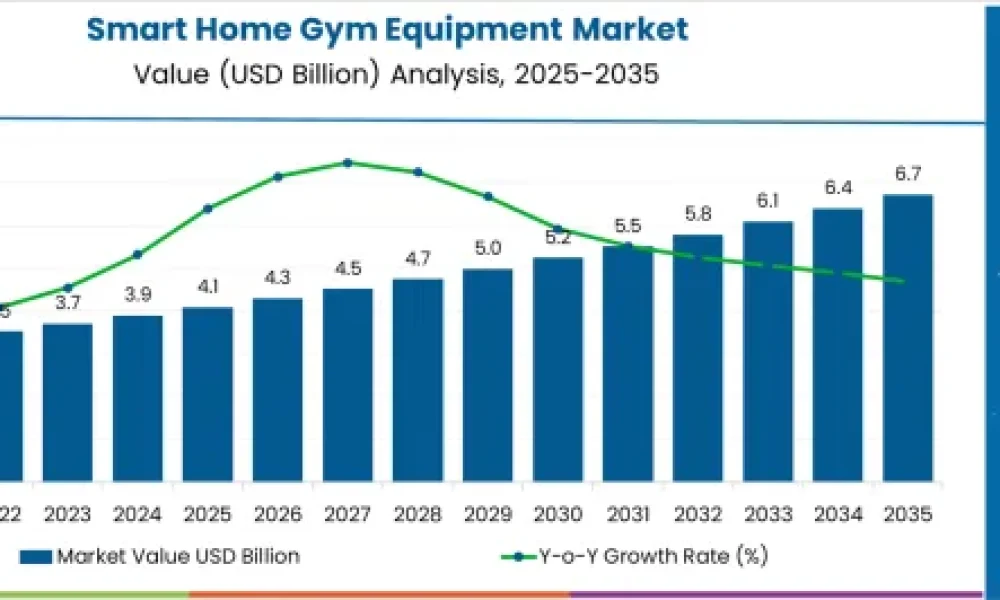
The global smart home gym equipment market is projected to grow from an estimated USD 4.1 billion in 2025 to USD 6.7 billion by 2035, registering a compound annual growth rate (CAGR) of 5.1% over the forecast period. The outlook reflects sustained demand for connected, interactive, and space-efficient fitness solutions as consumers increasingly invest in at-home training supported by digital technologies.
The forecast, based on market value and segmental performance trends through 2035, shows consistent year-on-year expansion. Between 2021 and 2025, the market increased from USD 3.2 billion to USD 4.1 billion, with incremental gains each year. From 2026 to 2030, it is expected to rise from USD 4.1 billion to USD 5.2 billion, followed by further growth to USD 6.7 billion by 2035. Over this period, traditional fitness equipment providers are expected to see gradual market share erosion as connected, AI-powered, and app-integrated systems capture a larger portion of consumer spending.
Gain access to detailed segment-wise analysis and forecast statistics – Request the Sample Report Today
Market Context: Why Smart Home Gyms Are Gaining Traction
The smart home gym equipment market is expanding as fitness technology converges with connected devices and evolving consumer health priorities. Advancements in AI-driven workout guidance, real-time performance tracking, and interactive fitness platforms have enhanced user engagement and training efficiency. Industry announcements and product portfolio expansions point to increased adoption of multifunctional cardio and strength systems designed for compact home spaces.
Lifestyle shifts, accelerated by hybrid work models, have further strengthened at-home fitness demand. Integration of subscription-based virtual classes and social workout communities is improving user retention and recurring revenue potential. As consumers prioritize convenience, personalization, and long-term health investment, the market is positioned for sustained growth, particularly in the medium price tier that balances quality with affordability.
Key Market Metrics at a Glance
- Market value (2025): USD 4.1 billion
- Forecast value (2035): USD 6.7 billion
- Forecast CAGR (2025–2035): 5.1%
- Leading segment (2025): Cardiovascular training equipment (61.4% share)
- Largest end-user group (2025): Professional users (72.9% share)
- Dominant price tier (2025): Medium-priced equipment (54.2% share)
- Key growth regions: North America, Europe, Asia-Pacific
Segment Insights: Cardio, Professional Users, and Medium-Priced Equipment Lead
Cardiovascular training equipment is projected to account for 61.4% of market revenue in 2025, reinforcing its role as the leading equipment category. Growth in this segment is driven by the versatility and accessibility of connected treadmills, stationary bikes, and rowing machines that integrate performance analytics, interactive classes, and virtual terrains. Continuous innovation, including adaptive resistance and personalized training programs, has expanded appeal across fitness levels, while rising awareness of heart health monitoring supports broader adoption.
By end user, the professional segment is forecast to represent 72.9% of market revenue in 2025. Demand is being driven by fitness professionals, athletes, and dedicated enthusiasts seeking high-performance equipment for consistent, results-driven training. Professional-grade smart gym systems emphasize durability, precision engineering, and compatibility with specialized training software. Remote coaching platforms and integrated workout tracking are making professional-level training more accessible in home environments.
The medium price segment is expected to capture 54.2% of revenue in 2025, reflecting strong consumer preference for products that offer advanced features without premium price points. Equipment in this tier typically includes integrated smart displays, performance tracking, and compatibility with popular fitness apps. Strong sales through both online platforms and specialty fitness stores are supported by promotional bundles, flexible payment options, and compact, multifunctional designs suited to urban living spaces.
Regional Outlook: Asia-Pacific Leads Growth, North America and Europe Maintain Scale
Asia-Pacific is expected to record the fastest growth, led by China and India. China’s market is projected to expand at a CAGR of 6.9% from 2025 to 2035, driven by rising health awareness, increasing disposable income, rapid urbanization, and strong e-commerce penetration. India is forecast to grow at 6.4% CAGR, supported by an expanding middle class, increasing fitness consciousness, and investments in digital features, app integration, and AI-enabled training modules by local manufacturers.
In Europe, Germany is projected to grow at a CAGR of 5.9%, reflecting demand for high-quality, durable equipment integrated with smart home ecosystems. The UK market is expected to expand at 4.8% CAGR, supported by rising adoption of connected gym devices and virtual training platforms. In North America, the United States is forecast to grow at a moderate CAGR of 4.3%, driven by demand for AI-enabled strength equipment, smart treadmills, and subscription-based interactive content.
Competitive Landscape: Focus on Connectivity and Ecosystem Integration
Competition in the smart home gym equipment market is defined by connectivity, interactivity, and ecosystem integration. Peloton Interactive Inc. leads with connected bikes and treadmills supported by live and on-demand classes. TECHNOGYM S.p.A. positions premium smart fitness platforms with wellness tracking and personalized coaching, while Tonal Systems Inc. specializes in wall-mounted strength training systems with digital weights and AI-guided workouts.
Other key players include AOPEN Inc., Aroleap Fitness Private Limited, Aviron Interactive, Beyond Power Inc., EGYM, Flexnest Gym Accessories, INNODIGYM, Life Fitness, Maxpro Fitness, Nordic Track, Precor, and Speediance. Across the market, strategies emphasize software subscriptions, connected platforms, and integration with mobile apps for real-time feedback, underscoring the convergence of hardware, software, and digital content in home wellness.
Outlook: Steady Expansion Through 2035
The smart home gym equipment market is set for steady expansion through 2035, supported by continued innovation in connected cardiovascular training equipment, AI-driven personalization, and subscription-based fitness content. While challenges remain, including high upfront costs and technical integration requirements, manufacturers offering user-friendly, customizable, and digitally integrated solutions are positioned to capture market share. With strong adoption across North America, Europe, and Asia-Pacific, the market is expected to remain a key growth segment within the broader home fitness and digital wellness ecosystem.
Have a specific Requirements and Need Assistant on Report Pricing or Limited Budget please contact us – [email protected]
About Future Market Insights (FMI)
Future Market Insights, Inc. (FMI) is an ESOMAR-certified, ISO 9001:2015 market research and consulting organization, trusted by Fortune 500 clients and global enterprises. With operations in the U.S., UK, India, and Dubai, FMI provides data-backed insights and strategic intelligence across 30+ industries and 1200 markets worldwide
Why Choose FMI: https://www.futuremarketinsights.com/why-fmi



