
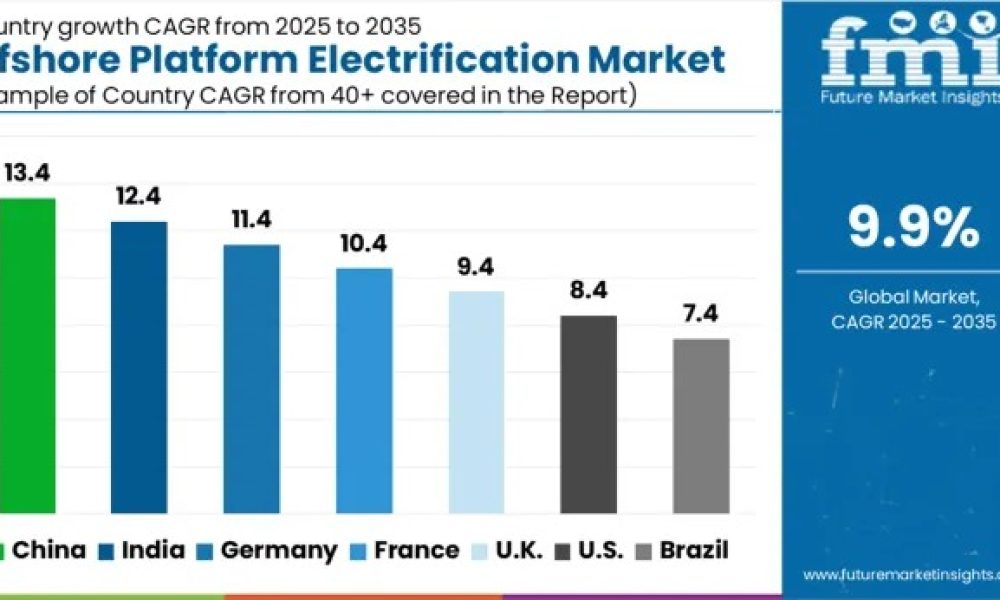
The global offshore platform electrification market is entering a critical transition phase, moving from early adoption toward sustained growth as offshore energy operators intensify efforts to reduce emissions, optimize operating costs, and comply with tightening environmental regulations. Valued at USD 0.9 million in 2025, the market is projected to reach USD 2.3 million by 2035, expanding at a compound annual growth rate (CAGR) of 9.9% over the forecast period.
Offshore platform electrification involves replacing conventional diesel- or gas-powered systems with electric and hybrid power solutions across offshore oil, gas, and renewable energy installations. While the market remains relatively small in absolute value, its growth trajectory reflects a structural shift in offshore energy infrastructure aligned with global decarbonization strategies.
Early Adoption Phase Characterized by Technology Validation
Between 2025 and 2027, the offshore platform electrification market remains in its introductory phase, marked by limited deployments, high upfront capital requirements, and selective adoption by early movers. During this period, investments are concentrated on pilot projects, feasibility studies, and technology validation. Operators pursuing electrification are primarily motivated by emissions reduction targets, long-term operational efficiency, and alignment with evolving national and international environmental standards.
Early adoption has been strongest among offshore operators in regions with high energy costs and strict emissions regulations, where the economic and regulatory benefits of electrification are most pronounced. Stakeholder awareness, supply chain readiness, and system reliability testing remain central themes during this stage of market development.
Get access to comprehensive data tables and detailed market insights — request your sample report today!
Regulatory Momentum Drives Early Growth Acceleration
From 2028 to 2032, the market is expected to enter an early growth phase, supported by rising regulatory pressure, maturing technologies, and increasing confidence in electrification solutions. Governments are strengthening carbon pricing mechanisms, emissions reporting requirements, and sustainability mandates, compelling offshore operators to adopt cleaner power systems.
Electrification is increasingly viewed as a strategic solution to reduce lifecycle emissions, enhance safety, and lower long-term maintenance costs. Declining equipment costs, combined with policy incentives and improved grid connectivity, are enabling broader adoption across both new-build and retrofit offshore platforms. During this period, standardization of system designs and gradual scaling of installations are anticipated.
Offshore Wind Emerges as the Leading Technology Segment
By technology, offshore wind is projected to account for 47.9% of total market revenue in 2025, making it the dominant electrification solution. The growing proximity of offshore wind farms to oil and gas platforms, coupled with expanding grid integration capabilities, has enhanced the feasibility of delivering clean electricity to offshore facilities.
Advancements in floating wind turbines, subsea cable reliability, and power transmission technologies have significantly improved system performance in harsh marine environments. Offshore wind offers a scalable, emissions-free alternative to conventional power generation methods, enabling operators to meet environmental compliance requirements without compromising operational reliability.
As governments advance offshore wind deployment as part of broader energy security and decarbonization strategies, integration with offshore platforms is expected to play a central role in the evolution of hybrid offshore energy hubs.
Environmental Compliance and Cost Optimization Fuel Adoption
Environmental compliance remains the primary driver of offshore platform electrification. International emissions standards and regional regulatory frameworks are compelling operators to reduce carbon dioxide and nitrogen oxide emissions from offshore operations. Electrification of pumps, compressors, cranes, and drilling equipment is increasingly replacing diesel-powered machinery, resulting in lower fuel consumption and improved energy efficiency.
In parallel, offshore operators are pursuing electrification to achieve operational efficiency and cost optimization. Electric drives and motors offer higher precision, reduced maintenance requirements, and longer equipment lifespans compared to mechanical systems. Centralized power distribution and advanced energy management systems further reduce energy losses and enhance system reliability.
Technological Advancements Enable Deployment in Harsh Environments
Continuous innovation in electrical systems has expanded the applicability of electrification across complex offshore environments. High-capacity electric drives, advanced frequency converters, modular power distribution units, and digital control systems have improved durability and reliability under extreme offshore conditions.
Remote monitoring, automation, and predictive maintenance technologies are increasingly integrated into electrification systems, enabling operators to minimize downtime, optimize energy usage, and enhance operational safety. These advancements have made electrification viable for deepwater and remote offshore installations that were previously considered technically challenging.
Drive Your Business Growth Strategy: Checkout the Report for Key Insights
Asia-Pacific and Europe Lead Regional Growth
Regionally, North America, Europe, and Asia-Pacific represent the most significant growth opportunities. China leads country-level growth with a projected CAGR of 13.4%, driven by large-scale offshore infrastructure development, government-backed decarbonization initiatives, and growing adoption of hybrid power systems. India follows with a 12.4% CAGR, supported by investments in offshore electrification, regulatory incentives, and collaborations with global engineering firms.
In Europe, Germany is forecast to grow at 11.4%, fueled by strict environmental standards and modernization of North Sea offshore assets. The United Kingdom, growing at 9.4%, continues to integrate low-carbon and hybrid power solutions across offshore platforms. The United States, with an 8.4% CAGR, is witnessing steady adoption across Gulf of Mexico platforms, supported by regulatory incentives and corporate sustainability goals.
Competitive Landscape Shaped by Integrated Solution Providers
The offshore platform electrification market is characterized by the presence of global energy and engineering companies offering end-to-end electrification solutions. Companies such as Siemens Energy, ABB, GE Vernova, Aker Solutions, and SLB provide advanced power distribution, automation, and grid integration technologies tailored to offshore operations.
Oil and gas operators including BP, ADNOC, and Equinor are actively implementing electrification projects to reduce emissions and improve power management across offshore assets. Subsea and high-voltage cable specialists such as Prysmian, Nexans, NKT, LS Cable, Southwire, ZTT, and Norddeutsche Seekabelwerke play a critical role in enabling reliable electricity transmission to offshore installations. Renewable integration specialists, including Cerulean Winds, further support the development of hybrid electrification systems.
Market Outlook
By 2033 to 2035, the offshore platform electrification market is expected to approach a late growth phase, characterized by broader acceptance, supplier diversification, and gradual consolidation. While full market maturity has yet to be reached, electrification is increasingly positioned as a standard component of offshore energy infrastructure, reflecting a long-term shift toward cleaner, more efficient, and digitally enabled offshore operations.
Why Choose FMI: Empowering Decisions that Drive Real-World Outcomes: https://www.futuremarketinsights.com/why-fmi
About Future Market Insights (FMI)
Future Market Insights, Inc. (FMI) is an ESOMAR-certified, ISO 9001:2015 market research and consulting organization, trusted by Fortune 500 clients and global enterprises. With operations in the U.S., UK, India, and Dubai, FMI provides data-backed insights and strategic intelligence across 30+ industries and 1200 markets worldwide.



