
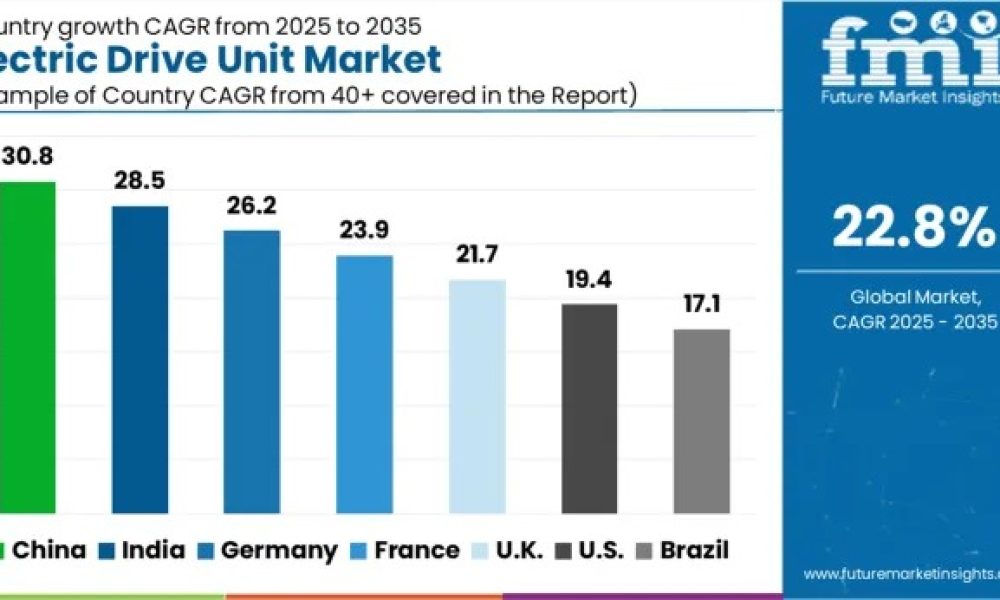
The global electric drive unit market is projected to expand from USD 30.2 billion in 2025 to USD 235.2 billion by 2035, registering a compound annual growth rate (CAGR) of 22.8% over the forecast period. Market expansion reflects accelerating adoption of electric vehicles (EVs), tightening emission regulations, and sustained investment in electric mobility infrastructure across major automotive regions.
Electric drive units, which integrate electric motors, power electronics, and gear systems into compact modules, are increasingly being adopted by automakers to simplify drivetrain architecture, improve energy efficiency, and optimize vehicle packaging. These systems are emerging as a foundational technology in the global transition toward electrified transportation.
Strong Growth Expected Through 2030 as EV Adoption Accelerates
Between 2025 and 2030, the electric drive unit market is expected to grow from USD 30.2 billion to USD 84.2 billion, supported by rapid expansion in battery electric vehicle production and policy-driven incentives promoting low-emission transport. Year-on-year growth highlights sustained momentum, with market values projected at USD 37.0 billion in 2026 and USD 45.5 billion in 2027.
By 2028, the market is forecast to reach USD 55.8 billion, increasing to USD 68.6 billion in 2029 before crossing USD 84.2 billion by 2030. Growth during this period is being reinforced by advances in electric powertrain design, battery integration, thermal management, and power density, alongside expanding EV charging infrastructure.
Electric Drive Units Central to Vehicle Electrification Strategies
The market’s rapid expansion is being driven by automakers’ increasing reliance on electric drive units to support vehicle electrification strategies. These integrated systems reduce manufacturing complexity, improve reliability, and enable scalable vehicle platforms across battery electric, hybrid, and plug-in hybrid vehicles.
Government incentives, tightening emission norms, and growing consumer demand for sustainable mobility are further strengthening market adoption. As OEMs scale EV production globally, electric drive units are becoming standard components across passenger and commercial electric vehicle platforms.
Get access to comprehensive data tables and detailed market insights — request your sample report today!
Battery Electric Vehicles Lead Market Demand
The battery electric vehicle (BEV) segment is projected to account for 48.6% of total market revenue by 2025, making it the leading vehicle type category. This dominance is attributed to zero tailpipe emission targets, expanding government subsidies, and increasing consumer preference for fully electric vehicles.
BEVs rely exclusively on electric propulsion, driving strong demand for high-efficiency, compact electric drive units. Commitments by global automakers to expand BEV model portfolios and production capacity continue to reinforce this segment’s leadership within the market.
OEMs Dominate Sales Channel Adoption
The original equipment manufacturer (OEM) segment is expected to contribute 55.2% of total market revenue by 2025, reflecting the widespread integration of electric drive units during vehicle production. OEMs benefit from platform-level customization, system optimization, and economies of scale, enabling cost efficiency and standardized performance.
Close collaboration between OEMs and component suppliers has accelerated innovation in drive unit modularity, thermal control, and system integration, reinforcing OEM dominance across global markets.
Water Glycol Coolant Systems Remain Preferred Technology
Within the coolant category, water glycol-based systems are anticipated to represent 62.3% of market revenue by 2025. Their adoption is driven by superior thermal conductivity, corrosion resistance, and compatibility with high-power electric components.
As electric drive units become more compact and power-dense, efficient thermal regulation is critical to maintaining performance, reliability, and safety. Water glycol solutions remain the preferred choice for managing heat across motors and power electronics.
Drive Your Business Growth Strategy: Checkout the Report for Key Insights
Asia-Pacific and Europe Lead Regional Growth
North America, Asia-Pacific, and Europe represent the primary growth regions for electric drive units. Country-level growth rates highlight strong momentum in emerging and established markets, led by China (30.8% CAGR), India (28.5%), and Germany (26.2%).
China’s expansion is supported by its large EV manufacturing base, government incentives, and investments in charging infrastructure. India’s growth reflects policy support, rising urbanization, and increasing adoption of electric buses and commercial vehicles. Germany’s growth is driven by its strong automotive sector, regulatory support for zero-emission vehicles, and investments by major OEMs in electric mobility.
The United Kingdom (21.7%) and the United States (19.4%) continue to demonstrate steady growth, supported by regulatory frameworks, EV infrastructure investment, and the transition toward electrified transportation systems.
Competitive Landscape Focused on Integration and Efficiency
The electric drive unit market remains highly competitive, with leading suppliers emphasizing energy efficiency, system integration, lightweight design, and scalability. Key market participants include AVL, BorgWarner Inc., Magna International Inc., Robert Bosch GmbH, ZF Friedrichshafen AG, Aisin Corporation, ElringKlinger AG, and LG Magna e-Powertrain, among others.
Manufacturers are investing in modular drive architectures, improved battery integration, and advanced cooling technologies to support next-generation electric vehicles across passenger and commercial segments.
Market Outlook
With accelerating EV adoption, expanding charging infrastructure, and continued innovation in electric powertrain technologies, the electric drive unit market is positioned for sustained high-growth through 2035. The projected 22.8% CAGR underscores the market’s strategic importance within the global electric mobility ecosystem, presenting significant opportunities for automakers, suppliers, and investors aligned with the transition to low-emission transportation.
Why Choose FMI: Empowering Decisions that Drive Real-World Outcomes: https://www.futuremarketinsights.com/why-fmi
About Future Market Insights (FMI)
Future Market Insights, Inc. (FMI) is an ESOMAR-certified, ISO 9001:2015 market research and consulting organization, trusted by Fortune 500 clients and global enterprises. With operations in the U.S., UK, India, and Dubai, FMI provides data-backed insights and strategic intelligence across 30+ industries and 1200 markets worldwide.



