
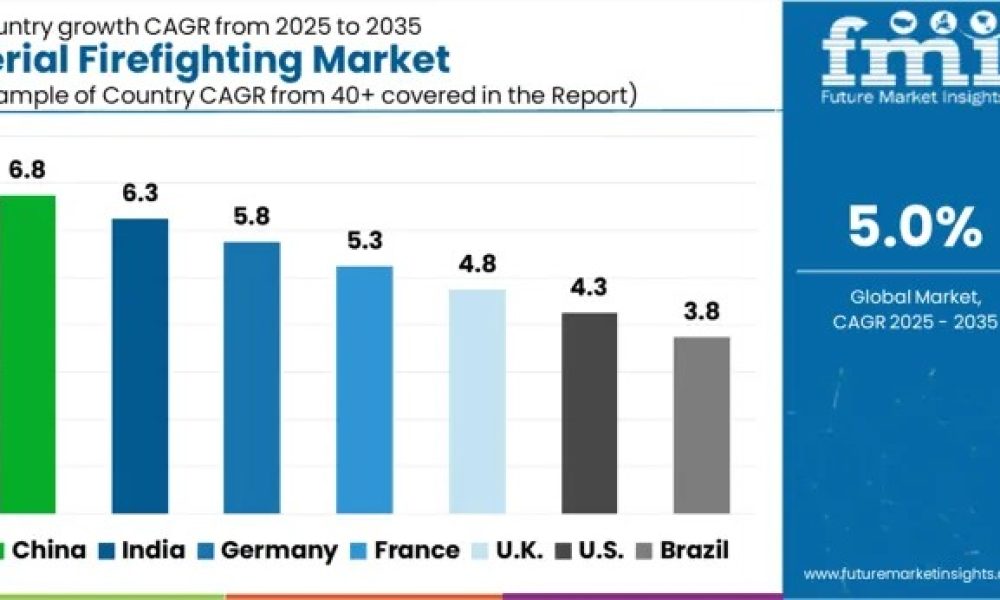
The global aerial firefighting market is projected to expand from USD 1.4 billion in 2025 to USD 2.3 billion by 2035, registering a compound annual growth rate (CAGR) of 5.0% over the decade. This growth represents an absolute market opportunity of USD 0.9 billion and a growth multiplier of 1.64x, reflecting the rising importance of aerial assets in combating increasingly frequent and severe wildfire events across multiple regions.
Market expansion is being shaped by climate change, prolonged droughts, deforestation, and the rapid expansion of urban–wildland interfaces, all of which have intensified wildfire risks globally. Governments, disaster management authorities, and private firefighting contractors are increasing investments in aerial firefighting infrastructure to improve response speed, coverage, and suppression effectiveness in difficult-to-access terrain.
Growth Phases Highlight Gradual Acceleration
Between 2025 and 2030, the aerial firefighting market is expected to grow from USD 1.4 billion to USD 1.8 billion, generating USD 0.4 billion in new value. This initial phase accounts for approximately 45.5% of total forecast growth, supported by heightened awareness of climate-driven fire risks and early-stage investments in fleet expansion and modernization. During this period, the market records a five-year growth multiplier of 1.29x, reflecting stable but measured adoption.
From 2030 to 2035, growth momentum is expected to strengthen, contributing an additional USD 0.5 billion, or 54.5% of total incremental growth. Annual market additions are projected to increase from around USD 0.1 billion in the early years to nearly USD 0.2 billion by 2035. This acceleration reflects deeper integration of advanced firefighting technologies, including improved retardant dispersal systems, enhanced avionics, and increasing use of unmanned and semi-autonomous aerial platforms.
Get access to comprehensive data tables and detailed market insights — request your sample report today!
Aircraft Segment Maintains Market Leadership
By 2025, aircraft are projected to account for 48.6% of total market revenue, making them the leading type segment within the aerial firefighting market. Fixed-wing aircraft are favored for their high payload capacity, long operational range, and ability to cover large fire zones rapidly. These aircraft play a central role in both direct fire suppression and coordinated support missions, particularly during large-scale wildfire outbreaks.
Ongoing fleet modernization programs and long-term contracts for large airtankers are reinforcing the dominance of this segment. Advances in fire retardant delivery systems and mission endurance capabilities further enhance the operational value of fixed-wing aircraft in national and regional firefighting strategies.
Firefighting Operations Dominate Service Demand
Firefighting operations are expected to represent 53.2% of total market revenue in 2025, making this the most critical service segment. As wildfires grow in scale and intensity, aerial firefighting is increasingly relied upon as a frontline response mechanism rather than a supplementary tool.
Governments and emergency agencies are expanding the use of contracted aerial firefighting services to augment in-house capabilities, particularly during peak fire seasons. The strategic importance of rapid aerial response in protecting lives, infrastructure, and ecosystems continues to drive sustained demand for firefighting operations services.
Government Agencies Lead End-User Adoption
Government agencies are anticipated to account for 46.7% of total market demand in 2025, reflecting their central role in disaster management and public safety. National, state, and municipal authorities remain the primary operators and purchasers of aerial firefighting fleets, often coordinated through defense, interior, and emergency management departments.
Rising budget allocations for disaster preparedness, along with improved inter-agency coordination, are strengthening government-led procurement and deployment of aerial firefighting assets. This leadership position is expected to continue as wildfire risks remain a persistent public policy concern.
Drive Your Business Growth Strategy: Checkout the Report for Key Insights
Regional Growth Patterns Reflect Risk Exposure
North America, Asia-Pacific, and Europe are identified as the key growth regions for the aerial firefighting market. Country-level analysis shows China leading with a CAGR of 6.8%, driven by increased wildfire exposure, urban expansion, and government investment in disaster response infrastructure. India follows with a CAGR of 6.3%, supported by rising forest fire incidents, infrastructure development, and growing emphasis on emergency preparedness.
In Europe, Germany is projected to grow at 5.8% and France at 5.3%, reflecting steady investments in firefighting modernization and forest protection programs. The United Kingdom records growth of 4.8%, while the United States expands at a comparatively moderate 4.3%, reflecting its status as a mature but technologically advanced market with ongoing fleet upgrades and service optimization.
Technology Innovation Shapes Competitive Dynamics
The competitive landscape is defined by a mix of aircraft manufacturers and specialized aerial firefighting service providers. Key participants include Aero Empresa Brasileira de Aeronáutica S.A. (Embraer), Air Tractor, Inc., Airbus Defence and Space, Boeing Company, Bombardier Inc., Coulson Aviation, Conair Group Inc., Bridger Aerospace Group Holdings, LLC, Dauntless Air, Inc., and Erickson Incorporated.
Competitive differentiation increasingly centers on aircraft efficiency, payload optimization, cost-effective operations, and integration of emerging technologies such as drone-assisted firefighting, autonomous flight systems, and real-time fire monitoring. Manufacturers and service providers that deliver reliable, scalable, and technologically advanced solutions are positioned to capture a significant share of the USD 0.9 billion growth opportunity forecast through 2035.
As wildfire events continue to escalate in frequency and severity, the aerial firefighting market is expected to remain a critical component of global disaster response systems, supported by steady investment, technological progress, and long-term public safety priorities.
Why Choose FMI: Empowering Decisions that Drive Real-World Outcomes: https://www.futuremarketinsights.com/why-fmi
About Future Market Insights (FMI)
Future Market Insights, Inc. (FMI) is an ESOMAR-certified, ISO 9001:2015 market research and consulting organization, trusted by Fortune 500 clients and global enterprises. With operations in the U.S., UK, India, and Dubai, FMI provides data-backed insights and strategic intelligence across 30+ industries and 1200 markets worldwide.



