
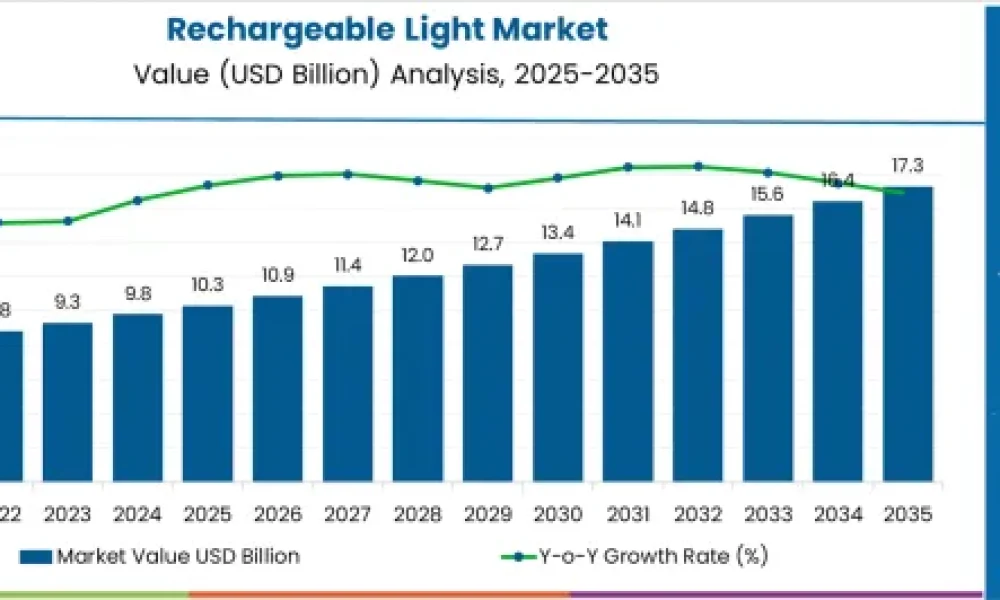
The global rechargeable light market is forecast to grow from USD 10.3 billion in 2025 to USD 17.3 billion by 2035, registering a compound annual growth rate (CAGR) of 5.3% over the ten-year period. The USD 7.0 billion absolute dollar opportunity highlights a sustained expansion supported by rising adoption of portable and energy-efficient lighting solutions across residential, commercial, industrial, and outdoor applications worldwide.
Gain access to detailed segment-wise analysis and forecast statistics – Request the Sample Report Today
Market Overview:
The market encompasses rechargeable lighting products such as handheld flashlights, camping lanterns, headlamps, emergency lights, and industrial work lights. Growth is being observed globally, with North America, Asia-Pacific, and Europe emerging as the most influential regions. Between 2025 and 2035, demand is being shaped by a combination of technological advancements in battery storage, increasing consumer awareness of sustainability, and growing reliance on portable lighting for emergency preparedness and off-grid use.
Rechargeable lights are increasingly replacing disposable battery-powered alternatives as households, businesses, and institutions seek cost-effective and environmentally responsible illumination. The shift is further reinforced by government initiatives promoting energy efficiency and the reduction of single-use battery waste.
Key Market Metrics and Structure
In 2025, portable rechargeable lights account for 57.4% of global revenue, making them the leading type segment due to their versatility and ease of use across home, outdoor, and professional settings. By product category, handheld flashlights represent 38.6% of market revenue, reflecting their widespread adoption in residential, commercial, tactical, and maintenance applications.
From a power source perspective, battery-powered models using lithium-ion and NiMH batteries dominate with a 61.8% share. These technologies are favored for their high energy density, longer cycle life, and compatibility with USB and solar-assisted charging systems.
Market Context: Parent Industries and Demand Drivers
The rechargeable light market is influenced by five interconnected parent markets. Consumer electronics and portable devices lead with a 32% share, followed by residential lighting at 28% and industrial and commercial lighting at 20%. Together, these segments account for 80% of total demand, underscoring the importance of convenience, energy savings, and mobility.
Growth is also being supported by the automotive and outdoor mobility segment (12%), where rechargeable lights are integrated into vehicle kits and adventure gear, and the renewable and off-grid energy solutions segment (8%), particularly in regions with limited grid reliability.
Why the Rechargeable Light Market Is Growing
Market expansion is being driven by improvements in LED efficiency, advances in lithium-ion and NiMH battery technologies, and shorter recharge times with longer operational life. Rechargeable lights are increasingly included in emergency preparedness kits, outdoor recreation equipment, and professional work environments, broadening their relevance across end-use sectors.
The rapid growth of e-commerce channels has further enhanced accessibility, allowing consumers to compare features, pricing, and durability across brands. Competitive pricing and online availability are contributing to higher adoption rates, particularly in developing economies.
Regional Growth Patterns and Country-Level Insights
The global market is expected to grow at 5.3% CAGR, with notable regional variation. China leads with a CAGR of 7.2%, supported by high-volume manufacturing, rural electrification programs, and strong domestic consumption. India follows at 6.6%, driven by government-backed off-grid lighting initiatives and rising demand for affordable solar-rechargeable solutions.
In Europe, Germany (6.1%) emphasizes premium, durable, and eco-compliant products, while France (5.6%) and the U.K. (5.0%) show steady growth through household adoption and online distribution. The United States, growing at 4.5%, represents a stable market where demand is shaped by outdoor recreation, disaster preparedness, and gradual replacement of disposable battery-based lighting.
Competitive Landscape and Industry Positioning
The rechargeable light market features a mix of global brands and regional manufacturers competing on battery performance, durability, and multifunctionality. Key players include Philips Lighting, Black Diamond Equipment, Coleman, Duracell, Energizer, Panasonic, Petzl, Maglite, Milwaukee Tool, Nitecore, Olight, Streamlight, Fenix Lighting, Goal Zero, and SureFireC.
Competition is intensifying as companies balance affordability with innovation, introducing features such as USB charging, solar compatibility, waterproof housings, and integrated power-bank functionality. E-commerce and direct-to-consumer strategies are playing a central role in expanding market reach.
Outlook Through 2035
As sustainability, portability, and energy efficiency remain central to purchasing decisions, the rechargeable light market is expected to maintain steady growth through 2035. Continued innovation in battery chemistry, expanding off-grid applications, and the rising importance of multifunctional lighting devices are set to define the next phase of industry development, positioning rechargeable lighting as a core component of modern illumination solutions worldwide.
Have a specific Requirements and Need Assistant on Report Pricing or Limited Budget please contact us – [email protected]
About Future Market Insights (FMI)
Future Market Insights, Inc. (FMI) is an ESOMAR-certified, ISO 9001:2015 market research and consulting organization, trusted by Fortune 500 clients and global enterprises. With operations in the U.S., UK, India, and Dubai, FMI provides data-backed insights and strategic intelligence across 30+ industries and 1200 markets worldwide
Why Choose FMI: https://www.futuremarketinsights.com/why-fmi



