
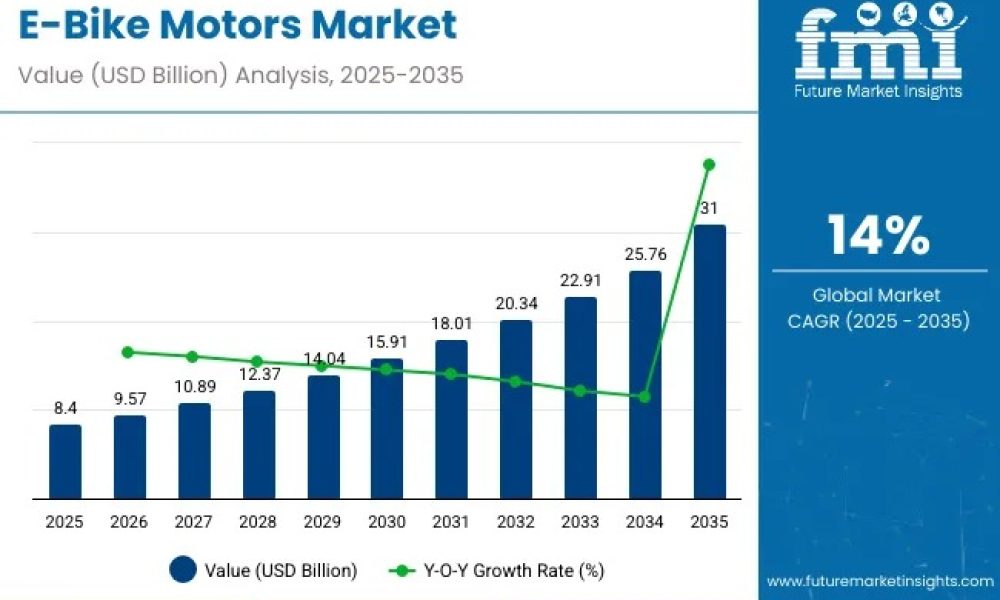
The global e-bike motors market is entering a decade of accelerated expansion as electric bicycles move from niche adoption toward a core role in urban and recreational mobility. The market is projected to reach USD 8.4 billion in 2025 and expand to USD 31 billion by 2035, growing at a compound annual growth rate (CAGR) of 14%. This represents a 3.7x increase in market value over ten years, reflecting the convergence of clean transport policies, affordability, and sustained improvements in motor and battery technology.
Growth is being shaped by rising adoption of electric mobility, government incentives for low-emission transport, and consumer demand for cost-efficient commuting solutions. As cities expand cycling infrastructure and prioritize micromobility, e-bike motors are increasingly viewed as a practical component of everyday transport rather than an alternative or recreational add-on.
Market Context: What Is Driving Expansion and How Adoption Is Evolving
E-bike motors sit at the center of the electric bicycle value chain, converting stored battery energy into assisted propulsion that reduces rider effort and travel time. Adoption is accelerating across commuter, cargo, trekking, and performance segments as motor efficiency improves and total cost of ownership declines.
Breakpoint analysis shows that early growth phases were defined by basic hub motor adoption in entry-level city bikes. The market is now crossing a structural breakpoint where mid-drive motors, smart assistance, and integrated designs are broadening acceptance across premium commuter, cargo, and mountain bike categories. By 2035, with market value reaching USD 31 billion, e-bike motors are expected to transition from a sustainability-led solution to a mainstream mobility technology across developed and emerging economies.
Get access to comprehensive data tables and detailed market insights — request your sample report today!
Technology Shifts Reshaping Demand
Motor development is increasingly focused on lighter weight, quieter operation, and higher torque density. Compact mid-drive motors are gaining traction in performance, trekking, and cargo bikes due to improved weight balance and torque delivery, while hub motors continue to dominate entry-level and urban models because of affordability and ease of installation.
Efficiency improvements of 8–15% over previous generations are extending riding range on typical 400–700 Wh battery packs, while controller upgrades are reducing energy losses in stop-start urban routes. Manufacturers are also exploring regenerative braking concepts and integrating motors with IoT-based platforms that allow riders to monitor efficiency and adjust assistance levels. Lightweight architectures are reducing motor mass by 10–15%, improving handling and portability.
Segment Analysis: Power, Application, and Product Structure
By motor type, up to 250 W motors account for approximately 45% of demand, driven by regulatory compliance in Europe and widespread use in urban commuter bikes. These motors typically weigh 2.5–3.5 kg, deliver ranges of 40–70 km per charge, and are capped at 25 km/h in compliance-driven markets.
By application, OEM integration dominates with around 70% of demand, as manufacturers embed motors directly into bicycle designs to improve efficiency, durability, and warranty coverage. OEM contracts commonly span 3–5 years, supporting predictable production volumes and standardized battery-motor systems.
By product category, hub motors hold roughly 60% market share, favored for cost efficiency and low maintenance. These units are widely used in commuter bikes, shared mobility fleets, and rental programs. Mid-drive motors account for about 35%, expanding rapidly in premium segments where riders value 70–95 Nm torque delivery and natural cadence feel.
Drive Your Business Growth Strategy: Checkout the Report for Key Insights
Regional Growth Patterns Reflect Volume and Value Differences
Regionally, Asia Pacific leads global unit demand, with China and Southeast Asia driving volume through large-scale production and domestic adoption. Europe remains the center of premium commuter and cargo e-bikes, supported by regulatory alignment and cycling infrastructure investment. North America shows steady growth, particularly in cargo and delivery applications.
China records the fastest growth at a 14.8% CAGR, supported by an unmatched manufacturing ecosystem and more than 35 million annual e-bike sales. India follows at 13.9%, driven by affordable hub motors and rising fleet adoption. Germany grows at 11.5%, emphasizing premium mid-drive technology, while the United Kingdom and United States expand at 11.0% and 10.0%, respectively, reflecting gradual but steady adoption in mature markets.
Competitive Landscape and Industry Structure
The e-bike motors market is characterized by a mix of global leaders and specialized manufacturers. Bosch holds an estimated 30% market share in 2025, driven by its strong position in mid-drive systems for premium e-bikes in Europe and North America. Yamaha Motor continues to expand with compact, lightweight motors, while TDCM and other suppliers focus on customized motor systems for OEM partners. Chinese manufacturers such as Suzhou Xiongda Motor play a central role in supplying cost-effective hub motors at scale.
Competition centers on performance reliability, integration capability, and efficiency rather than on price alone. Manufacturers are increasingly collaborating with bicycle brands and battery suppliers to deliver integrated motor-battery platforms that reduce bill of materials and speed time to market.
Outlook Through 2035
The e-bike motors market is being reshaped by urban electrification, performance gains, and segment diversification. As regulatory clarity, infrastructure investment, and technology alignment continue, motors are becoming a foundational element of future mobility systems. The projected tripling of market value by 2035 underscores how affordability, innovation, and policy support are collectively positioning e-bike motors as a long-term growth engine within the global electric mobility landscape.
Why Choose FMI: Empowering Decisions that Drive Real-World Outcomes: https://www.futuremarketinsights.com/why-fmi
About Future Market Insights (FMI)
Future Market Insights, Inc. (FMI) is an ESOMAR-certified, ISO 9001:2015 market research and consulting organization, trusted by Fortune 500 clients and global enterprises. With operations in the U.S., UK, India, and Dubai, FMI provides data-backed insights and strategic intelligence across 30+ industries and 1200 markets worldwide.



