
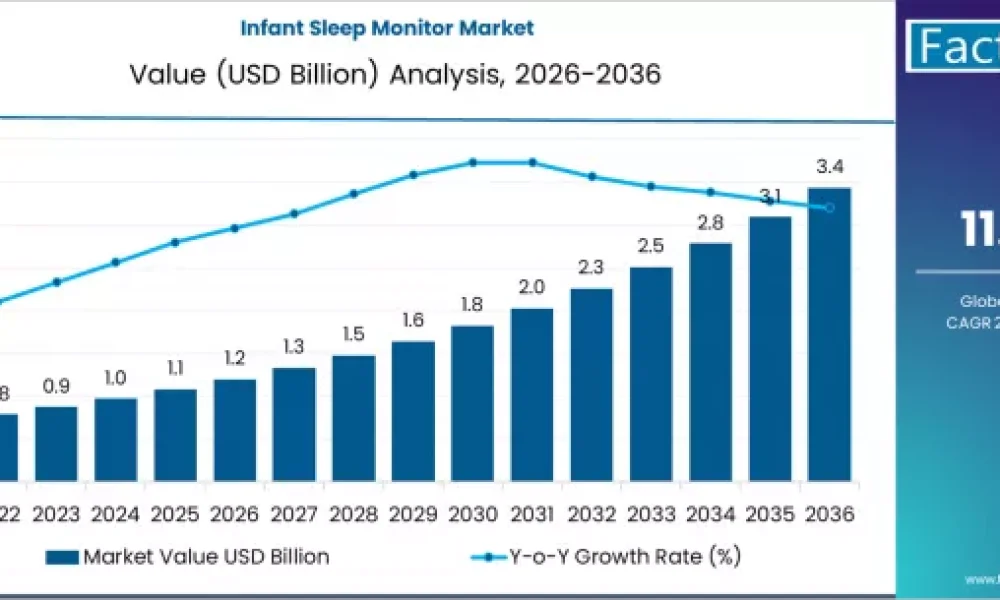
The global Infant Sleep Monitor Market is poised for significant expansion through 2036 as parents, caregivers, and healthcare providers increasingly prioritize safe sleep practices for newborns and infants. Infant sleep monitors are specialized devices designed to track vital signs and sleep patterns — such as movement, breathing, heart rate, and oxygen levels — helping caregivers detect irregularities and respond promptly. With rising awareness of sleep-related infant health risks, including Sudden Infant Death Syndrome (SIDS) and sleep apnea, demand for reliable monitoring solutions is growing in both home and clinical settings.
The market for newborn sleep monitors is expected to increase at a compound annual growth rate (CAGR) of 11.1% between 2026 and 2036, from USD 1.2 billion in 2026 to USD 3.4 billion by 2036.
Market Outlook (2026–2036)
- Infant Sleep Monitor Market Value (2026): USD 1.2 billion
- Infant Sleep Monitor Market Forecast Value (2036): USD 3.4 billion
- Infant Sleep Monitor Market Forecast CAGR: 11.1%
- Leading Device Category in Infant Sleep Monitor Market: Wearable Sleep Socks or Bands (50.6%)
- Key Growth Regions in Infant Sleep Monitor Market: North America, Europe, Asia Pacific
- Key Players in Infant Sleep Monitor Market: Owlet, Nanit, Withings, Philips, Motorola Mobility
The market’s strong forecast reflects the combined impact of safety priorities, technological enhancements, and shifting consumer expectations around infant care and monitoring.
To Access the Complete Data Tables & in-depth Insights, Request a Discount on this report: https://www.factmr.com/connectus/sample?flag=S&rep_id=13547
Market Overview
Infant sleep monitors are devices that track physiological and behavioral indicators while babies sleep. These monitors vary by technology and form factor, including:
Wearable Monitors: Devices worn on the infant’s clothing or attached to a sleep garment that measure breathing, movement, and vital signs.
Under-Mattress and Sensor-Pad Systems: Contactless solutions placed beneath a mattress to detect motion and respiration without direct skin contact.
Video and Camera-Based Monitors: Visual systems that provide live video feed, night vision, and audio alerts.
Smartphone-Connected Monitors: Devices that transmit real-time data to mobile apps, enabling remote monitoring and customizable notifications.
Modern sleep monitors often include features such as alerts for irregular breathing or prolonged inactivity, two-way audio, temperature and humidity sensors, and integration with smart home devices.
Key Market Drivers
1. Increased Awareness of Infant Sleep Safety
Parents and caregivers are becoming more informed about risks associated with infant sleep, including SIDS and sleep-related distress. This awareness is driving uptake of monitoring solutions that help detect early signs of irregular sleep patterns.
2. Growth in Connected Health and Smart Home Integration
Advances in wireless technology, mobile health applications, and cloud connectivity enable sleep monitors to deliver real-time insights, alerts, and trends directly to caregivers’ smartphones. Integration with smart home ecosystems enhances both convenience and safety.
3. Rising Disposable Income and Infant Care Spending
As disposable incomes rise in many regions, parents are allocating greater share of household spending toward advanced infant care and safety products. Infant sleep monitors are increasingly viewed as essential tools for early childhood care.
4. Expansion of E-Commerce and Retail Access
Wider availability of sleep monitors through online marketplaces and specialty baby product retailers makes it easier for consumers to access a range of options, driving adoption across diverse demographic segments.
5. Innovation in Sensor and Wearable Technologies
Continuous improvements in sensor accuracy, battery life, miniaturization, and user-friendly interfaces are enhancing device reliability and caregiver trust. Wearable technologies and non-invasive sensing methods expand choices based on comfort and preference.
Market Segmentation Insights
By Product Type:
Wearable Sleep Monitors: Devices worn by infants, often with Bluetooth or Wi-Fi integration.
Sensor-Pad and Under-Mattress Monitors: Contactless options placed under sleep surfaces.
Video/Smart Camera Monitors: Visual monitoring with alarms, night vision, and audio.
Mobile App-Enabled Monitoring Systems: Smartphone-connected solutions with data analytics.
By End User:
Parents and Primary Caregivers: Largest segment driven by home safety use cases.
Pediatric Clinics and Hospitals: Clinical applications for high-risk infants or post-discharge monitoring.
Home Healthcare Providers: Services that support remote monitoring and caregiver assistance.
By Distribution Channel:
Online/E-Commerce Platforms: Increasingly dominant due to convenience and variety.
Specialty Baby Product Retailers: Physical stores with expert advice.
General Retail and Department Stores: Broader access through mainstream channels.
Regional Demand Dynamics
North America is expected to command a significant share of the market due to high awareness of infant health risks, advanced healthcare systems, rapid adoption of mobile and smart technologies, and strong consumer spending on baby products.
Europe represents a key regional market supported by well-established pediatric care standards, wide availability of monitoring solutions, and strong safety regulations. Parental adoption of connected health devices is also robust.
Asia Pacific is projected to exhibit rapid growth, driven by expanding middle-class populations, rising urbanization, increasing internet penetration, and growing awareness of infant health and safety. Emerging markets such as China and India are seeing higher household spending on nursery technologies.
Regions including Latin America and Middle East & Africa are registering incremental adoption as access to digital devices expands and consumer preferences shift toward advanced infant care products.
Competitive Landscape
The infant sleep monitor market is moderately competitive, featuring technology firms, baby product specialists, and consumer electronics manufacturers. Companies are differentiating products through features such as advanced sensors, smart alerts, AI-powered sleep analytics, integration with mobile apps, and compatibility with other smart nursery devices.
Strategic partnerships with pediatric healthcare providers, digital health platforms, and parenting communities help vendors validate device effectiveness and build trust. Service offerings such as cloud-based data storage, subscription-based analytics, and regular firmware updates also support customer engagement and retention.
Future Outlook
The Infant Sleep Monitor Market is expected to maintain strong momentum through 2036 as caregivers increasingly adopt solutions that combine safety, convenience, and connectivity. Continued innovation in sensor technology, wireless standards, and predictive analytics will further enhance monitoring accuracy and user experience.
As parental awareness grows and smart home ecosystems expand into nursery settings, infant sleep monitors will become integral components of modern infant care routines — supporting safer sleep environments, better peace of mind, and improved early childhood health outcomes.
Have specific requirements or need assistance on report pricing or have a limited budget? Please contact [email protected]
About Fact.MR:
Fact.MR is a global market research and consulting firm, trusted by Fortune 500 companies and emerging businesses for reliable insights and strategic intelligence. With a presence across the U.S., UK, India, and Dubai, we deliver data-driven research and tailored consulting solutions across 30+ industries and 1,000+ markets. Backed by deep expertise and advanced analytics, Fact.MR helps organizations uncover opportunities, reduce risks, and make informed decisions for sustainable growth



