
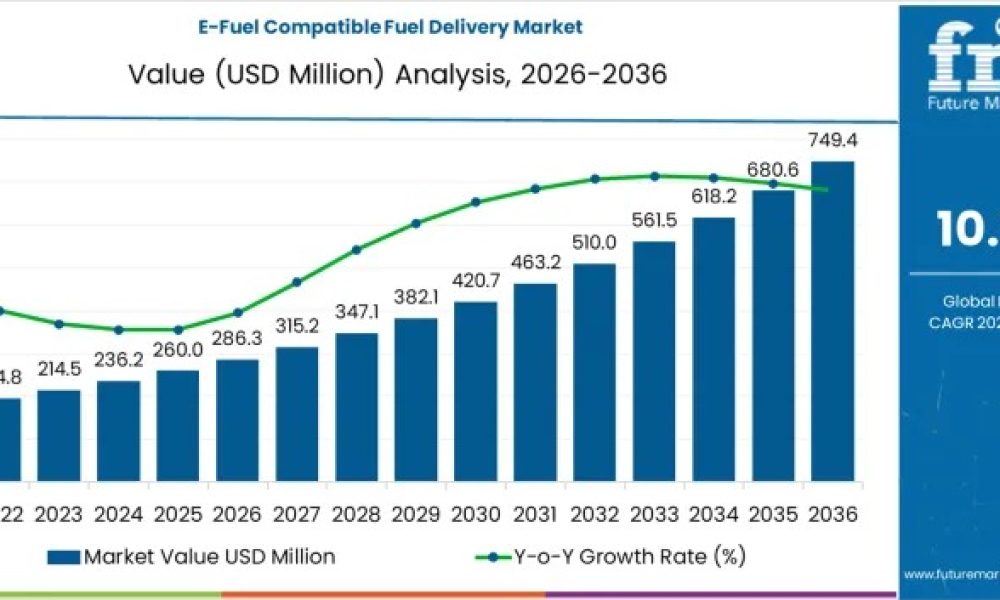
The global e-fuel compatible fuel delivery market is entering a high-growth phase as automotive and industrial stakeholders intensify efforts to decarbonize internal combustion engines while preserving existing vehicle platforms. Valued at USD 286.3 million in 2026, the market is projected to reach USD 749.4 million by 2036, expanding at a robust CAGR of 10.1%. This growth trajectory highlights the rising strategic role of e-fuel compatible systems in enabling synthetic and renewable fuels to integrate seamlessly into current and next-generation powertrains.
E-fuel compatible fuel delivery systems are designed to handle the chemical variability, viscosity shifts, and material stresses associated with synthetic hydrocarbons, renewable alcohol blends, and other low-carbon fuels. Unlike conventional fuel delivery components engineered primarily for fossil fuels, modern systems incorporate chemically resistant materials, precision pumps, injectors, seals, and calibrated controls to maintain performance, durability, and emissions compliance across diverse fuel formulations. As regulatory frameworks increasingly recognize e-fuels as viable decarbonization pathways, these delivery systems are becoming critical enablers of sustainable mobility strategies.
Market Structure Anchored in Fleet Programs and OEM Integration
Market outcomes are shaped by strong concentration in vehicles and fleets designed for sustainable fuel adoption. Passenger and commercial vehicle programs remain the primary end-use drivers, determining procurement cycles, production planning, and revenue visibility. Volume stability depends heavily on infrastructure readiness, OEM adoption timelines, and regulatory certification, rather than short-term demand fluctuations.
Suppliers delivering validated, multi-fuel compatible fuel delivery systems benefit from more predictable revenue streams, particularly when aligned with high-volume OEM platforms or long-term fleet programs. In contrast, smaller or regional producers often face order volatility and limited bargaining leverage, especially where system integration, testing, and certification requirements create high entry barriers. As a result, value creation increasingly favors established operators capable of combining engineering validation, regulatory compliance, and scalable manufacturing.
Get access to comprehensive data tables and detailed market insights — request your sample report today!
Strong Growth Outlook Driven by Volume and System Adoption
Between 2026 and 2031, the market is expected to expand from USD 286.3 million to USD 420.7 million, generating an absolute increase of USD 134.4 million. Approximately 67% of this growth is volume-driven, supported by rising adoption of drop-in ready components, seal and material upgrades, and calibration support across gasoline ICE, diesel ICE, and hybrid powertrains. The remaining 33% of growth comes from price effects, reflecting premium component designs, enhanced materials, and OEM line-fit programs.
From 2031 to 2036, growth accelerates further, with market value projected to reach USD 749.4 million, adding USD 328.7 million. Volume remains the dominant contributor at 65%, driven by broader powertrain coverage, aftermarket retrofits, and deeper Tier-1 integration. Price growth, accounting for 35%, is supported by advanced material technologies, system-level calibration, and differentiated delivery modules. Competitive advantage increasingly rests with suppliers that combine proven e-fuel performance, OEM partnerships, and scalable production capabilities.
Drop-In Ready Components and Gasoline ICE Lead Adoption
By compatibility level, drop-in ready components represent approximately 42% of total demand, making them the leading segment. These solutions allow existing fuel systems to operate on e-fuels with minimal modification, reducing downtime and retrofit costs while preserving operational flexibility. Their ease of integration, compatibility with existing injectors and pumps, and validated performance under variable fuel chemistries make them particularly attractive for fleets and OEMs seeking rapid e-fuel adoption.
By powertrain, gasoline internal combustion engines account for around 46% of total market demand. Gasoline ICE platforms represent the largest installed base globally and are well suited for adaptation to e-fuels with targeted fuel delivery upgrades. Optimized materials, seals, and calibrations enable stable combustion, precise injection, and emissions compliance, allowing gasoline ICE vehicles to achieve meaningful carbon reductions without extensive infrastructure changes.
Regional Growth Reflects Policy Support and Fuel Availability
Regional adoption patterns vary according to renewable fuel availability, fleet modernization strategies, and policy frameworks. China leads global growth with a CAGR of 12.5%, driven by supportive regulations, large-scale alternative fuel initiatives, and integration of e-fuel compatible systems into both passenger and commercial vehicles. Brazil follows closely at 12.1%, leveraging its long history with alternative fuels and government incentives to modernize vehicle fleets.
The United States, growing at 9.5%, is characterized by pilot programs, fleet trials, and research initiatives focused on low-carbon fuels. Growth in the United Kingdom (9.3%) reflects strong regulatory alignment and expanding alternative fuel infrastructure, while Japan (8.3%) shows steady adoption through advanced vehicle platforms and targeted industrial programs. Across regions, demand is concentrated in automotive manufacturing hubs, engine assembly plants, and pilot deployments rather than mass fleet rollouts in the near term.
Competitive Landscape Defined by Precision and Validation
Competition in the e-fuel compatible fuel delivery market centers on materials compatibility, precision metering, and integration with engine management systems. Leading players—including Bosch, Denso, Continental, Delphi (BorgWarner), Parker Hannifin, Marelli, Mahle, Eaton, Weifu High-Technology, and Gates—differentiate through validated performance across multiple fuel chemistries, high-pressure stability, and long-term durability.
Established suppliers secure concentrated value by standardizing platforms, documenting performance under varied e-fuel blends, and embedding systems within OEM supply chains. Fragmentation persists among aftermarket and regional providers; however, certification requirements and performance verification increasingly favor operators with scale, technical depth, and regulatory expertise.
Outlook: A Strategic Enabler for Low-Carbon Combustion
Looking ahead, e-fuel compatible fuel delivery systems are poised to become a foundational element of decarbonized internal combustion strategies. Growth will be driven less by output volume alone and more by system reliability, fleet program alignment, and verified compliance with evolving fuel and emissions standards. As governments, OEMs, and fleet operators seek practical pathways to reduce lifecycle emissions while leveraging existing assets, demand for proven e-fuel compatible solutions is set to accelerate.
The full market report provides detailed forecasts, segmentation analysis, competitive benchmarking, and regional insights essential for understanding how e-fuel compatible fuel delivery systems will shape the future of sustainable mobility through 2036.
Why Choose FMI: Empowering Decisions that Drive Real-World Outcomes: https://www.futuremarketinsights.com/why-fmi
About Future Market Insights (FMI)
Future Market Insights, Inc. (FMI) is an ESOMAR-certified, ISO 9001:2015 market research and consulting organization, trusted by Fortune 500 clients and global enterprises. With operations in the U.S., UK, India, and Dubai, FMI provides data-backed insights and strategic intelligence across 30+ industries and 1200 markets worldwide.



