
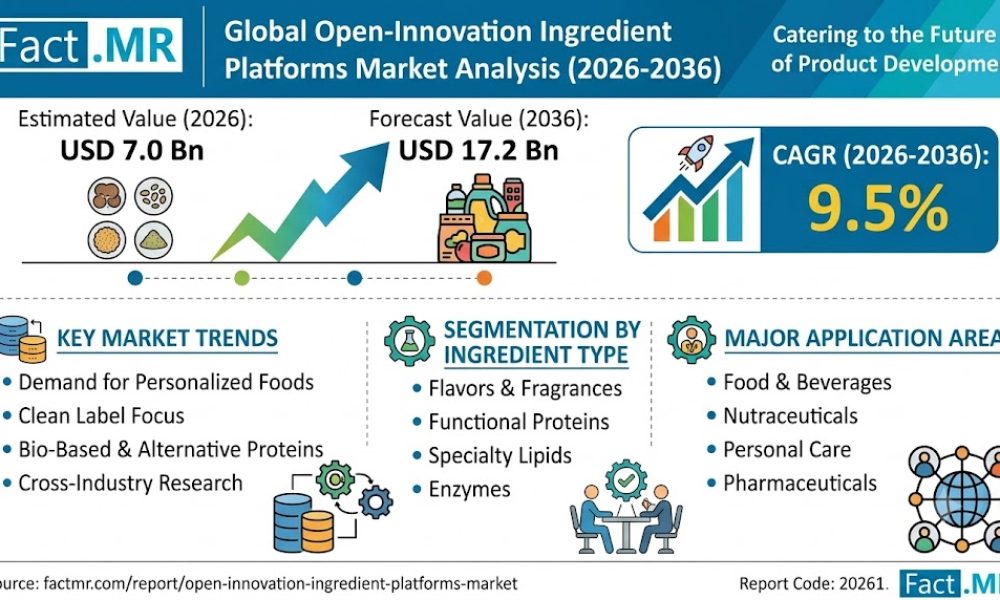
The global open-innovation ingredient platforms market is projected to grow from USD 7.0 billion in 2026 to USD 17.2 billion by 2036, registering a 9.5% CAGR during the forecast period. The market reached USD 6.4 billion in 2025. Growth is being supported by ingredient companies, consumer brands, research institutions, and technology partners using external networks to identify, screen, test, license, and commercialize new ingredient ideas.
Ingredient firms are expanding their search beyond internal laboratories as enzymes, proteins, cultures, fermentation technologies, and other functional ingredients increasingly require outside research and technical capabilities. The USDA Economic Research Service reported in June 2026 that inflation-adjusted U.S. food spending reached USD 2.51 trillion in 2025, highlighting the scale of the food market in which product-development teams are seeking new ingredient solutions.
Get Detailed Market Forecasts, Competitive Benchmarking, and Pricing Trends: https://www.factmr.com/connectus/sample?flag=S&rep_id=16571
Global Segment Leaders
- Startup scouting — 36.0% share in 2026: This platform model leads as ingredient companies seek structured ways to identify external ventures, technologies, and intellectual property before entering formal joint projects.
- Food — 32.0% share: Food represents the leading ingredient domain because product teams often need solutions spanning taste, texture, nutrition, preservation, and processing performance.
- Discovery — 31.0% share: Discovery accounts for the largest workflow share because outside options generally need to be identified and screened before companies commit resources to prototypes, validation, or scale-up.
- Ingredient suppliers — 35.0% share: Ingredient suppliers lead by connecting their internal laboratories and formulation expertise with startups, research institutes, buyers, and technology partners.
Country-Level Performance
- United Kingdom — 10.0% CAGR: The UK benefits from a research-intensive business base supporting external technology searches and joint development. The Office for National Statistics reported in November 2025 that UK businesses performed GBP 55.6 billion in R&D during 2024, up 4.5% from 2023.
- Japan — 9.7% CAGR: University ventures are expanding the pool of technologies available for scouting. Japan’s Ministry of Economy, Trade and Industry reported in June 2026 that 6,220 university startups had been identified as of October 2025, compared with 5,074 in the previous survey.
- United States — 9.4% CAGR: A broad corporate research base supports external ingredient research and cross-border R&D. The U.S. Bureau of Economic Analysis reported in July 2026 that R&D by U.S. affiliates of foreign multinational enterprises reached USD 95.5 billion in 2024, an increase of 5.3%.
- Germany — 9.1% CAGR: Business R&D and applied-science networks provide routes for ingredient firms to identify external technologies and move selected concepts into testing and licensing. Destatis reported in March 2026 that German R&D spending reached EUR 137.1 billion in 2024, up 3.8% year over year.
- France — 8.7% CAGR: France’s research workforce supports partner searches and joint testing across food, nutrition, and biotechnology applications. The Ministry of Higher Education and Research reported in April 2026 that companies employed 321,500 full-time-equivalent R&D staff in 2024, up 3.1% from 2023.
The five-country CAGR range spans 1.3 percentage points, from 10.0% in the UK to 8.7% in France. Fact.MR covers North America, Latin America, Western Europe, Eastern Europe, East Asia, South Asia & Pacific, and the Middle East & Africa in its regional assessment.
Regional Context
North America, Europe, and East Asia remain important markets for open ingredient innovation because of their research infrastructure, corporate R&D activity, university networks, and established ingredient industries. Startup and university scouting is identified by Fact.MR as a short-term growth driver, while licensing routes for outside intellectual property are expected to have a longer-term effect.
Digital screening tools and buyer joint-work networks are also supporting adoption. AI-assisted ingredient search represents an emerging opportunity, while shared pilot and testing networks can help close the gap between discovery and commercial proof. At the same time, uneven proof quality, intellectual-property and confidentiality terms, novel-ingredient regulatory review, and gaps between scouting and scale-up can slow conversion.
Competitive Landscape
The market includes Kerry Group, Ingredion, IFF, Cargill, Tate & Lyle, and dsm-firmenich. Competition is shaped by scientific breadth, customer collaboration, testing infrastructure, evidence quality, and the ability to move an external technology from discovery toward a commercially viable ingredient or product solution.
Kerry Group opened its Biotechnology Centre in Leipzig in September 2025. The company said the facility brings together more than 100 scientists and technical experts and supports enzyme and strain identification and engineering, fermentation, bioprocess development, scale-up, and production.
Cargill reopened its transformed Singapore Innovation Center in April 2025. The facility supports food science, culinary innovation, consumer research, and co-creation with customers across Asia.
Tate & Lyle uses Customer Innovation and Collaboration Centres and technology-enabled resources such as its ALFIE automated laboratory to support ingredient development and testing. Ingredion operates its Idea Labs® network and co-creation programs, while IFF, Cargill, and dsm-firmenich maintain innovation, laboratory, pilot, and customer collaboration capabilities across their respective ingredient portfolios.
Analyst Opinion
Shambhu Nath Jha, Principal Consultant at Fact.MR, states: “Open-innovation networks create value when search leads move into product proof. Ingredient teams need clear proof, ownership and test steps. Networks that link search, screening, testing and launch are expected to draw more use than simple partner lists.”
Strategic Implications
Ingredient companies can improve external scouting by defining technology searches around specific product gaps. Clear challenge briefs can also help CPG brands communicate performance targets, processing limits, and proof requirements before inviting outside proposals.
Platform operators need visible stage gates so users can distinguish early discovery leads from technologies that have passed screening, trials, or validation. This can help product teams focus on the next proof requirement and reduce internal handoffs.
The Fact.MR study draws on 120+ sources, 35+ company portfolios, 25+ countries, and more than 20 industry interviews. Its analysis combines primary discussions with manufacturers, service providers, technology developers, distributors, end users, and subject-matter experts with government statistics, regulatory publications, company filings, trade data, technical studies, industry associations, standards, and public policy sources.
Explore More Related Studies Published by Fact.MR Research:
Low-Drag Satellite Platforms Market
Multi-Chamber Biobased Detergents Market
About Fact.MR
Fact.MR is a global market research and consulting firm providing market intelligence across industries including Food & Beverage, Consumer Goods, Healthcare, Technology, Chemical & Materials, Automotive, and Industrial Goods. Its research combines primary and secondary sources to support market sizing, competitive analysis, demand assessment, and industry forecasting.



