
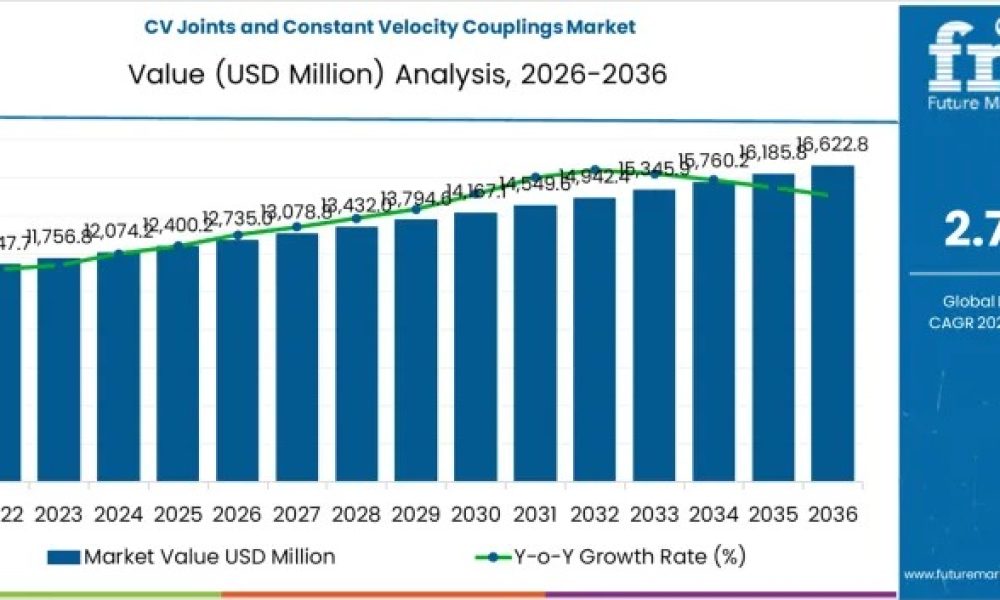
The global CV joints and constant velocity couplings market continues to demonstrate steady, structurally anchored growth, reflecting the indispensable role of constant velocity transmission in modern driveline architectures. Valued at USD 12,735.0 million in 2026, the market is forecast to reach USD 16,622.8 million by 2036, expanding at a compound annual growth rate (CAGR) of 2.7% over the forecast period. This progression underscores the non-discretionary nature of CV joints in front-wheel drive (FWD), all-wheel drive (AWD), and independent suspension systems, where smooth torque transfer under articulation is essential for safety, performance, and durability.
Unlike components influenced by rapid propulsion shifts, CV joints and constant velocity couplings remain fundamentally tied to drivetrain geometry and vehicle architecture continuity. These components operate under combined torsional load, angular displacement, and axial movement, making fatigue resistance, precision geometry, and sealing integrity critical to long-term performance. As a result, market value behavior is shaped more by platform stability, mileage accumulation, and disciplined maintenance cycles than by short-term changes in vehicle mix.
Structural Dependence on Articulated Driveline Architectures
The sustained relevance of CV joints is rooted in the widespread adoption of FWD and AWD platforms across passenger vehicles, light trucks, and commercial fleets. These architectures rely on constant velocity transmission to maintain uniform rotational speed during steering input and suspension travel. Even as powertrain technologies evolve, the mechanical requirement for articulated torque transfer remains unchanged.
Electrified drivetrains introduce higher instantaneous torque and regenerative loading, increasing stress concentration within joints without eliminating the need for mechanical articulation. This reinforces demand for proven designs capable of handling elevated torque profiles while maintaining noise, vibration, and harshness (NVH) control. However, safety-critical failure consequences and high validation costs continue to drive design conservatism, limiting rapid shifts in geometry or material selection.
OEM Stability and Aftermarket-Driven Volume Progression
Original equipment manufacturer (OEM) demand remains anchored to platform continuity and validated joint families with predictable service life and interchangeability across vehicle programs. Procurement strategies prioritize components with established performance histories, tight dimensional tolerances, and consistent heat treatment outcomes.
In contrast, aftermarket demand tracks mileage accumulation, boot degradation, lubrication loss, and vibration thresholds identified during inspection cycles. Replacement dynamics are typically triggered by progressive wear in ball tracks, cages, and splines, often accelerated by seal failure or misalignment rather than outright torque overload. As global vehicle fleets age and utilization intensity remains high, maintenance-led replacement continues to contribute materially to market stability.
Get access to comprehensive data tables and detailed market insights — request your sample report today!
Rzeppa Joints Lead Demand Due to Steering Compatibility
By joint type, Rzeppa joints account for 46.0% of global demand, reflecting their superior angular capability and smooth torque delivery under steering conditions. These joints are widely deployed in outboard applications where steering articulation and ride refinement are critical. Their ability to minimize torque fluctuation during cornering supports widespread adoption across passenger vehicles and crossovers.
Tripod joints address inboard applications requiring axial plunge to accommodate suspension travel, while heavy-duty constant velocity couplings support higher torque requirements in specialized vehicles. Overall segmentation highlights a strong preference for joint designs that balance articulation range, durability, and NVH performance across high-volume driveline configurations.
Passenger Vehicles Remain the Primary Demand Center
By vehicle segment, passenger vehicles represent 58.0% of total demand, driven by high production volumes and the dominance of FWD layouts. Consumer expectations for smooth acceleration, low vibration, and predictable handling elevate the importance of precision CV joint performance. Standardized platforms enable scalable integration across multiple models, reinforcing volume efficiency.
Light trucks and light commercial vehicles apply CV joints under higher load conditions but lower unit volumes, while heavy-duty vehicles often rely on alternative driveline solutions for extreme torque environments. This segmentation underscores the concentration of CV joint demand within passenger-focused platforms emphasizing refinement and cost efficiency.
Internal Combustion Engines Sustain Near-Term Dominance
From a powertrain perspective, internal combustion engine (ICE) platforms account for 54.0% of demand, reflecting the continued dominance of established vehicle parc globally. Conventional torque profiles align well with existing CV joint designs, supporting long production runs and standardized specifications.
Hybrid and battery electric vehicles introduce evolving torque characteristics, including rapid torque onset and regenerative braking loads. While these dynamics increase performance requirements, they do not reduce CV joint relevance. Instead, they reinforce the need for robust designs validated for higher stress cycles and extended durability.
Manufacturing Precision and Cost Discipline Shape Scalability
Manufacturing economics in the CV joints and constant velocity couplings market depend on heat treatment consistency, surface finish control, and tight tolerance stacking at scale. Small deviations can significantly affect fatigue life and NVH performance, raising the importance of process discipline and quality management systems.
Cost pressure remains a defining factor, particularly in high-volume passenger vehicle segments with aggressive pricing targets. At the same time, lightweighting initiatives introduce tradeoffs between strength and longevity, requiring careful material selection and geometry optimization. These factors collectively constrain rapid scalability and favor suppliers with mature manufacturing capabilities.
Global Demand Reflects Utilization Intensity and Maintenance Cycles
Regionally, demand growth remains steady rather than disruptive. China leads with a CAGR of 3.7%, supported by intensive commercial vehicle utilization in logistics and construction, frequent stop-start operation, and regulatory emphasis on drivetrain safety. Brazil follows at 3.6%, where long-haul freight, uneven road conditions, and agricultural transport accelerate joint wear and aftermarket replacement.
In the United States (2.5%), high mileage accumulation in commercial fleets sustains replacement demand, while preventive maintenance practices influence predictable service cycles. Germany (2.3%) and South Korea (2.2%) reflect mature fleet management environments, where strong engineering standards and disciplined servicing moderate replacement frequency but ensure consistent baseline demand.
Competitive Landscape Defined by Validation and Reliability
The competitive landscape is characterized by suppliers with deep engineering expertise, global manufacturing footprints, and long-standing OEM relationships. Leading players such as GKN Automotive, Dana, American Axle & Manufacturing, NTN, JTEKT, Schaeffler, Nexteer, ZF, Hyundai WIA, and Weichai compete on articulation performance, NVH control, material quality, and sealing effectiveness.
Differentiation increasingly depends on the ability to support higher torque loads, electrified driveline integration, and extended service life without compromising safety or reliability. As driveline architectures evolve incrementally rather than radically, suppliers that combine proven designs with incremental performance enhancements remain best positioned.
Outlook: Stability Anchored in Mechanical Necessity
The CV joints and constant velocity couplings market is defined by mechanical necessity rather than technological disruption. As long as vehicles rely on articulated drivetrains, constant velocity transmission will remain indispensable. Steady growth through 2036 reflects the market’s alignment with lifecycle maintenance, platform continuity, and safety-critical performance requirements, positioning CV joints as a durable cornerstone of global driveline systems.
Why Choose FMI: Empowering Decisions that Drive Real-World Outcomes: https://www.futuremarketinsights.com/why-fmi
About Future Market Insights (FMI)
Future Market Insights, Inc. (FMI) is an ESOMAR-certified, ISO 9001:2015 market research and consulting organization, trusted by Fortune 500 clients and global enterprises. With operations in the U.S., UK, India, and Dubai, FMI provides data-backed insights and strategic intelligence across 30+ industries and 1200 markets worldwide.



