
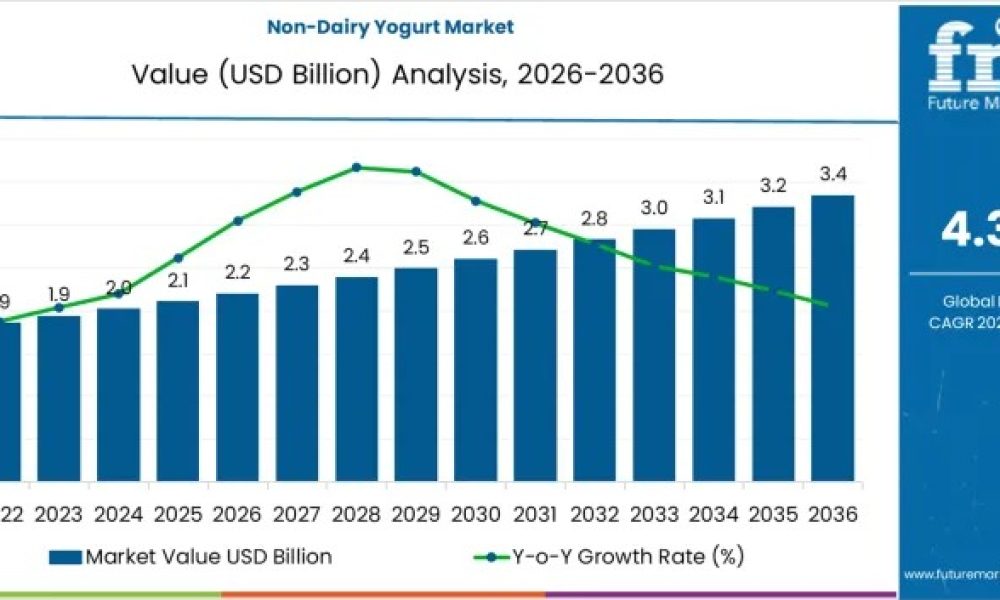
The global non-dairy yogurt market is entering a phase of measured yet resilient growth, supported by sustained consumer interest in plant-based nutrition and dairy-free alternatives. Valued at USD 2.2 billion in 2026, the market is projected to reach USD 3.4 billion by 2036, expanding at a compound annual growth rate (CAGR) of 4.3%. While growth is not explosive, it reflects a structurally sound market anchored in health awareness, dietary inclusivity, and expanding retail penetration.
Explore trends before investing – request a sample report today!
Non-dairy yogurt has transitioned from a niche health product to a mainstream food category, particularly among lactose-intolerant consumers, vegans, flexitarians, and individuals seeking clean-label and functional foods. Unlike short-term food trends, demand is being reinforced by consistent consumption patterns in both retail and foodservice channels, positioning the category for long-term stability rather than volatility.
Market Growth Outlook Through 2036
Between 2026 and 2031, the market is expected to grow from USD 2.2 billion to approximately USD 2.8 billion, driven by broader product availability, improved taste and texture, and innovation across plant bases such as almond, coconut, soy, and oats. This phase reflects increasing trial and repeat purchases as non-dairy yogurt becomes a routine dietary choice.
From 2031 onward, growth is forecast to moderate as the market enters a mature stage, ultimately reaching USD 3.4 billion by 2036. This trajectory reflects a classic S-shaped adoption curve, where early acceleration gives way to demand stabilization as penetration deepens across developed and emerging markets.
Quick Market Snapshot
- Market Value (2026): USD 2.2 billion
- Forecast Value (2036): USD 3.4 billion
- CAGR (2026–2036): 4.3%
- Leading Sales Channel: B2C retail (68% share)
- Dominant Form: Spoonable non-dairy yogurt (57% share)
- High-Growth Region: India
- Key Players: General Mills, Danone, Nestlé, Chobani, The Hain Celestial Group, Forager Project, Valio, Stonyfield Farm, Daiya Foods, Springfield Creamery
Demand Drivers Shaping the Market
Historically, growth in non-dairy yogurt was fueled by rising awareness of lactose intolerance, dairy allergies, and plant-based diets. Over time, innovation in fermentation techniques and ingredient formulation helped close the sensory gap with traditional dairy yogurt, strengthening consumer confidence and repeat consumption.
Looking ahead, demand will continue to be shaped by:
- Growing focus on digestive health and probiotics
- Environmental and ethical concerns related to animal agriculture
- Expansion of e-commerce and modern grocery retail
- Increased investment in clean-label, fortified, and protein-enhanced formulations
While higher production costs and raw material price fluctuations remain challenges, sustained interest in dairy-free nutrition is expected to support stable market expansion.
Leading Segments Driving Revenue
By form, spoonable non-dairy yogurt leads the market with a 57% share, favored for its familiarity, versatility, and alignment with traditional yogurt consumption habits. Consumers increasingly view spoonable formats as convenient meal or snack options with added functional benefits such as probiotics and micronutrients.
By sales channel, B2C distribution dominates with 68% share, supported by strong visibility in:
- Hypermarkets and supermarkets
- Specialty and health food stores
- Convenience outlets
- Online retail platforms
The combination of physical retail reach and digital accessibility continues to strengthen brand exposure and category penetration.
Regional Performance Highlights
India stands out as a high-growth market, projected to expand at a 5.3% CAGR through 2036, driven by rising urban health awareness, increasing lactose intolerance, and growing acceptance of plant-based diets. China follows closely with a 5.1% CAGR, supported by urban wellness trends and expanding domestic product portfolios.
Other markets showing steady momentum include South Korea, Australia, and Japan, where younger consumers and urban populations are accelerating adoption of dairy-free alternatives.
To Access The Full Market Analysis, Strategic Recommendations, And Analyst Support, Purchase The Complete Report Here.
Competitive Landscape and Strategic Focus
The competitive environment is defined by continuous innovation, brand trust, and scale. Established players such as General Mills, Danone, Nestlé, and Chobani leverage strong distribution networks and R&D capabilities to expand their plant-based portfolios. Meanwhile, brands like Forager Project, Daiya Foods, and Springfield Creamery differentiate through organic positioning, allergen-friendly formulations, and artisanal production.
As competition intensifies, success will depend on consistent product quality, cost optimization, and the ability to align with evolving consumer expectations around nutrition, sustainability, and taste.
About Future Market Insights (FMI)
Future Market Insights, Inc. (FMI) is an ESOMAR-certified, ISO 9001:2015 market research and consulting organization, trusted by Fortune 500 clients and global enterprises. With operations in the U.S., UK, India, and Dubai, FMI provides data-backed insights and strategic intelligence across 30+ industries and 1,200 markets worldwide.



