
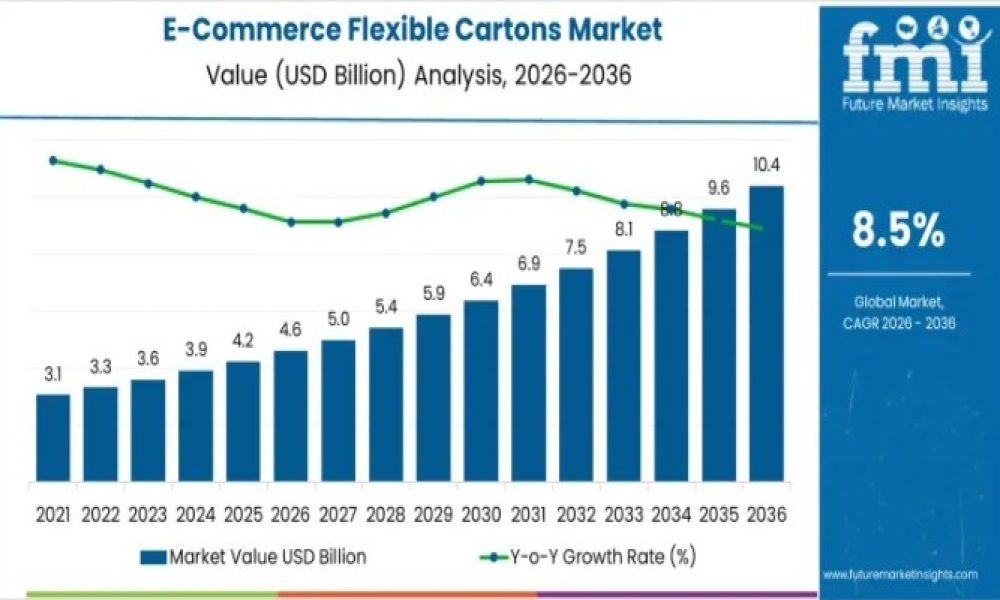
The global e-commerce flexible cartons market is valued at USD 4.6 billion in 2026 and is projected to reach USD 10.4 billion by 2036, registering a CAGR of 8.5% over the forecast period. Growth reflects rising parcel volumes, increased cross-border shipping, and retailer focus on cost-effective, sustainable packaging alternatives.
Market structure remains moderately fragmented, with regional converters serving niche applications and large players securing long-term contracts with major fulfillment centers. Revenue concentration is driven less by output volume and more by portfolio breadth, material validation, and supply reliability.
The rapid evolution of global e-commerce is redefining how products are packed, shipped, and experienced by consumers. As online retail volumes rise and delivery timelines shrink, packaging has shifted from being a cost center to a strategic enabler of efficiency, sustainability, and brand identity. Within this transformation, e-commerce flexible cartons have emerged as a preferred packaging solution, offering a balance of lightweight design, protection, and environmental responsibility.
Discover Growth Opportunities in the Market – Get Your Sample Report Now
Market Meaning and Scope
E-commerce flexible cartons refer to lightweight, adaptable packaging formats designed specifically for online retail shipments. Unlike traditional rigid cartons, these solutions integrate paperboard, corrugated laminates, barrier films, and biodegradable materials to deliver strength while minimizing material use. Their flexibility enables efficient storage, automated packing compatibility, and enhanced unboxing experiences for consumers.
These cartons are widely adopted across apparel, electronics, beauty, food, and direct-to-consumer segments, where protection, presentation, and shipping efficiency are equally critical.
Quick Market Highlights
- Market Value (2026): USD 4.6 billion
- Forecast Value (2036): USD 10.4 billion
- Forecast CAGR (2026–2036): 8.5%
- Leading Material Type: Paperboard flexible cartons (36.7%)
- Top End-Use Industry: Apparel & accessories (31.8%)
- High-Growth Regions: USA, China, India, Germany, Brazil
Growth Dynamics
Market growth between 2026 and 2031 is fueled by rapid online retail expansion, rising consumer expectations for secure delivery, and the need to reduce shipping weight and costs. Flexible cartons address these requirements through lightweight construction, foldability, and material efficiency.
From 2031 to 2036, growth remains robust as manufacturers invest in:
- Multi-layer recyclable laminates
- Enhanced structural integrity for stacked transport
- Improved print quality and customization
- Tamper-evident and moisture-resistant designs
Sustainability regulations and extended producer responsibility (EPR) frameworks further accelerate adoption, particularly in Europe and North America.
Demand Drivers Across Industries
Demand for e-commerce flexible cartons is shaped by both material performance and end-use application needs.
Key demand drivers include:
- Rising e-commerce penetration across emerging and developed markets
- Need for damage reduction during last-mile delivery
- Growth of direct-to-consumer and subscription models
- Retailer focus on recyclable and certified packaging formats
Material selection varies by product fragility, shipping distance, and regulatory compliance, ensuring optimized protection and cost efficiency.
Why Paperboard Flexible Cartons Lead
Paperboard flexible cartons account for 36.7% of total market demand, making them the dominant material segment. Their leadership is supported by:
- High strength-to-weight ratio
- Excellent recyclability and sustainability credentials
- Compatibility with branding and digital printing
- Suitability for apparel, accessories, and personal care items
Operationally, paperboard cartons perform well under compression and handling stress when designed with appropriate thickness and lamination, making them a reliable choice for high-volume fulfillment environments.
Apparel & Accessories: The Largest End-Use Segment
Apparel and accessories represent 31.8% of total end-use demand, reflecting the dominance of fashion in global online retail. These products are lightweight, non-fragile, and shipped in high volumes, making them ideal candidates for flexible carton packaging.
Retailers favor flexible cartons in this segment due to:
- Reduced shipping costs
- Enhanced branding and unboxing experience
- Ease of handling and storage
- Alignment with sustainability commitments
Design considerations prioritize foldability, moisture resistance, and visual appeal to minimize returns and improve customer satisfaction.
Regional Demand Trends
Growth varies by region, influenced by e-commerce maturity, logistics infrastructure, and regulatory frameworks.
Country-level CAGR (2026–2036):
- India: 11.0% – driven by rapid e-commerce adoption and logistics expansion
- China: 10.3% – supported by large-scale online retail operations
- USA: 9.1% – fueled by sustainability-focused packaging demand
- Germany: 8.4% – shaped by strict recycling regulations
- Brazil: 7.9% – reflecting steady online retail growth
Urban fulfillment centers and logistics hubs remain the primary demand centers across all regions.
Competitive Landscape
Competition in the e-commerce flexible cartons market is defined by material innovation, structural performance, and fulfillment compatibility rather than sheer production volume.
Key players include:
- International Paper – Focuses on fiber quality and carton durability
- WestRock Company – Engineers lightweight cartons with high stacking strength
- Smurfit Kappa Group – Integrates recycled content and traceable designs
- Amcor plc – Emphasizes print quality and branding impact
- DS Smith – Specializes in automated-system-compatible carton formats
Regional and specialty suppliers complement the market by offering moisture-resistant and cushioning-enhanced solutions tailored to specific product categories.
Why FMI: https://www.futuremarketinsights.com/why-fmi
About Future Market Insights (FMI)
Future Market Insights, Inc. (FMI) is an ESOMAR-certified, ISO 9001:2015 market research and consulting organization, trusted by Fortune 500 clients and global enterprises. With operations in the U.S., UK, India, and Dubai, FMI provides data-backed insights and strategic intelligence across 30+ industries and 1200 markets worldwide.



