
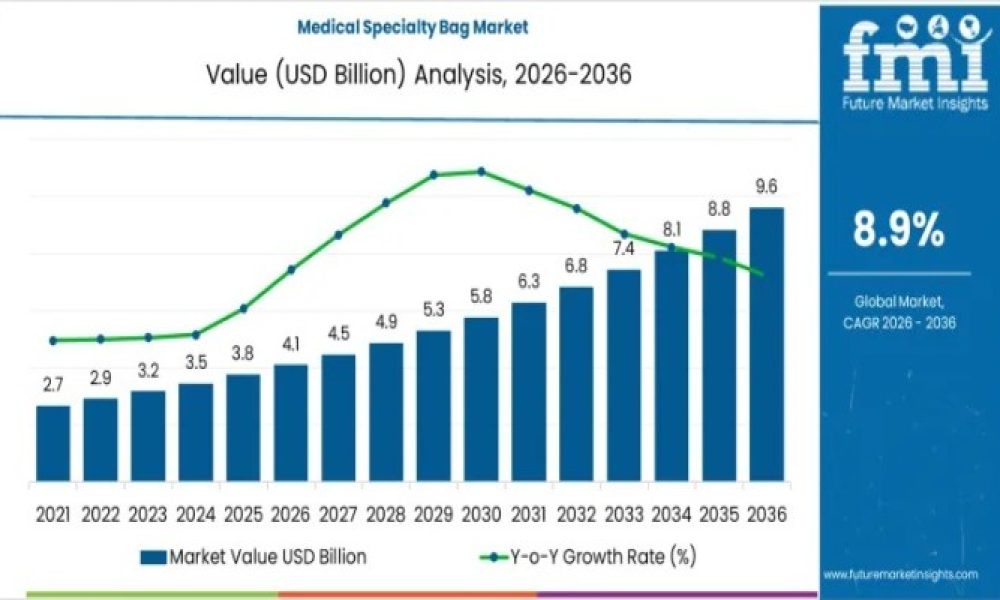
The global medical specialty bag market is entering a decade of sustained, volume-driven expansion as healthcare systems worldwide intensify their focus on infection control, procedural efficiency, and single-use consumables. Valued at USD 4.1 billion in 2026, the market is forecast to reach USD 9.6 billion by 2036, growing at a robust compound annual growth rate (CAGR) of 8.9% over the forecast period.
This growth trajectory reflects rising inpatient and outpatient procedure volumes, expanding chronic disease management programs, and the growing reliance on disposable medical devices across hospitals, ambulatory centers, and home-based care environments. Unlike discretionary medical equipment markets, revenue formation in medical specialty bags remains volume-led, supported by high consumption frequency, standardized procurement, and routine replenishment cycles.
Explore Opportunities – Get Your Sample of Our Industry Overview Now!
Explore Opportunities – Get Your Sample of Our Industry Overview Now!
Quick Market Snapshot
- Market Value (2026): USD 4.1 billion
- Forecast Value (2036): USD 9.6 billion
- Forecast CAGR (2026–2036): 8.9%
- Leading Product Type: IV Fluid Bags
- Fastest-Growing Countries: China, USA, Germany, UK, Japan
- Key Companies: Baxter International, B. Braun Melsungen, Fresenius Kabi, Nipro Medical Corporation, Terumo Corporation
Market Value Formation and Structural Dynamics
Medical specialty bags are integral to daily clinical operations, supporting the safe storage, transport, and administration of fluids, pharmaceuticals, biological samples, and medical waste. Market scalability is shaped by a combination of regulatory oversight, procurement practices, and material availability.
Key structural influences include:
- Strict regulatory requirements for material biocompatibility, sterilization compatibility, and leak resistance
- Margin pressure from bulk purchasing contracts and concentrated supplier competition
- Environmental scrutiny surrounding single-use medical plastics, driving design and material innovation
- Supply chain dependence on consistent medical-grade polymer availability and automated manufacturing reliability
Geographic value concentration continues to align closely with healthcare utilization density and adoption of single-use clinical protocols, particularly within hospital networks and regulated outpatient settings.
Why Demand for Medical Specialty Bags Is Rising
Healthcare providers increasingly rely on medical specialty bags to meet stringent safety, hygiene, and traceability standards. These products are critical across a wide range of applications—from IV therapy and blood transfusion to specimen transport and biohazard waste containment.
Demand growth is driven by:
- Expansion of diagnostic testing, infusion therapy, and point-of-care services
- Heightened infection prevention and control protocols
- Increased ambulatory and home healthcare delivery
- Greater emphasis on single-use solutions to reduce cross-contamination risk
Advances in polymer technology are enabling bags with improved tensile strength, barrier performance, and compatibility with waste segregation and sterilization systems, further reinforcing adoption.
Product and End-Use Segmentation Insights
IV fluid bags dominate global demand, accounting for 44.0% of total market consumption. Their routine use in hydration, medication delivery, surgical care, and emergency medicine ensures consistent, high-volume replenishment across hospital pharmacies and wards.
Key product insights include:
- IV fluid bags support everyday clinical workflows
- High procedural frequency sustains predictable demand
- Blood, nutrition, and drainage bags serve specialized therapies with lower volume intensity
From an end-use perspective, hospitals represent 58.0% of total demand, reflecting the concentration of acute care services and continuous patient throughput.
End-use highlights:
- Hospitals require uninterrupted access to sterile fluid management solutions
- Centralized procurement amplifies purchasing volume and consistency
- Outpatient centers, dialysis clinics, and home care apply bags for procedure-specific needs
Global Growth Outlook by Region
The medical specialty bag market is expanding across both mature and emerging healthcare systems, supported by procedural growth, aging populations, and regulatory compliance requirements.
Country-level CAGR highlights:
- China: 11.2%
- USA: 8.6%
- Germany: 7.9%
- United Kingdom: 7.4%
- Japan: 7.1%
China leads growth due to hospital capacity expansion, rising dialysis and oncology procedures, and regulatory emphasis on single-use devices. The USA benefits from strong outpatient and home healthcare adoption, while Germany, the UK, and Japan show stable expansion driven by chronic care utilization and standardized procurement.
Competitive Landscape and Supplier Positioning
Competition in the medical specialty bag market centers on material performance, regulatory readiness, sterilization compatibility, and supply reliability. Buyers prioritize manufacturers with validated quality systems, comprehensive documentation, and the ability to serve diverse clinical environments at scale.
Key players shaping global demand include:
- Baxter International – Leading supplier of IV fluid and infusion bags across acute and home care settings
- B. Braun Melsungen – Strong presence in infusion, dialysis, and enteral nutrition bags
- Fresenius Kabi – Global provider of specialty bags for infusion and blood management
- Nipro Medical Corporation – Sterile fluid containment solutions for surgical and infusion use
- Terumo Corporation – Medical bags aligned with global safety and clinical standards
The market continues to favor suppliers capable of delivering consistent quality, regulatory compliance, and uninterrupted supply to healthcare systems operating under increasing procedural and safety demands.
Why FMI: https://www.futuremarketinsights.com/why-fmi
About Future Market Insights (FMI)
Future Market Insights, Inc. (FMI) is an ESOMAR-certified, ISO 9001:2015 market research and consulting organization, trusted by Fortune 500 clients and global enterprises. With operations in the U.S., UK, India, and Dubai, FMI provides data-backed insights and strategic intelligence across 30+ industries and 1200 markets worldwide.



