
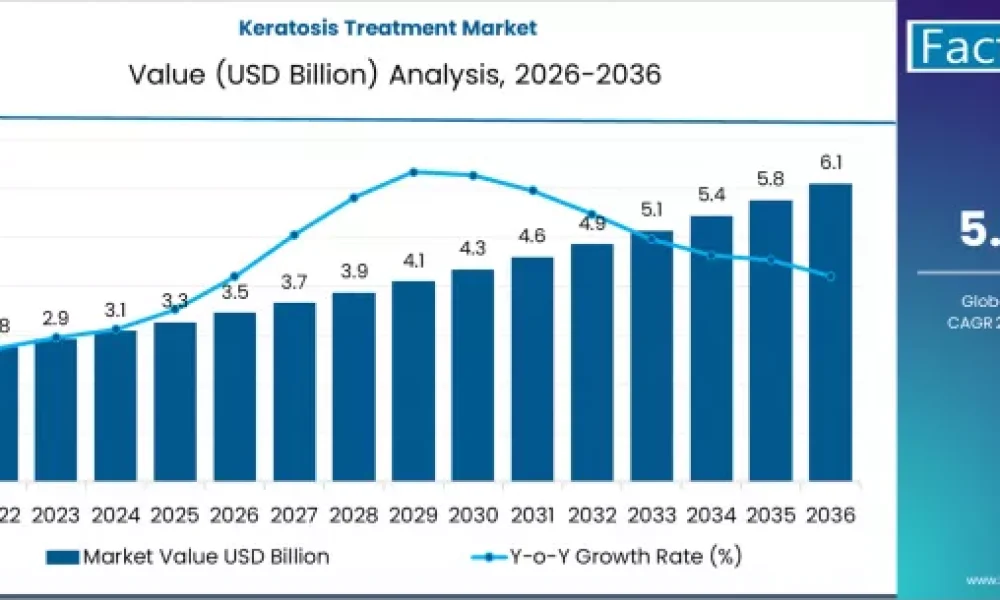
The global keratosis treatment market is poised for significant growth over the next decade, driven by increasing prevalence of skin lesions, aging populations, and rising awareness of skin health. In 2026, the market is estimated at approximately USD 3.46 billion and is projected to reach around USD 6.10 billion by 2036, representing a compound annual growth rate (CAGR) of about 5.8%. This growth trajectory underscores both the clinical need for effective keratosis therapies and the expansion of healthcare access worldwide.
Market Drivers
One of the primary drivers of market growth is the rising prevalence of actinic keratosis, a condition with potential to progress to squamous cell carcinoma. The incidence of keratosis increases with age due to cumulative ultraviolet exposure, making older adults the largest patient population. Alongside demographic trends, increasing awareness and proactive diagnosis have contributed to higher treatment adoption. Patients are increasingly seeking dermatological consultation, leading to earlier detection and intervention.
Diversification in treatment options also supports market expansion. Topical medications, including retinoids and keratolytic agents, remain widely used, particularly for patients with mild-to-moderate lesions. Simultaneously, procedural treatments such as cryotherapy, laser therapy, and photodynamic therapy are gaining traction due to their efficiency and ability to treat multiple lesions simultaneously. These developments have created opportunities for more tailored treatment approaches, enhancing both efficacy and patient satisfaction.
To access the complete data tables and in-depth insights, request a Discount On The Report here: https://www.factmr.com/connectus/sample?flag=S&rep_id=13524
Market Restraints
Despite these positive drivers, the market faces several restraints. Patient adherence to topical therapies can be challenging due to local skin irritation, long treatment durations, and the need for consistent application. This can limit the effectiveness of treatments and influence physicians to prefer procedural options for certain patients. Additionally, cost and access disparities in various regions may constrain market growth. In some areas, advanced treatments and dermatology consultations remain prohibitively expensive or limited in availability, restricting uptake.
Market Opportunities
Opportunities within the keratosis treatment market are closely linked to product innovation and improved clinical protocols. New topical formulations are being developed to reduce irritation, shorten treatment duration, and improve cosmetic outcomes. Combination therapies that integrate topical agents with procedural interventions are emerging as effective strategies for treating multiple or resistant lesions. These developments not only improve clinical outcomes but also expand the potential patient base by making treatments more tolerable and accessible.
Market Segmentation
The market can be segmented by product, application, and distribution channel. Among product categories, topical retinoids are projected to maintain the largest share, representing approximately 36% of the market. These are complemented by keratolytic agents and procedural treatments, which continue to grow in popularity due to their effectiveness in treating extensive or stubborn lesions.
By application, actinic keratosis constitutes the dominant segment, accounting for roughly 58% of the market. This is due to its higher clinical risk profile and the strong need for early intervention. Seborrheic keratosis also represents a significant segment, particularly in regions with aging populations, as these lesions are common and often treated for cosmetic reasons or discomfort.
Distribution channels further influence market dynamics. Dermatology clinics are the primary route for both diagnosis and treatment, contributing over half of market revenues. Hospitals and retail pharmacies also serve as significant channels, particularly for topical formulations. The structure of the distribution network emphasizes the importance of professional oversight, especially for procedural treatments, and highlights the need for efficient supply chains to maintain availability.
Regional Insights
Geographically, the market exhibits strong growth in both mature and emerging regions. Asia, particularly India and China, is expected to experience the highest growth rates due to increasing healthcare access, urbanization, and rising awareness of skin conditions. Brazil and other Latin American countries are also witnessing rapid expansion driven by improved dermatology infrastructure and increasing patient demand.
In mature markets such as the United States and Western Europe, the market growth is steadier but supported by technological innovation, high diagnosis rates, and consistent adoption of procedural treatments. While market penetration is already substantial, continuous improvements in treatment formulations and the integration of digital dermatology are expected to sustain growth.
Risk Assessment
The keratosis treatment market faces several risks that could impact growth. Clinical risks include adverse reactions associated with topical therapies, which may reduce adherence and limit treatment effectiveness. Procedural interventions, while generally effective, carry their own set of risks, including scarring, pigmentation changes, and patient discomfort.
Market risks are linked to reimbursement and regulatory environments. Insurance coverage and reimbursement policies influence patient access to certain therapies, particularly in regions with high procedural costs. Supply chain risks also exist due to the need for specialized manufacturing capabilities for procedural devices and strict quality control for topical agents. Disruptions in raw material supply, regulatory delays, or manufacturing bottlenecks could impact product availability and market performance.
Supply Chain Insights
The supply chain for keratosis treatments involves upstream sourcing of active ingredients for topicals and specialized components for procedural devices. Efficient inventory management and reliable distribution channels are essential to ensure continuous availability, particularly in regions with limited access to dermatology clinics. Regulatory compliance and product registration across multiple jurisdictions are key considerations that influence both manufacturing timelines and distribution strategies.
Competitive Landscape
The competitive environment is characterized by a focus on product innovation, clinical efficacy, and professional engagement. Leading companies are investing in research and development to create more tolerable topical agents, minimally invasive procedural devices, and combination therapies. Marketing strategies are increasingly targeting dermatologists and patients through education on new treatment protocols and emerging technologies.
Market Trajectory
Overall, the keratosis treatment market is projected to nearly double over the next decade. Growth will be driven by the persistent clinical need for effective treatments, expansion of dermatology services, adoption of advanced procedural technologies, and geographic diversification. Emerging trends include the integration of hybrid treatment protocols, the rise of minimally invasive technologies in routine dermatology, and the adoption of digital and AI-assisted tools for early lesion detection.
In summary, the global keratosis treatment market is set for sustained growth, supported by demographic trends, clinical need, and ongoing innovation in therapeutic and procedural options. While challenges related to adherence, cost, and access remain, the market presents significant opportunities for companies and healthcare providers to expand treatment access and improve patient outcomes.
Have a specific Requirements and Need Assistant on Report Pricing or Limited Budget please contact us – [email protected]
To View Related Report :
Porokeratosis Treatment Market https://www.factmr.com/report/porokeratosis-treatment-market
Canine Keratosis Treatment Market https://www.factmr.com/report/canine-keratosis-treatment-market
Actinic Keratosis Treatment Market https://www.factmr.com/report/actinic-keratosis-treatment-market
Treatment-Resistance Depression Treatment Market https://www.factmr.com/report/3147/treatment-resistance-depression-treatment-market



