
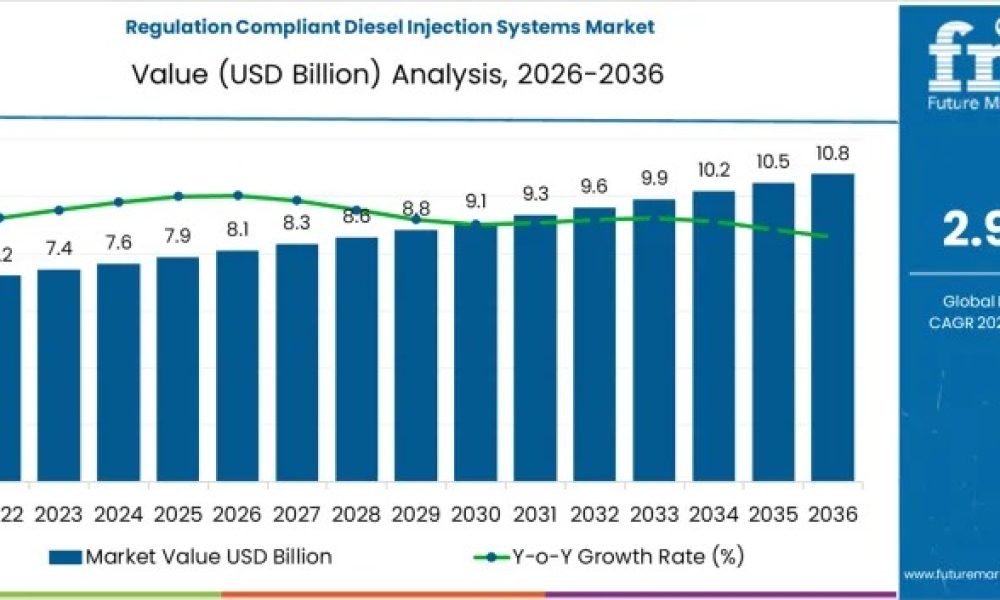
The global regulation-compliant diesel injection systems market continues to demonstrate steady, regulation-driven expansion, reinforcing its role as a cornerstone technology in modern diesel powertrains. Valued at USD 8.1 billion in 2026, the market is projected to reach USD 10.8 billion by 2036, growing at a compound annual growth rate (CAGR) of 2.90%. This measured yet resilient growth reflects the market’s maturity and its ongoing importance in helping automotive and commercial vehicle manufacturers comply with increasingly stringent emissions standards while maintaining performance and fuel efficiency.
Diesel injection systems sit at the heart of emission control strategies, enabling precise fuel metering, optimized combustion, and reduced output of nitrogen oxides (NOx) and particulate matter. As regulatory frameworks such as Euro VI, BS VI, and EPA Tier standards continue to evolve, regulation-compliant injection technologies remain essential for extending the viability of diesel engines across passenger cars, trucks, buses, and off-highway vehicles.
Regulatory Pressure as a Structural Growth Driver
The primary force shaping the regulation-compliant diesel injection systems market is the sustained tightening of global emissions regulations. Governments across major automotive regions are enforcing lower emission thresholds to address air quality concerns and climate commitments. Diesel engines, traditionally scrutinized for higher NOx and particulate emissions, face particularly strict oversight, elevating the importance of advanced injection systems that can deliver cleaner combustion without compromising torque, durability, or operating efficiency.
These regulatory pressures are not cyclical but structural, creating long-term demand for compliant technologies even as electrification progresses. In commercial transportation, logistics, agriculture, construction, and long-haul applications, diesel engines remain difficult to replace at scale. As a result, manufacturers are investing in sophisticated fuel delivery systems that allow diesel platforms to meet current and future regulatory requirements.
Get access to comprehensive data tables and detailed market insights — request your sample report today!
Technology Advancements Reinforcing Market Stability
Technological innovation continues to underpin market progress. Modern regulation-compliant diesel injection systems integrate high-pressure fuel pumps, advanced injectors, electronic control units, and sensor networks to precisely manage injection timing, pressure, and spray patterns. These capabilities significantly improve combustion efficiency, reduce fuel consumption, and lower emissions across varying operating conditions.
Common rail direct injection (CRDI) systems represent the leading injection type, accounting for approximately 52% of the market. Their dominance is driven by superior flexibility, enabling multiple injection events per combustion cycle and finer fuel atomization. This precision supports compliance with strict emissions standards while enhancing engine responsiveness and noise characteristics.
Advances in piezoelectric and high-performance solenoid injectors further enhance system performance, offering faster response times and greater control accuracy. Digital engine management and real-time optimization are increasingly standard, allowing injection systems to adapt dynamically to load, temperature, and fuel quality variations. These innovations collectively reinforce the relevance of diesel injection technologies in an era of heightened environmental scrutiny.
OEM Line-Fit as the Primary Commercial Channel
From a sales channel perspective, OEM line-fit remains the dominant route to market, representing around 62% of total demand. Original equipment manufacturers integrate regulation-compliant diesel injection systems directly into new vehicles to ensure compliance from first deployment. As emission regulations tighten, OEMs have limited tolerance for retrofit-based solutions, increasing reliance on factory-installed, fully validated injection systems.
This trend is particularly evident in passenger cars and heavy-duty commercial vehicles, where compliance failures carry significant financial and reputational risks. While the aftermarket, service, and replacement segments provide incremental revenue, OEM line-fit applications will continue to anchor market demand over the forecast period.
Regional Growth Patterns Highlight Emerging Momentum
Geographically, the regulation-compliant diesel injection systems market exhibits varied growth dynamics. China leads with an estimated CAGR of 4.4% from 2026 to 2036, supported by stringent domestic emissions policies and the scale of its automotive and commercial vehicle sectors. Efforts to improve urban air quality and modernize logistics fleets are accelerating adoption of advanced diesel injection technologies.
Brazil follows with projected growth of 4.0%, driven by tightening environmental standards and demand for fuel-efficient vehicles across agriculture, logistics, and construction. The United States market is expected to grow at 2.6%, reflecting continued enforcement of EPA emission standards, particularly for heavy-duty trucks. Germany, with a CAGR of 2.5%, benefits from its strong automotive manufacturing base and leadership in regulatory compliance, while South Korea’s 2.4% growth reflects its commitment to cleaner vehicle technologies and efficiency improvements.
Competitive Landscape Defined by Precision and Compliance
The competitive environment is shaped by a focus on precision fuel control, system durability, and regulatory readiness. Global leaders such as Bosch, Denso, Delphi (BorgWarner), Continental, and Cummins dominate through extensive portfolios of common rail systems, injectors, and electronic controls designed to meet diverse regional standards.
Competition increasingly centers on the ability to deliver modular, scalable solutions that balance cost efficiency with performance and compliance. Suppliers emphasize integration with engine management systems, advanced diagnostics, and long-term reliability as key differentiators. Specialized players including Weifu High-Technology, Stanadyne, Hitachi Astemo, Rheinmetall, and Mahle further intensify competition by offering high-precision components and targeted solutions for OEMs and aftermarket customers.
Outlook: A Compliance-Critical Market with Enduring Relevance
While growth rates remain moderate compared with emerging propulsion technologies, the regulation-compliant diesel injection systems market holds enduring strategic importance. Its future will be defined by the industry’s ability to continuously adapt injection technologies to evolving emissions standards, alternative fuels such as biodiesel, and increasingly digital engine architectures.
As diesel engines continue to power critical segments of global transportation and industry, detailed insights into technology trends, regulatory impacts, competitive positioning, and regional opportunities will be essential for navigating this complex market. Comprehensive analysis provides the clarity needed to assess long-term value, identify innovation pathways, and understand how regulation-compliant diesel injection systems will continue to shape the future of efficient, lower-emission mobility.
Why Choose FMI: Empowering Decisions that Drive Real-World Outcomes: https://www.futuremarketinsights.com/why-fmi
About Future Market Insights (FMI)
Future Market Insights, Inc. (FMI) is an ESOMAR-certified, ISO 9001:2015 market research and consulting organization, trusted by Fortune 500 clients and global enterprises. With operations in the U.S., UK, India, and Dubai, FMI provides data-backed insights and strategic intelligence across 30+ industries and 1200 markets worldwide.



